



Mobile World Congress 2025: the year of AI
- March 14, 2025
- 3 min read

As Mobile World Congress wrapped up for another year, it was apparent that only one topic was on everyone’s minds: artificial intelligence.
Major players—such as Google, Ericsson, and Deutsche Telekom—showcased the various ways in which they’re piloting AI applications—from operations to infrastructure management and customer interactions. It’s clear there is a great desire to see AI move from the research lab into the real world, where it can make a real difference to people’s everyday lives. The days of more theoretical projects and gimmicky robots seem to be behind us: this year, it was all about real-world applications.
MWC has long been an event for telecommunications companies to launch their latest innovations, and this year was no different. Telco companies demonstrated how AI is now essential in managing network performance, reducing operational downtime, and driving significant cost savings. The industry consensus is that AI is no longer experimental but a critical component of modern telecommunications. While many of the applications showcased were early-stage pilots and stakeholders are still figuring out what wide-scale, real-time AI means in practice, the ambition to innovate and move forward on adoption is clear.
Here are three of the most exciting AI developments that caught our eye in Barcelona:
Conversational AI
Chatbots were probably the key telco application showcased across MWC, with applications ranging from contact centers, in-field repairs, personal assistants transcribing calls, booking taxis and making restaurant reservations, to emergency responders using intelligent assistants to manage critical incidents. The easy-to-use, conversational nature of chatbots makes them an attractive means to deploy AI across functions, as it doesn’t require users to have any prior hands-on machine learning expertise.
AI for first responders
Emergency responders often rely on telco partners to access novel, technology-enabled solutions to address their challenges. One such example is the collaboration between telcos and large language model (LLM) companies to deliver emergency-response chatbots. These tailored chatbots integrate various decision-making models, enabling them to quickly parse vast data streams and suggest actionable steps for human operators in real time.
This collaboration not only speeds up response times during critical situations but also enhances the overall effectiveness of emergency services, ensuring that support reaches those in need faster.
Another interesting example in this field was the Deutsche Telekom drone with an integrated LTE base station, which can be deployed in emergencies to deliver temporary coverage to an affected area or extend the service footprint during sports events and festivals, for example.
Enhancing Radio Access Networks (RAN)
Telecommunication companies are increasingly turning to advanced applications to manage the growing complexity of their networks and provide high-quality, uninterrupted service for their customers.
By leveraging artificial intelligence, these applications can proactively monitor network performance, detect anomalies in real time, and automatically implement corrective measures. This not only enhances network reliability but reduces operational costs and minimizes downtime, paving the way for more efficient, agile, and customer-focused network management.
One notable example was the Deutsche Telekom and Google Cloud collaboration: RAN Guardian. Built using Gemini 2.0, this agent analyzes network behavior, identifies performance issues, and takes corrective measures to boost reliability, lower operational costs, and improve customer experience.
As telecom networks become more complex, conventional rule-based automation struggles to handle real-time challenges. In contrast, agentic AI employs large language models (LLMs) and sophisticated reasoning frameworks to create intelligent systems capable of independent thought, action, and learning.
What’s next in the world of AI?
The innovation on show at MWC 2025 confirms that AI is rapidly transitioning from a research topic to a fundamental component of telecom and enterprise operations. Wide-scale AI adoption is, however, a balancing act between cost, benefit, and risk management.
Telcos are global by design, operating in multiple regions with varying business needs and local regulations. Ensuring service continuity and a good return on investment from AI-driven applications while carefully navigating regional laws around data privacy and security is no mean feat.
If you want to learn more about incorporating AI into your business operations, we can help.
Gcore Everywhere Inference significantly simplifies large-scale AI deployments by providing a simple-to-use serverless inference tool that abstracts the complexity of AI hardware and allows users to deploy and manage AI inference globally with just a few clicks. It enables fully automated, auto-scalable deployment of inference workloads across multiple geographic locations, making it easier to handle fluctuating requirements, thus simplifying deployment and maintenance.



Related articles

Earlier this year we brought NVIDIA Dynamo to Gcore — one-click disaggregated inference that delivered up to 6× higher GPU throughput and 2× lower latency inside a deployment, by separating prefill and decode and routing each request to the
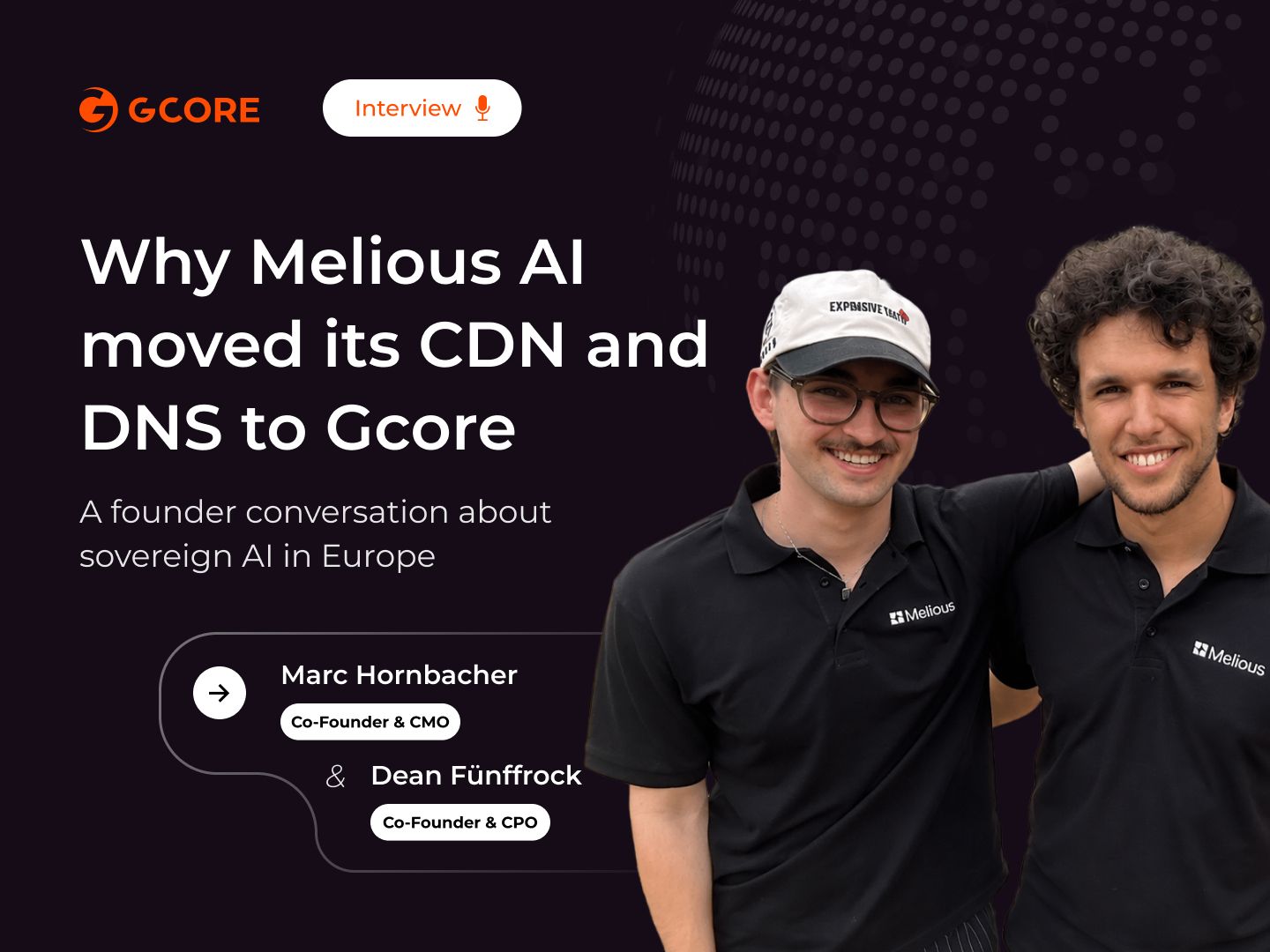
For many startups, infrastructure decisions are mostly about performance, pricing, and developer experience. For Melious AI, they are also about trust.Melious AI is a German startup building a European AI platform around privacy, transparen
As enterprises move AI from experimentation into production, they face a new infrastructure challenge. AI applications, models, and data are no longer confined to a single cloud or data center. Instead, they are distributed across multiple

Subscribe to our newsletter
Get the latest industry trends, exclusive insights, and Gcore updates delivered straight to your inbox.