
Bare-Metal Support
Bare-Metal support for worker nodes to improve latency and performance
Free Cluster Management
Free production-grade cluster management with a 99.9% SLA
Great Value
Great value prices for worker nodes, the same as for our VMs and Bare Metal servers
Compare Gcore’s prices for high-availability clusters with SLA
| Gcore | Digital Ocean | AWS | Google Cloud | Azure | |
|---|---|---|---|---|---|
| Frankfurt | All over the world | Frankfurt | Frankfurt | Germany West Central | |
| High-availability production cluster management fee | FREE** | €37.74 | €68.87 | €68.87 | €68.87 |
| Egress traffic | FREE** | €0.009 per GiB | €0.047–0.085 per GiB | €0.066–0.075 per GiB | €0.066–0.075 per GiB |
| 2 vCPU / 4 GB RAM / 25 GB SSD / 4 TB egress traffic + cluster management | €35.29 | €77.36 | €485.69 | €472.16 | €443.42 |
| 4 vCPU / 8 GB RAM / 50 GB SSD / 8 TB egress traffic + cluster management | €68.02 | €147.1 | €902.5 | €875.45 | €826.51 |
| 8 vCPU / 16 GB RAM / 75 GB SSD / 16 TB egress traffic + cluster management | €131.18 | €294.19 | €1704.92 | €1561.37 | €1493.7 |
| 16 vCPU / 32 GB RAM / 100 GB SSD / 24 TB egress traffic + cluster management | €254.84 | €520.53 | €2631.28 | €2348.83 | €2266.66 |
| 32 vCPU / 64 GB RAM / 125 GB SSD / 32 TB egress traffic + cluster management | €499.88 | €895.93 | €3824.85 | €3416.69 | €3303.17 |
**For worker node types based on Virtual Instances.
Managed Kubernetes Calculator
Locations with
Managed Kubernetes
Advantages of Gcore Managed
Kubernetes
One-click provisioning
Provision your worker nodes in 'one-click' using a single command in the Gcore self-service portal, API, or via Terraform.
GPU worker nodes support
Gcore Managed Kubernetes clusters support GPU worker nodes, allowing you to run GPU-intensive workloads like machine learning, video processing, and gaming.
Latest versions
Support at least four latest versions of Kubernetes
Automated control
The service continuously monitors the health of your nodes, updating and restarting them automatically if necessary.
Automated scaling
Within your cluster, the number of nodes in your pool can dynamically scale up or down automatically.
High availability
Each cluster dashboard is duplicated to ensure that the cluster is always available.
Secure connections
All connections between the master node and the nodes within a cluster are automatically encrypted.
DDoS protection
Your projects are protected from DDoS attacks at the network and transport layers by default.
24/7 technical support
Quick real-time assistance and quality technical service around the clock.
How it works
See documentation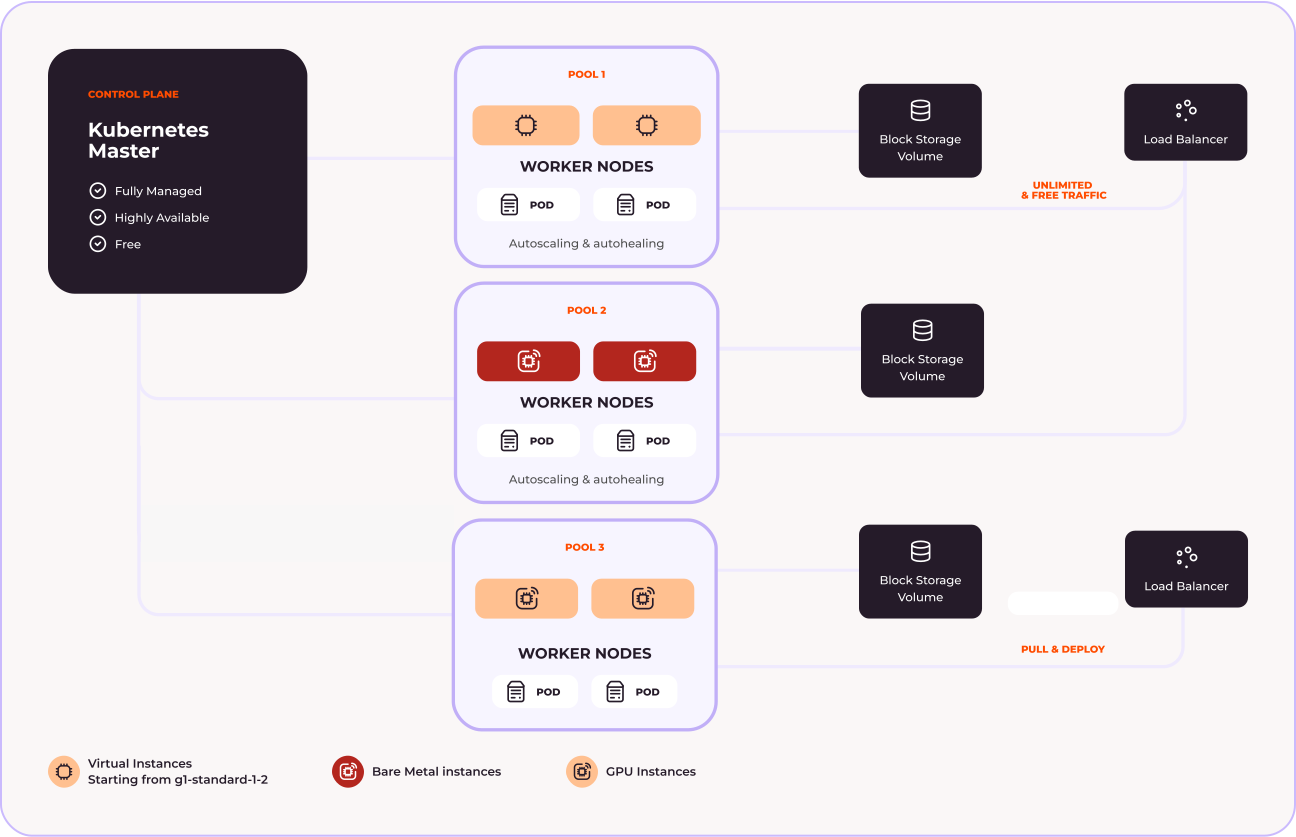
Get performance tailored to your needs
Virtual Machines as worker nodes
VMs are a good choice for most web applications that don’t require very high levels of performance and aren’t sensitive to latency. VMs provide a good balance of scalability, performance, security, and cost.
Benefits of running a Kubernetes cluster on VMs:
- Faster node provisioning - Faster cluster scalability - Easier OS updates and backups

Bare Metal servers as worker nodes
Bare Metal is the superior choice for compute-intensive web applications that need high performance and lower latency, but don’t require the fastest provisioning for new worker nodes.
Benefits of running a Kubernetes cluster on Bare Metal:
- Better compute performance - Lower network latency - No problems with noisy neighbors

Frequently Asked Questions
To learn more about managed services, read our article “[What Are Managed Services?](https://gcore.com/learning/how-managed-services-drive-business-growth)” For learning more about Kubernetes, read the article “[What Is a Kubernetes Cluster?](https://gcore.com/learning/what-is-kubernetes-cluster)”
- Deploy the underlying infrastructure - Manage the control plane - Provision and manage nodes - Ensure security and resiliency - Have a team of highly skilled engineers - Deal with a large operational overhead as a result of all of the above
A managed Kubernetes provider takes care of all these aspects. However, if you want more control over your Kubernetes clusters, self-managed Kubernetes may be right for you. Your choice of how to run Kubernetes depends on your organization’s specific needs and requirements.
**Performance**. Clusters running on Bare Metal have no hypervisor overhead, so they can provide better performance than clusters running on virtual machines. This is especially important for applications that require low latency and high throughput.
**Control**. Bare Metal gives you complete control of the underlying infrastructure. This means you can choose the hardware that best suits your needs and configure it accordingly.
**Latency**. When you run a Kubernetes cluster on Bare Metal, you don’t have an extra virtual networking layer. Applications communicate directly over physical network interfaces. As a result, you get lower network latency.
**Security**. Utilizing Kubernetes on Bare Metal offers more protection than VMs because there is no shared infrastructure with other users. You have full control over security measures and can apply customized security protocols.
Read more about this topic in our [article](https://gcore.com/blog/bare-metal-vs-vm-based-kubernetes).