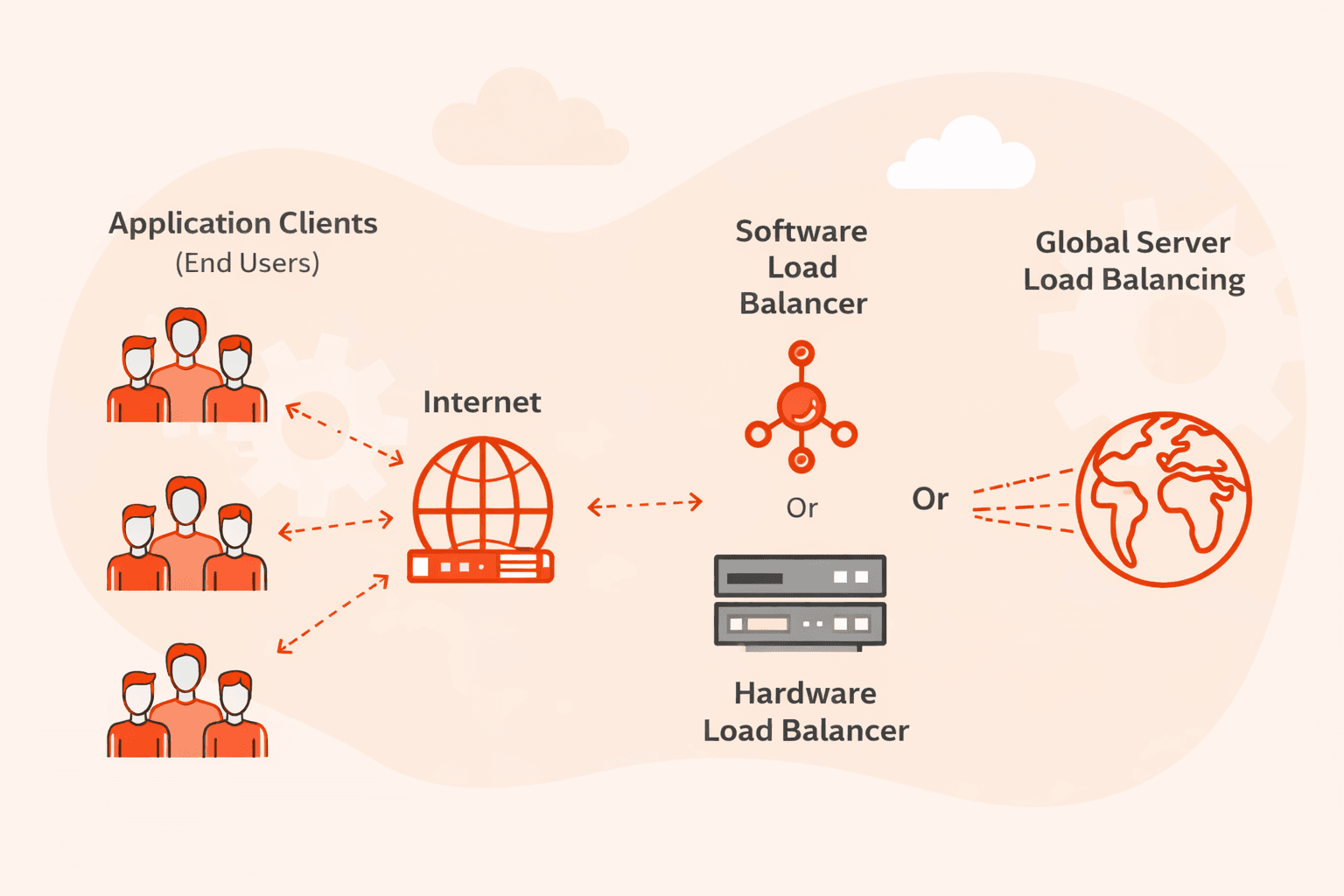
GSLB is a method of distributing client requests across multiple geographically dispersed data centers to improve performance, availability, and compliance. Over 60% of enterprises with a global footprint now use some form of GSLB for critical applications.
At its core, GSLB works at the DNS level. It resolves a single domain name to different IP addresses based on factors like geographic location, server health, and current load. When a user requests your domain, GSLB directs them to the best data center for their specific situation.
This happens in milliseconds, before the actual connection starts.
The main benefits include reduced latency, increased reliability, and better resource usage across your infrastructure. GSLB can reduce latency by 30 to 50% for geographically distributed users compared to single-site solutions. You also get automatic disaster recovery. If one data center fails, GSLB reroutes traffic to healthy sites without manual intervention.
Common GSLB algorithms determine how traffic gets distributed.
These include round-robin (equal distribution), weighted (proportional distribution), proximity-based (closest server), and topology-based routing (network path awareness). Each algorithm serves different needs, from simple load spreading to complex performance targeting.
GSLB matters because modern applications serve global audiences who expect fast, reliable access regardless of location. Whether you're running cloud-native applications, meeting data localization requirements, or protecting against regional outages, GSLB provides the infrastructure to keep your services available and responsive worldwide.
What is GSLB?
GSLB (Global Server Load Balancing) is a method of distributing client requests across multiple geographically dispersed data centers to improve performance, availability, and compliance. It works at the DNS level. When users request your domain, GSLB resolves it to different IP addresses based on factors like geographic location, server health, and current load. This approach routes users to the nearest or best-performing data center automatically, reducing latency by 30 to 50% for geographically distributed users compared to single-site solutions.
How does GSLB work?
GSLB uses DNS-based routing to direct user requests to the optimal data center based on factors like geographic location, server health, and current load. When a user tries to access your application, the GSLB system intercepts the DNS query and evaluates multiple criteria before responding with the best IP address. This happens in milliseconds, completely transparent to the end user.
The process starts when your DNS delegates authority to the GSLB controller.
The controller maintains constant health checks across all your data centers, monitoring server status, response times, and capacity. When a request arrives, the system applies routing algorithms. Round-robin distributes requests evenly. Weighted routing sends more traffic to higher-capacity sites. Proximity-based routing connects users to the nearest location.
The GSLB controller considers real-time data before making routing decisions. It checks which servers are currently healthy and responsive, calculates geographic distance between the user and available data centers, and evaluates current load on each site.
If a data center fails health checks, the system automatically removes it from the rotation and redirects traffic to healthy alternatives.
This DNS-level approach provides automatic failover during outages, reduces latency by routing users to nearby servers, and helps meet data sovereignty requirements by keeping traffic within specific regions. The system continuously monitors and adjusts routing decisions based on changing conditions across your global infrastructure.
What are the main benefits of GSLB?
GSLB distributes traffic across geographically dispersed data centers through DNS-based routing. Here's what your organization gains from implementing it.
- Improved performance: GSLB routes users to the nearest or fastest data center. This reduces latency by 30–50% compared to single-site solutions. Users get faster response times and a better experience across all global regions.
- High availability: GSLB automatically detects server failures and redirects traffic to healthy sites within seconds. Your applications stay running even during outages or maintenance windows.
- Disaster recovery: When an entire data center goes offline, GSLB instantly reroutes all traffic to backup locations. Business continuity is protected without manual intervention.
- Geographic load distribution: GSLB balances traffic across multiple sites based on real-time capacity and health metrics. No single location gets overwhelmed during traffic spikes.
- Data sovereignty compliance: GSLB routes users to data centers within specific legal jurisdictions to meet regulatory requirements. This helps you comply with GDPR, HIPAA, and other data localization laws.
- Cost efficiency: GSLB lets you use multiple smaller data centers instead of one massive facility. You'll reduce infrastructure costs while maintaining global reach.
- Flexible routing policies: GSLB supports multiple algorithms including round-robin, weighted distribution, and proximity-based routing. You can customize traffic patterns based on your specific business needs and priorities.
What are the common GSLB use cases?
Common GSLB use cases refer to the practical scenarios where organizations deploy Global Server Load Balancing to distribute traffic across geographically dispersed data centers. Here are the most common GSLB use cases.
- Disaster recovery: GSLB automatically reroutes traffic to healthy data centers when primary sites experience outages or failures. This automatic failover keeps applications running without manual intervention. It minimizes downtime during regional incidents or infrastructure problems.
- Geographic performance: Organizations route users to the nearest data center based on physical proximity. This reduces network latency by 30 to 50% compared to single-site deployments. Proximity-based routing improves load times for global audiences accessing web applications, APIs, or content.
- Data sovereignty compliance: GSLB directs users to data centers within specific legal jurisdictions to meet regulatory requirements like GDPR or data residency laws. Companies can enforce geographic boundaries automatically, keeping user data in approved regions without manual traffic management.
- Cloud migration: Organizations use GSLB to gradually shift traffic between on-premises infrastructure and cloud environments during migration projects. This controlled transition allows testing and validation while maintaining service availability across both environments.
- Multi-cloud distribution: GSLB balances workloads across different cloud platforms, preventing vendor lock-in and improving redundancy. Traffic flows to the best-performing or most cost-effective provider based on real-time conditions and business rules.
- Capacity management: During traffic spikes or peak usage periods, GSLB distributes load across multiple sites to prevent any single data center from becoming overwhelmed. This distribution maintains response times and prevents service degradation during high-demand events.
- Maintenance windows: Organizations shift traffic away from data centers undergoing planned maintenance or upgrades, enabling zero-downtime updates. Users continue accessing services through alternate sites while teams perform necessary infrastructure work.
How to implement GSLB effectively?
You implement GSLB effectively by configuring DNS-based routing, setting up health monitoring across your data centers, and choosing the right traffic distribution algorithm for your needs.
- First, set up a DNS delegation to point your domain to GSLB-capable nameservers. Configure your authoritative DNS to delegate queries for your service domain (like app.example.com) to the GSLB system. It'll then resolve requests to different IP addresses based on your routing policies.
- Next, deploy health checks across all data center endpoints to monitor server availability in real time. Configure probes to test HTTP responses, TCP connections, or application-specific metrics every 10 to 30 seconds. This ensures the GSLB system only routes traffic to healthy sites.
- Then, choose your traffic distribution algorithm based on your primary goal. Use proximity-based routing to minimize latency by directing users to the nearest data center. Or use weighted routing to control traffic distribution percentages, or round-robin for simple equal distribution across sites.
- Configure failover rules to handle outages automatically. Set thresholds for when to redirect traffic. For example, remove a site from rotation after three consecutive failed health checks, and restore it after five successful checks to prevent flapping between states.
- Set up monitoring and logging to track GSLB decisions and performance metrics. Record which data centers receive requests, response times by region, and failover events. You'll identify patterns and improve your configuration over time.
- Test your GSLB setup by simulating failures at individual data centers. Verify that traffic redirects to healthy sites within your target recovery time (typically 30to 60 seconds for DNS TTL expiration). Confirm that users in different regions connect to their optimal endpoints.
Start with conservative DNS TTL values (300 to 600 seconds) during initial deployment. Once you've validated failover behavior, reduce to 60 to 120 seconds to speed up recovery times.
What are the key GSLB algorithms and routing methods?
GSLB algorithms and routing methods refer to the decision-making logic that determines which data center or server receives a user's request based on factors like location, server health, and load distribution. Here are the key GSLB algorithms and routing methods you'll encounter.
- Round-robin: This method distributes requests equally across all available servers in rotation. Simple but effective. Each server receives the next request in sequence, regardless of current load or location. It's easy to set up, but it doesn't account for geographic proximity or server performance.
- Weighted round-robin: Administrators assign capacity values to each server based on hardware specifications or bandwidth. Servers with higher weights receive proportionally more traffic. This balances the load according to each server's actual capability to handle requests.
- Proximity-based routing: The system directs users to the geographically nearest data center using IP geolocation data. This approach can reduce latency by 30-50% compared to single-site solutions. It's ideal for applications where response time directly impacts user experience.
- Topology-based routing: This method maps network topology to route traffic along the most efficient path, considering factors like network hops and connection quality. It goes beyond simple geographic distance to find the fastest actual route. This works well in complex network environments with multiple ISPs.
- Least connections: The system sends new requests to the server currently handling the fewest active connections. This prevents any single server from becoming overwhelmed during traffic spikes. It's particularly effective for applications with long-lived connections like streaming or downloads.
- Health-based routing: The algorithm continuously monitors server health and automatically removes unhealthy endpoints from rotation. Traffic only goes to servers that pass health checks for CPU, memory, and application responsiveness. This method is essential for maintaining high availability during partial outages.
- Geographic compliance routing: This method enforces data sovereignty by directing users to data centers within specific legal jurisdictions. It's required for organizations handling data subject to GDPR, CCPA, or other regional regulations. The system can block or redirect requests that would violate compliance requirements.
How does GSLB integrate with CDN and edge computing?
GSLB integrates with CDN and edge computing by acting as the intelligent traffic director that routes users to the optimal edge location based on real-time conditions. The system works at the DNS layer, sitting above your CDN and edge infrastructure to make routing decisions before content delivery even begins.
When a user requests content, GSLB intercepts the DNS query and evaluates multiple factors: geographic proximity, server health, current load, and network conditions. It then resolves the domain to the IP address of the best-performing edge node or CDN point of presence. This happens in milliseconds. Users connect to the closest, healthiest endpoint every time.
The power comes from continuous health monitoring. GSLB constantly checks each edge location's status, response times, and capacity. If an edge node fails or degrades, GSLB automatically redirects traffic to the next best location without manual intervention. This creates a self-healing global network.
For CDN deployments, GSLB adds a critical control layer. You can weight traffic distribution across regions, enforce data sovereignty rules by keeping users within specific jurisdictions, or gradually shift load during maintenance windows. Edge computing platforms benefit
similarly. GSLB routes compute-intensive requests to edge nodes with available capacity, balancing workloads across your distributed infrastructure.
The result? Faster response times, higher availability, and better resource use across your entire edge network.
Frequently asked questions
What's the difference between GSLB and DNS load balancing?
GSLB is DNS load balancing enhanced with intelligent routing policies. It distributes traffic across multiple geographic data centers using DNS resolution plus health checks, proximity detection, and failover logic. Traditional DNS load balancing simply rotates between IP addresses without considering server health or user location.
What's the difference between GSLB and local load balancers?
GSLB routes traffic across multiple geographic data centers using DNS. Local load balancers distribute requests within a single site or data center.
Here's how they differ: Local load balancers operate at Layer 4 or Layer 7 to balance traffic between servers in one location. GSLB operates at the DNS level to direct users to the best-performing regional site based on proximity, health, and load.
How much does GSLB implementation cost?
GSLB implementation costs range from $5,000 to $100,000+ depending on your deployment complexity, number of data centers, traffic volume, and whether you choose cloud-based services or on-premises hardware. Cloud-based GSLB typically costs between $50 and $500 per month, while hardware solutions require larger upfront investment.
If you're running 2–3 sites with moderate traffic, expect to spend $10,000 to $30,000 for initial setup. You'll also need to budget $200 to $1,000 monthly for ongoing maintenance and monitoring.
Is GSLB secure against DDoS attacks?
No, GSLB itself doesn't protect against DDoS attacks. It works at the DNS level to route traffic, not filter malicious requests. You'll need dedicated DDoS mitigation services in front of your GSLB setup to block attack traffic before it reaches your data centers.
What are the requirements for implementing GSLB?
GSLB implementation requires several key components. You'll need DNS delegation to GSLB controllers and health-check mechanisms to monitor endpoint status. Your infrastructure must be redundant across multiple geographic sites, and you'll need continuous monitoring tools to track performance and availability.
How does GSLB handle SSL/TLS certificates?
GSLB doesn't handle SSL/TLS certificates directly. It works at the DNS layer, before the SSL/TLS handshake occurs. This means the individual data centers or load balancers that receive the routed traffic manage the certificates themselves.
Can GSLB work with cloud providers like AWS, Azure, and GCP?
Yes, GSLB works seamlessly with major cloud providers. It integrates through DNS delegation and uses API-based health monitoring to track their global infrastructure endpoints in real time.
Related articles

Subscribe to our newsletter
Get the latest industry trends, exclusive insights, and Gcore updates delivered straight to your inbox.