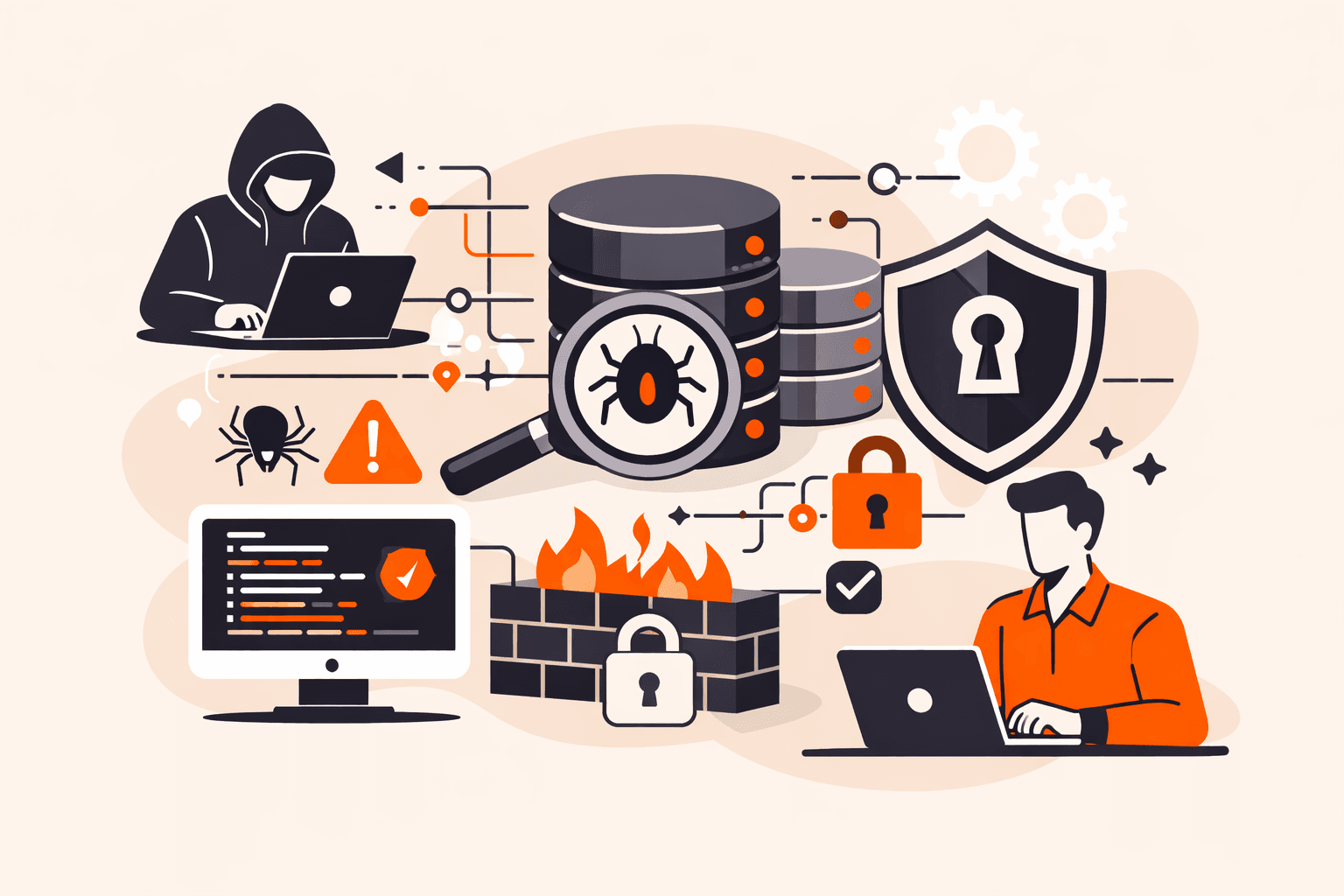
Your database gets compromised. Customer records disappear. Credit card data ends up for sale on the dark web. SQL injection attacks remain one of the most prevalent web application vulnerabilities in 2024, consistently appearing in top ten security threat lists and representing a large percentage of reported security incidents across organizations.
The danger isn't just theoretical, it's happening right now to applications just like yours. Attackers can manipulate a single login form or search box to bypass authentication entirely, extract your entire database, or delete critical business data. Even worse, many developers unknowingly leave their applications vulnerable by relying on outdated or incomplete security practices.
You'll discover the most effective SQL injection prevention techniques used by security professionals, from prepared statements and parameterized queries to layered security controls. You'll learn which methods actually work, which ones leave dangerous gaps, and how to build full protection across your entire application stack.
What is SQL injection prevention?
SQL injection prevention is a set of security practices that stops attackers from manipulating database queries to steal, modify, or delete your data. When you don't protect your application properly, malicious users can inject harmful SQL code through input fields like login forms or search boxes, potentially gaining complete control over your database. The goal is to ensure user input never gets treated as executable code, only as harmless data.
This type of attack remains one of the most common web application vulnerabilities. Here's the core problem: if your application directly combines user input with SQL queries without proper safeguards, an attacker can supply something like `'admin' --` as a username to bypass authentication entirely. The comment characters (`--`) turn the rest of your query into a comment, eliminating password verification and granting immediate access.
Effective prevention requires multiple defensive layers working together. You'll need prepared statements with parameterized queries as your primary defense, input validation to catch malicious patterns, and database-level controls that limit damage even if an attack succeeds. No single technique provides complete protection. That's why security professionals combine approaches like static code analysis, web application firewalls, and regular penetration testing to catch vulnerabilities before attackers do.
How do SQL injection attacks work?
SQL injection attacks work by exploiting vulnerabilities in how applications handle user input within database queries. When an application doesn't properly validate or sanitize user-supplied data, attackers can insert malicious SQL code that changes the intended query structure and behavior.
Here's the basic mechanism: An attacker enters specially crafted input containing SQL syntax into form fields, URL parameters, or other input channels. If the application directly concatenates this input into a SQL query string, the database engine executes both the legitimate query and the attacker's injected commands. For example, entering `admin' --` as a username can transform a login query into one that bypasses password verification entirely. The `--` characters tell the database to treat everything after as a comment, effectively removing the password check.
Attackers use different injection techniques depending on their goals. Union-based attacks combine malicious queries with legitimate ones to extract data from other tables. Error-based injections trigger database errors that reveal system information. Boolean-based attacks observe application behavior changes to infer data one bit at a time. Time-based techniques use database delay functions to confirm successful injection when no visible output exists.
The fundamental problem is that databases can't distinguish between legitimate SQL code and attacker-controlled input when both arrive as a single text string. This lets attackers read sensitive data, modify records, delete information, or even execute administrative operations if the database connection has elevated privileges.
What are the primary SQL injection prevention methods?
SQL injection prevention methods are security techniques that stop attackers from manipulating database queries through malicious input. The primary methods are listed below.
- Prepared statements with parameterized queries: This approach separates SQL code from user data by defining the query structure first and passing parameters separately. The database engine treats all user input as data rather than executable code, making it impossible for attackers to alter query logic. All major programming languages and database systems support this method, making it the industry-standard primary defense.
- Input validation and sanitization: This technique removes or blocks dangerous characters from user input before it reaches the database. While useful as an additional layer, it shouldn't be your only defense because attackers can find creative ways to bypass filters. Allowlist validation works best when you can validate inputs against a closed list of known legal values.
- Stored procedures: These encapsulate query logic directly within the database, limiting how applications interact with raw SQL. When implemented correctly with proper parameterization, stored procedures provide security benefits similar to prepared statements. The key is ensuring the stored procedure itself doesn't concatenate user input into dynamic SQL.
- Web application firewalls: WAFs analyze incoming requests between the internet and your application, filtering out traffic that matches known SQL injection attack patterns. This creates a protective perimeter layer that can block attacks before they reach your application code. WAFs work best when combined with secure coding practices rather than as a standalone solution.
- Object-relational mapping frameworks: ORMs like Hibernate, SQLAlchemy, and Entity Framework automatically handle query binding and parameterization. These frameworks abstract database interactions and reduce the likelihood of developers writing vulnerable SQL code. You'll still need to review generated queries and avoid unsafe raw SQL operations.
- Least privilege database access: Configure your application to connect using database accounts with only the minimum necessary permissions. If an SQL injection attack succeeds, limited privileges prevent attackers from dropping tables, accessing sensitive data outside their scope, or executing administrative commands. Never use database administrator accounts for application connections.
- Static application security testing: SAST tools scan your source code for unsafe SQL patterns and risky coding practices before deployment. These automated scans catch vulnerabilities during development when they're cheapest to fix. Regular SAST scanning should be integrated into your development pipeline.
- Database error suppression: Disable detailed database error messages on production systems because attackers use error information to learn about your database structure. Generic error messages prevent attackers from gathering intelligence during reconnaissance phases. Log detailed errors securely for your development team instead.
How to use advanced SQL injection protection techniques?
You use advanced SQL injection protection techniques by layering multiple security controls across your application stack, from code-level defenses to network monitoring and continuous testing.
- Deploy a web application firewall at the network perimeter. The WAF analyzes incoming HTTP requests for known SQL injection patterns and malicious payloads before they reach your application. Configure custom rules that match your application's specific traffic patterns and block suspicious query strings, POST data, or header values that contain SQL metacharacters.
- Integrate static application security testing into your development pipeline. SAST tools scan your source code before deployment to identify unsafe SQL patterns, missing parameterization, and risky coding practices. Set up automated scans that run on every commit or pull request, and configure your CI/CD pipeline to fail builds when critical SQL injection vulnerabilities are detected.
- Use database activity monitoring to detect attack attempts in real time. Configure logging systems that track all database queries, flagging suspicious patterns like multiple failed authentication attempts, unusual query structures, or access to sensitive tables. Set up alerts that notify your security team immediately when potential SQL injection activity is detected.
- Enforce least privilege access at the database level for all application accounts. Create separate database users for different application functions, granting only the minimum permissions needed. Your read-only features should use accounts that can't modify data, while admin functions use separate credentials with elevated privileges. This limits damage if an attacker successfully injects SQL code.
- Schedule regular penetration testing to simulate real-world attack scenarios. Conduct tests before launching new applications, after significant code changes, and quarterly as part of your security program. Penetration testers will attempt SQL injection attacks using the same techniques as malicious actors, revealing vulnerabilities that automated tools might miss.
- Configure your production environment to suppress detailed database error messages. Database errors can reveal table names, column structures, and query syntax that attackers exploit during SQL injection reconnaissance. Replace detailed error messages with generic responses while logging the full error details to secure monitoring systems accessible only to your development team.
- Use Content Security Policy headers to add an extra defense layer. While CSP primarily protects against cross-site scripting, strict CSP configurations can limit the damage from successful SQL injection attacks by restricting where your application can send data and what scripts it can execute.
The key thing is that no single technique provides complete protection. Each layer reinforces the others, so if an attacker bypasses one control, additional defenses still block the attack.
What are the best practices for secure database development?
Secure database development practices establish defense mechanisms at every layer of your application and infrastructure to prevent SQL injection and other database attacks. These practices protect your data by combining secure coding techniques, proper configuration, and ongoing security monitoring.
- Prepared statements: These force you to define SQL structure before adding user data, making it impossible for attackers to alter query logic. All major programming languages and database systems support this approach, which remains the industry-standard primary defense. When you use placeholders like ? or @param, the database engine treats input strictly as data rather than executable code.
- Input validation: This removes or rejects dangerous characters before they reach your database queries, though it shouldn't be your only defense mechanism. Allowlist validation works best when you can define a closed set of acceptable values, for example, only accepting specific product IDs or status codes. You'll want to validate data type, length, format, and range to catch malicious input early.
- Least privilege access: Configure database accounts with only the permissions they absolutely need rather than using administrative credentials. If an attacker successfully injects SQL, limited permissions prevent them from dropping tables, accessing sensitive data outside the application's scope, or modifying system configurations. Create separate accounts for different application functions with tightly scoped privileges.
- ORM frameworks: Tools like Hibernate, SQLAlchemy, and Entity Framework automatically handle query binding, reducing your exposure to SQL injection vulnerabilities. These frameworks abstract raw SQL into object-oriented code and manage parameterization behind the scenes. You'll still need to be careful with raw query features that some ORMs provide for complex operations.
- Web application firewalls: WAFs analyze incoming requests between the internet and your application, filtering out traffic that matches known SQL injection patterns. This adds a critical perimeter defense layer that catches attacks before they reach your code. Modern WAF solutions can block common injection payloads while allowing legitimate traffic through.
- Error handling: Disable detailed database error messages on production systems because attackers can exploit these to learn about your database structure during reconnaissance. Generic error messages prevent information leakage while still logging detailed errors server-side for debugging. Database errors often reveal table names, column names, and SQL syntax that makes crafting injection attacks easier.
- Static code analysis: SAST tools scan your source code for unsafe SQL patterns and risky coding practices before deployment, giving you actionable insights to fix vulnerabilities early. These tools identify dynamic SQL construction, missing parameterization, and other red flags that human code reviews might miss. Running static analysis in your CI/CD pipeline catches issues before they reach production.
- Regular penetration testing: Security professionals simulate real-world attacks to uncover weaknesses in your defenses that automated tools might miss. You should conduct penetration tests before launching new applications, after significant code changes, and regularly as part of your security program. These tests reveal how multiple small vulnerabilities can combine into serious exploits.
How to test and monitor for SQL injection vulnerabilities?
You test and monitor for SQL injection vulnerabilities by combining automated scanning tools with manual testing techniques, then establishing continuous monitoring to catch threats before they cause damage.
- Start with static code analysis tools that scan your source code for unsafe SQL patterns. These SAST tools examine your codebase before deployment, flagging risky practices like string concatenation in queries or missing input validation. They'll show you exactly which lines of code need fixing and often suggest secure alternatives.
- Run dynamic application security testing against your running application. Unlike static analysis, DAST tools interact with your live application the way an attacker would, sending malicious payloads to input fields and analyzing responses. This catches vulnerabilities that only appear when code executes in a real environment.
- Conduct manual penetration testing to simulate real-world attack scenarios. Automated tools miss creative attack vectors, so security professionals should test your application by hand, attempting authentication bypasses, union-based injections, and time-based blind attacks. Schedule these tests before launching new applications, after significant code changes, and at least quarterly for production systems.
- Deploy a web application firewall to monitor and block suspicious requests in real time. Your WAF sits between users and your application, analyzing incoming traffic for known SQL injection patterns and blocking malicious requests before they reach your database. It creates logs of attempted attacks that help you identify which parts of your application attract the most attention from attackers.
- Set up database activity monitoring to track unusual query patterns. Configure alerts for suspicious behaviors like excessive failed login attempts, queries from unexpected IP addresses, or database commands that don't match your application's normal patterns. This catches successful attacks that bypass other defenses.
- Review database error logs regularly but never expose them to users. Error messages reveal database structure details that attackers exploit during injection attempts. Keep detailed logging enabled for your security team while showing generic error messages to end users.
The key thing is treating security testing as continuous, not a one-time event. Attackers constantly develop new techniques, so your testing and monitoring need to evolve alongside emerging threats.
How can Gcore help with SQL injection prevention?
Gcore protects against SQL injection attacks through the Web Application Firewall, which filters malicious requests at the network edge across 210+ global PoPs before they reach your application or database. The WAF analyzes incoming traffic for known SQL injection patterns and suspicious payloads, blocking attacks in real time while legitimate queries pass through normally.
You'll get layered defense that complements your code-level protections like prepared statements and input validation. If an attacker finds a way past your application controls, edge security catches the threat before it can exploit database vulnerabilities, and you can customize rules to match your specific risk profile without sacrificing performance.
Explore Gcore Web Application Security at gcore.com/waas.
Frequently asked questions
What's the difference between SQL injection and other web attacks?
SQL injection targets database layers by manipulating SQL queries, while other web attacks like cross-site scripting (XSS) exploit browser vulnerabilities or cross-site request forgery (CSRF) tricks users into executing unwanted actions. The key difference is that SQL injection specifically exploits how applications construct and execute database queries.
How much does using SQL injection prevention cost?
The upfront cost of using SQL injection prevention is minimal, most effective defenses like prepared statements and parameterized queries are built into standard programming languages and frameworks at no additional cost. However, organizations typically invest $5,000 to $50,000 annually in complementary tools like WAFs, SAST scanners, and penetration testing services to maintain layered protection.
Is parameterized query protection foolproof against all SQL injection attacks?
No, parameterized queries aren't completely foolproof, they can't protect against SQL injection in dynamic table names, column names, or ORDER BY clauses where parameters aren't supported. You'll need additional defenses like allowlist validation and least privilege database access to cover these edge cases.
What are the legal compliance requirements for SQL injection prevention?
Major data protection regulations like GDPR, PCI DSS, and HIPAA require organizations to use appropriate technical safeguards against unauthorized data access, which includes SQL injection prevention through secure coding practices, regular security testing, and documented security controls. Failure to prevent SQL injection vulnerabilities can result in regulatory fines, mandatory breach notifications, and potential legal liability if attackers exploit these weaknesses to access protected data.
How does SQL injection prevention impact application performance?
Properly implemented SQL injection prevention techniques have minimal performance impact on modern applications. Prepared statements and parameterized queries add negligible overhead, typically microseconds per query, while ORMs and input validation introduce slight processing delays that are imperceptible to users in most scenarios.
What should you do if you discover a SQL injection vulnerability?
Immediately patch the vulnerability by using prepared statements with parameterized queries, then conduct a full security audit to identify any data breaches or unauthorized access. Disable the affected functionality until the fix is deployed, rotate all potentially compromised credentials, and review access logs to determine if the vulnerability was exploited.
Which programming languages are most vulnerable to SQL injection attacks?
No programming language is inherently more vulnerable to SQL injection, vulnerability depends entirely on how developers write database queries, not the language itself. Languages like PHP, Python, Java, C#, and JavaScript all provide secure parameterized query mechanisms that prevent SQL injection when used correctly.
Related articles

You click a link in what looks like a routine email from your bank, and within seconds, $5,000 vanishes from your account, transferred to a stranger while you were simply logged in to your banking app. Many legacy web applications have vuln


API rate limiting is the process of controlling how many requests a user or system can make to an API within a specific timeframe. This mechanism caps transactions to prevent server overload and ensures fair distribution of resources across
Subscribe to our newsletter
Get the latest industry trends, exclusive insights, and Gcore updates delivered straight to your inbox.