



TLS 1.3 vs TLS 1.2: what’s the difference?
- December 1, 2025
- 7 min read
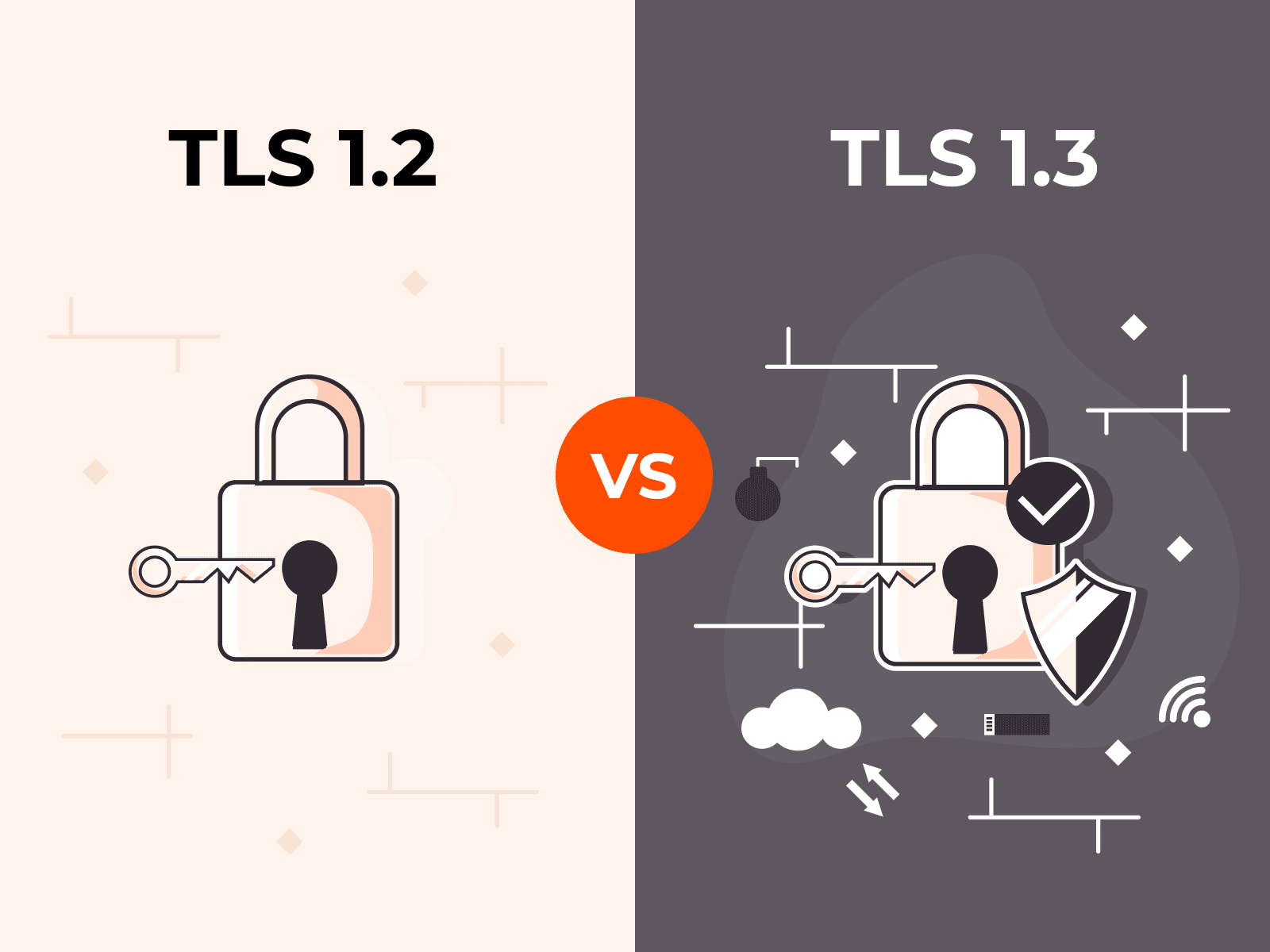
TLS 1.3 vs 1.2 refers to the comparison between two versions of the Transport Layer Security protocol, a cryptographic standard that encrypts data exchanged between clients and servers to secure network communications. TLS 1.3, finalized in 2018, represents a major upgrade over TLS 1.2, which was standardized in 2008.
Transport Layer Security serves as the foundation for secure internet connections. It protects everything from web browsing to API calls. The version you use directly affects both security strength and connection speed.
As of 2025, over 90% of HTTPS connections in major browsers now utilize TLS 1.3, reflecting the widespread industry adoption of the newer standard.
The performance gap between these versions centers on the handshake process. TLS 1.3 requires only one round-trip (1RTT) between client and server to establish a secure connection. TLS 1.2 requires two round-trips (2RTT). This change reduces handshake latency by approximately 50% compared to TLS 1.2, making connections noticeably faster.
TLS 1.3 also introduces 0-RTT (zero round-trip time) resumption for returning clients.
This feature allows clients to send encrypted data immediately when reconnecting to a server they've previously visited. Connection setup time drops to near zero on repeated connections. The protocol removes outdated cryptographic algorithms and simplifies cipher suite negotiation, creating a smaller attack surface.
These improvements matter because secure connections form the backbone of modern internet infrastructure. Faster handshakes result in a better user experience, especially on mobile networks where latency significantly impacts every interaction.
Stronger security protections defend against evolving threats that can compromise older protocols.
What is TLS, and why does the version matter?
TLS is a cryptographic protocol that encrypts data exchanged between clients and servers to secure communication over computer networks. The version matters because newer versions fix security vulnerabilities, improve performance, and reduce latency in secure connections.
TLS 1.3, finalized in 2018, requires only one round-trip between client and server to establish a secure connection. That's half the two round-trips needed in TLS 1.2 from 2008, cutting handshake latency by approximately 50%.
The latest version also removes more than a dozen insecure cipher suites and supports 0-RTT resumption. This feature allows clients to send encrypted data immediately when reconnecting, eliminating the handshake delay entirely for repeat connections.
What are the key differences between TLS 1.3 and 1.2?
The key differences between TLS 1.3 and 1.2 refer to improvements in security, performance, and protocol efficiency introduced in the 2018 TLS 1.3 specification compared to its 2008 predecessor. The key differences between TLS 1.3 and 1.2 are listed below.
- Handshake speed: TLS 1.3 requires only one round-trip between client and server to establish a secure connection. TLS 1.2 needs two round-trips. This change reduces latency by approximately 50%, making connections faster and more responsive.
- 0-RTT resumption: TLS 1.3 supports zero round-trip time resumption, allowing clients to send encrypted data immediately when reconnecting to a previously visited server. TLS 1.2 doesn't offer this feature. Even repeat connections require a full handshake.
- Cipher suite security: TLS 1.3 removes more than a dozen insecure cipher suites and cryptographic algorithms present in TLS 1.2. This includes RSA key exchange and certain block ciphers vulnerable to padding oracle attacks. Only modern, secure algorithms remain in TLS 1.3.
- Forward secrecy: TLS 1.3 enforces forward secrecy by default. This means past communications can't be decrypted even if the server's private key is later compromised, protecting against man-in-the-middle attacks. TLS 1.2 made forward secrecy optional, leaving many connections vulnerable.
- Handshake encryption: TLS 1.3 encrypts more of the handshake process itself, hiding certificate information and other metadata from potential attackers. TLS 1.2 sends much of this information in plaintext, exposing it to surveillance.
- Protocol simplification: TLS 1.3 removes legacy features and outdated cryptographic options, creating a cleaner and more secure protocol. This simplification reduces the attack surface and makes implementations easier to secure correctly.
- Session resumption: TLS 1.3 replaces TLS 1.2's session ID and session ticket mechanisms with a single PSK (pre-shared key) approach. This unified method improves both security and performance for repeat connections.
How does the handshake process differ between TLS 1.3 and 1.2?
The handshake process differs between TLS 1.3 and 1.2 in speed, security, and efficiency. TLS 1.3 completes its handshake in one round-trip (1RTT) between client and server, while TLS 1.2 requires two round-trips (2RTT). This cuts connection setup time in half, reducing latency by approximately 50%.
TLS 1.2 follows a two-step process.
First, the client sends a "hello" message with supported cipher suites. The server responds with its chosen cipher suite and certificate. Then the client and server exchange key information in a second round-trip before encrypted communication begins.
This back-and-forth takes time, especially over high-latency networks.
TLS 1.3 streamlines this by combining steps. The client sends its "hello" message with key share information immediately. The server responds with its key share and certificate in one message.
Both sides can start encrypting data after just one round-trip. For repeat connections, TLS 1.3 supports 0-RTT resumption, allowing clients to send encrypted data immediately without any handshake delay.
TLS 1.3 also removes insecure cipher suites that TLS 1.2 still supports. It eliminates RSA key exchange and older block ciphers vulnerable to attacks.
This makes TLS 1.3 faster and more secure by default.
What are the security improvements in TLS 1.3?
TLS 1.3 includes several security enhancements that make encrypted connections more resistant to attacks compared to earlier versions. Here are the key security improvements in TLS 1.3.
- Removed weak cipher suites: TLS 1.3 eliminates support for older cryptographic algorithms with known vulnerabilities, including RSA key exchange, SHA-1, and CBC-mode ciphers. This removes entire classes of attacks, such as BEAST, CRIME, and Lucky 13, that exploited weaknesses in TLS 1.2.
- Forward secrecy by default: All cipher suites in TLS 1.3 require Diffie-Hellman key exchange, ensuring forward secrecy for every connection. If an attacker compromises a server's private key, they can't decrypt past communications recorded during earlier sessions.
- Encrypted handshake: TLS 1.3 encrypts almost the entire handshake process, including server certificates and configuration details. Only the initial client hello message remains unencrypted. This hides more information from potential eavesdroppers.
- Simplified cipher suite selection: The protocol reduces cipher suite options from dozens to just five modern algorithms.
- Removed compression: TLS 1.3 completely removes support for TLS-level compression, which was exploited in attacks like CRIME and BREACH.
- Improved key derivation: The protocol uses a more secure key derivation function called HKDF, which better protects the generation of encryption keys from the master secret.
- Mandatory digital signatures: TLS 1.3 requires digital signatures for authentication in all cipher suites.
How does TLS 1.3 improve performance over TLS 1.2?
TLS 1.3 improves performance over TLS 1.2 by reducing the handshake process from two round-trips to a single round-trip. This streamlined handshake cuts connection setup time in half, directly reducing latency for users.
The protocol also introduces 0-RTT (zero round-trip time) resumption for repeat connections.
If you've connected to a server before, TLS 1.3 lets you send encrypted application data immediately. You don't need to wait for the handshake to complete.
TLS 1.3 removes computational overhead by eliminating support for older, slower cipher suites. The protocol mandates modern algorithms that process faster on current hardware.
Major web browsers now default to TLS 1.3. CDN providers report about a 50% reduction in handshake latency compared to TLS 1.2.
What are the feature differences between TLS 1.3 and 1.2?
TLS 1.3 brings significant technical improvements and security enhancements over its predecessor. Here's what sets the newer protocol apart from TLS 1.2.
- Handshake speed: TLS 1.3 completes its handshake in one round-trip between client and server.
- 0-RTT resumption: TLS 1.3 introduces zero round-trip time resumption, letting clients send encrypted data immediately when reconnecting to a server.
- Cipher suite simplification: TLS 1.3 removes support for more than a dozen outdated cipher suites that TLS 1.2 still includes.
- Forward secrecy: TLS 1.3 requires forward secrecy by default.
- Encrypted handshake: TLS 1.3 encrypts more of the handshake process than TLS 1.2.
- Session resumption: TLS 1.3 uses a unified PSK mode.
- Message authentication: TLS 1.3 removes the older HMAC-MD5 and HMAC-SHA1 constructions.
How to migrate from TLS 1.2 to TLS 1.3
You migrate from TLS 1.2 to TLS 1.3 by updating your server configuration, testing compatibility with clients, and enabling the new protocol while monitoring performance.
- First, check your current server software versions to confirm TLS 1.3 support.
- Next, enable TLS 1.3.
- Then, update your cipher suite configuration to prioritize TLS 1.3.
- Test your configuration in a staging environment with real client devices and browsers before deploying to production.
- Deploy the configuration to production servers gradually, starting with a small percentage of traffic if possible.
- After confirming stable performance for 2 to 4 weeks, analyze your server logs to determine the percentage of clients still using TLS 1.2.
- Finally, plan to disable TLS 1.2.
What is the current adoption status of TLS 1.3?
TLS 1.3 is now the dominant protocol for secure web connections. As of 2025, over 90% of HTTPS traffic in major browsers runs on this version. The protocol reached widespread adoption remarkably quickly after its 2018 release. Major browsers, including Chrome, Firefox, Safari, and Edge, enabled it by default, accelerating its growth. Today, all major web browsers, CDN providers, and cloud platforms support TLS 1.3, making it the standard for secure internet communications.
Optimize your infrastructure with TLS 1.3
Gcore's CDN service and edge network fully support TLS 1.3 across all 210+ points of presence, delivering faster handshakes and stronger security for your content delivery. Our infrastructure automatically optimizes TLS connections to ensure the best performance for your users globally.
Frequently asked questions
Should I upgrade from TLS 1.2 to TLS 1.3?
Yes, you should upgrade to TLS 1.3. You'll get faster connection speeds and stronger security through its streamlined 1-round-trip handshake, which cuts connection time in half compared to TLS 1.2. The protocol also removes vulnerable cipher suites that left older versions exposed to attacks.
Is TLS 1.2 still secure and supported?
Yes, TLS 1.2 remains secure and widely supported. However, TLS 1.3 offers better protection by removing vulnerable cipher suites and reducing handshake time by 50%.
Can TLS 1.3 and 1.2 work together?
Yes, TLS 1.3 and 1.2 work together through backward compatibility. During the handshake, servers and clients negotiate to find the highest version they both support.
What happens if my server only supports TLS 1.2?
Your server will continue to work and establish secure connections. However, it won't benefit from TLS 1.3's faster handshake speeds and improved security features. Most clients support both TLS 1.2 and 1.3, so they'll automatically connect using TLS 1.2 when that's the highest version your server offers.
Does TLS 1.3 break compatibility with older browsers?
No, TLS 1.3 doesn't work with browsers older than 2018. This includes Internet Explorer 11 and early versions of Safari, Chrome, and Firefox that don't support the protocol. Modern browsers support TLS 1.3 by default: Chrome 70+, Firefox 63+, Safari 12.1+, and Edge 79+.
How much faster is TLS 1.3 compared to TLS 1.2?
TLS 1.3 is about 50% faster than TLS 1.2. It cuts handshake latency by requiring just one round-trip to establish a secure connection instead of two.
What are the main security vulnerabilities removed in TLS 1.3?
TLS 1.3 removes several outdated cryptographic methods that made earlier versions vulnerable to attacks. It eliminates RSA key exchange, static Diffie-Hellman, CBC mode ciphers, RC4, 3DES, MD5, and SHA-224. These older methods exposed previous TLS versions to serious exploits, such as BEAST, POODLE, and padding oracle attacks.

Related articles

Your database gets compromised. Customer records disappear. Credit card data ends up for sale on the dark web. SQL injection attacks remain one of the most prevalent web application vulnerabilities in 2024, consistently appearing in top ten

You click a link in what looks like a routine email from your bank, and within seconds, $5,000 vanishes from your account, transferred to a stranger while you were simply logged in to your banking app. Many legacy web applications have vuln



API rate limiting is the process of controlling how many requests a user or system can make to an API within a specific timeframe. This mechanism caps transactions to prevent server overload and ensures fair distribution of resources across
Subscribe to our newsletter
Get the latest industry trends, exclusive insights, and Gcore updates delivered straight to your inbox.