



What is an IXP?
- January 19, 2026
- 9 min read
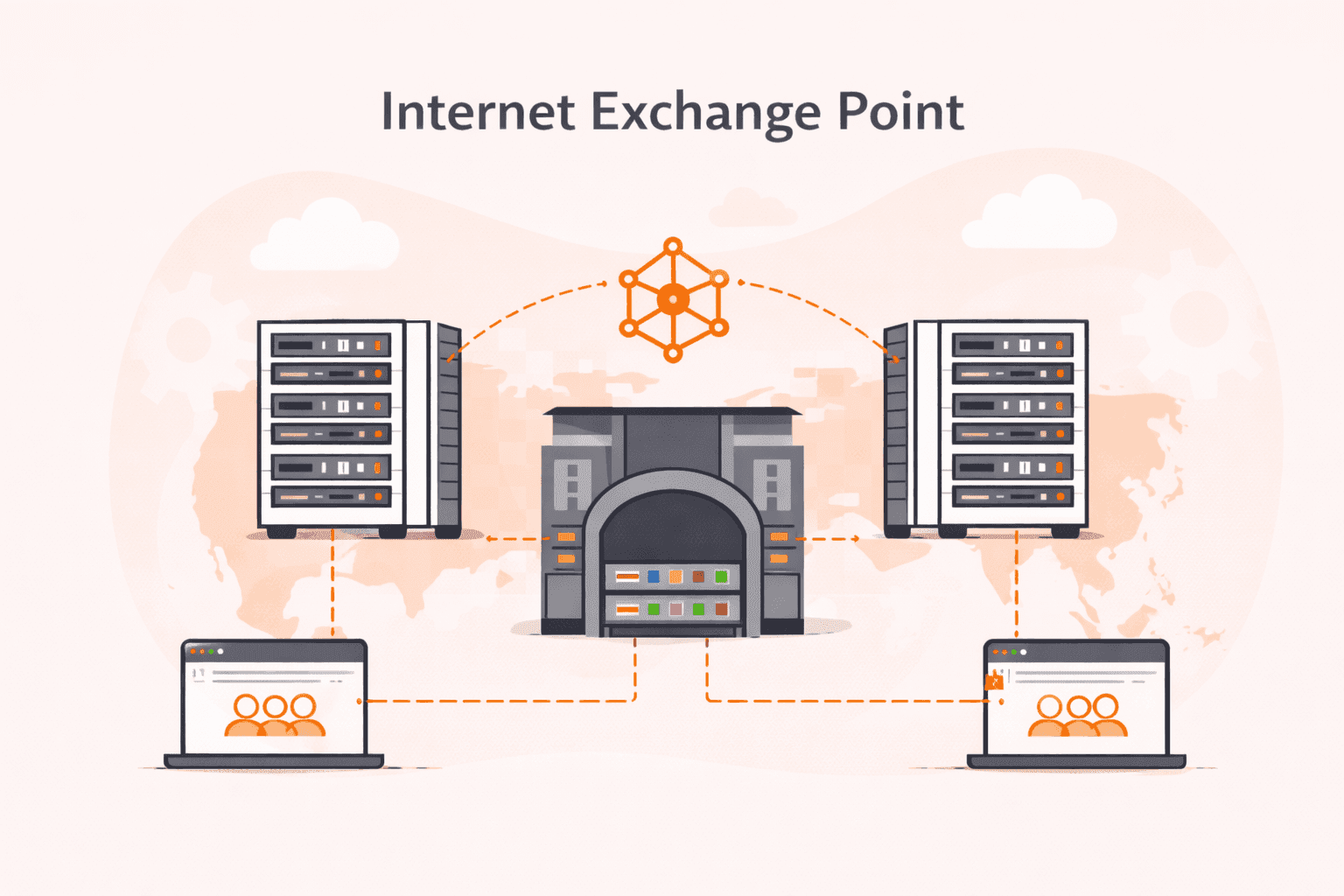
When you send an email or stream a video, your data doesn't just magically hop from your computer to its destination. It travels through multiple networks, and somewhere along that path, it might passes through an Internet Exchange Point (IXP). Think of an IXP as a major highway intersection where different Internet Service Providers, CDNs, and other networks meet to exchange traffic directly.
Instead of your data taking a long detour through multiple third-party networks, IXPs let these networks connect and swap data in one physical location.
Here's what makes IXPs interesting: they're built like massive Ethernet switches, similar to your home network but scaled up to handle hundreds of megabits to multiple terabits of data per second. When networks connect at an IXP, they use Border Gateway Protocol (BGP) to figure out the best routes for traffic. It's like having a direct conversation instead of playing telephone through five other people.
The real benefit? IXPs keep local traffic local.
If you're in London watching a video hosted in London, your data doesn't need to bounce through New York or Frankfurt. The networks serving you and the networks hosting that video can exchange traffic directly at a local IXP. This cuts down latency, reduces costs for network operators, and makes your internet experience faster.
There are nearly 1,200 IXPs worldwide, and they come in different shapes and sizes.
Some focus on connecting regional ISPs, while others serve as major hubs for international traffic. The key components include Ethernet switches for the actual data exchange, route servers that help networks discover each other, and the peering agreements that make it all work legally and financially. It's infrastructure you'll never see, but you use it dozens of times every day.
What is an internet exchange point?
An Internet Exchange Point (IXP) is a physical location where Internet Service Providers (ISPs), Content Delivery Networks (CDNs), and other networks connect to exchange traffic directly with each other. This direct connection lets networks bypass third-party transit providers, keeping local traffic local instead of routing it through distant networks. IXPs function as large Ethernet switching fabrics where member networks connect their routers and use Border Gateway Protocol (BGP) to manage routing and peering agreements, creating a more efficient path for data to travel between networks.
How does an internet exchange point work?
An internet exchange point connects multiple networks at a single physical location where they can exchange traffic directly through shared Ethernet switches. Networks connect their routers to the IXP's switching infrastructure and use Border Gateway Protocol (BGP) to establish peering relationships with other members. When data needs to travel between two networks connected to the same IXP, it routes through the exchange's switches instead of taking longer paths through third-party transit providers.
The process starts when networks physically install equipment at the IXP facility and connect to the shared Layer 2 Ethernet fabric.
Each network announces its IP address ranges through BGP. This lets other members know which destinations it can reach. Route servers at the IXP simplify this process by collecting routing information from all participants and distributing it effectively, so networks don't need individual BGP sessions with every other member.
Traffic exchange happens in real time as packets arrive at the IXP. The Ethernet switches examine destination addresses and forward data to the appropriate member network.
This direct exchange keeps local traffic local. Data traveling between two ISPs in the same city stays in that city instead of routing through distant locations. The shared infrastructure handles anywhere from hundreds of megabits per second to multiple terabits per second, depending on the IXP's size and member traffic volumes.
This direct interconnection reduces latency because data travels fewer hops between networks. It also cuts costs since networks avoid paying transit fees to third parties for traffic they can exchange directly.
The result is faster application performance, better round-trip times, and more efficient use of network resources for all participating organizations.
What are the main benefits of using an internet exchange point?
The main benefits of using an internet exchange point refer to the advantages networks gain when they interconnect directly at these physical locations rather than routing traffic through third-party providers. The main benefits of using an internet exchange point are listed below.
- Reduced latency: IXPs let networks exchange traffic locally instead of routing data through distant transit providers. This direct connection significantly cuts round-trip time. The result is faster response times for end users.
- Lower costs: Direct peering at IXPs eliminates or reduces the need for expensive transit services. Networks save on bandwidth fees by exchanging traffic directly with other members at the exchange point.
- Local traffic retention: IXPs keep regional traffic within the local area instead of sending it overseas or through multiple hops. This approach reduces unnecessary international routing and keeps data closer to its source and destination.
- Improved network performance: Direct connections at IXPs provide more efficient routing paths between networks. This effectiveness translates to better application performance and more reliable data delivery for services like streaming and cloud applications.
- Increased redundancy: Networks gain multiple peering options at a single location, creating backup paths for traffic. This redundancy improves overall network reliability and reduces the risk of service disruptions.
- Better traffic control: IXPs give networks direct control over their routing policies through BGP peering agreements. You can optimizetraffic flow based on your specific needs and business relationships.
- Scalability: IXPs support traffic exchange ranging from hundreds of megabits per second to many terabits per second. Networks can scale their capacity at these exchange points as their traffic demands increase without major infrastructure changes.
What are the different types of internet exchange points?
Internet Exchange Points (IXPs) use different operational models and architectural configurations to help networks interconnect and exchange traffic. Here are the main types of IXPs.
- Public IXPs: These facilities work as neutral meeting points where multiple networks connect to a shared switching fabric to exchange traffic. Public IXPs let any network join by meeting membership requirements and paying port fees. They handle traffic ranging from hundreds of megabits per second to many terabits per second.
- Remote Peering IXPs: These exchanges allow networks to connect without physical presence at the IXP facility. Networks access the peering fabric through authorized resellers or transport providers. Remote peering IXPs lower the barrier to entry for smaller networks and enable peering at distant exchanges without deploying equipment. This model has grown significantly as more IXPs partner with remote peering providers.
- Multi-site IXPs: These exchanges span several physical locations connected by high-speed links to create a unified peering fabric. Multi-site IXPs let networks connect at their preferred data center while accessing all peering partners. This model reduces the need to maintain equipment at multiple sites.
- Route server IXPs: These exchanges provide centralized routing infrastructure that simplifies BGP configuration for member networks. Route server IXPs let networks peer with many participants through a single BGP session instead of configuring hundreds of individual sessions. This approach cuts operational overhead and speeds up new peering connections.
- Regional IXPs: These exchanges focus on connecting networks within a specific geographic area to keep local traffic local. Regional IXPs reduce latency for users by preventing data from traveling overseas or through distant transit providers. They improve internet performance for local businesses and consumers.
- Global IXPs: These exchanges span multiple countries and continents to provide international peering opportunities. Global IXPs give content providers and CDNs efficient paths to reach users worldwide. They handle massive traffic volumes and connect hundreds of networks across their distributed infrastructure.
- Community IXPs: These exchanges run as nonprofit organizations focused on improving regional internet infrastructure and reducing costs. Community IXPs prioritize local network development over profit and often provide services at lower rates. They help build internet ecosystems in developing regions.
How to connect to an internet exchange point
You connect to an Internet Exchange Point (IXP) by establishing a physical connection to the exchange facility, configuring BGP peering, and completing the technical and administrative requirements set by the IXP operator.
- First, verify your network meets the basic requirements for IXP membership. You need an Autonomous System Number (ASN), IP address space, and routing equipment capable of BGP peering. Most IXPs require you to run a production network and maintain 24/7 network operations support.
- Next, select an IXP that matches your geographic and business needs. Consider factors like the exchange's location, connected networks, available port speeds, and membership costs. Contact the IXP to request membership information and review their technical requirements, service level agreements, and peering policies.
- Then, arrange physical connectivity to the IXP facility. You can establish a direct cross-connect if you have equipment in the same data center, or order a connection through a carrier or metro Ethernet provider if you're located elsewhere. The IXP provides specific instructions for the physical port location and connection details.
- After that, configure your router with the IP addresses and VLAN settings provided by the IXP. The exchange assigns you IP addresses from their address space, typically both IPv4 and IPv
- Set up your router interface with these addresses and verify Layer 2 connectivity by pinging the IXP's infrastructure addresses.
- Configure BGP sessions with other networks at the exchange. You can peer directly with individual networks through bilateral peering agreements, or connect to the IXP's route server for multilateral peering. Route servers simplify peering by letting you exchange routes with multiple networks through a single BGP session.
- Finally, test your connection and monitor traffic flow. Verify that routes are being exchanged correctly, check latency improvements, and confirm that traffic flows through the IXP as expected. Most IXPs provide looking glass services and traffic statistics to help you monitor your connection performance.
Start with a smaller port speed like 1 Gbps or 10 Gbps to test the connection and prove the business case before upgrading to higher capacity ports as your traffic grows.
What are the key considerations when selecting an internet exchange point?
Choosing the right Internet Exchange Point (IXP) requires evaluating several critical factors that directly impact your network's performance, costs, and peering opportunities. Here are the key considerations when selecting an IXP.
- Geographic location: The IXP's physical location determines latency and routing effectiveness for your target users. Selecting an IXP close to your primary traffic sources can reduce round-trip time by 20 to 50 milliseconds and keep local traffic local.
- Network diversity: The number and variety of networks present at an IXP directly affect your peering opportunities and redundancy options. An IXP with 200 to 500 connected networks offers more potential peering partners than one with only 20 to 30 members.
- Traffic volume capacity: The IXP's switching infrastructure must handle your current and projected traffic needs without bottlenecks. Look for facilities that support hundreds of gigabits per second to multiple terabits per second of aggregate capacity.
- Port costs and fees: Connection costs vary widely between IXPs. These include one-time setup fees, monthly port charges, and traffic-based billing. Compare pricing structures to find options that match your budget and expected traffic patterns.
- Technical infrastructure: The quality of switching equipment, route servers, and monitoring tools affects performance and reliability. Modern IXPs use high-capacity Ethernet switches and offer IPv6 support, multicast capabilities, and real-time traffic statistics.
- Redundancy and reliability: Multiple physical locations, backup power systems, and diverse fiber paths protect against outages and equipment failures. Look for IXPs with 99.9% or higher uptime guarantees and documented disaster recovery procedures.
- Peering policies: Understanding whether the IXP supports open peering, selective peering, or restrictive peering models helps you identify compatible partners. Some IXPs require members to peer with all participants, while others allow selective arrangements.
What challenges do internet exchange points face?
Running an internet exchange point comes with real operational and planned challenges that can impact effectiveness and growth. Let's look at what IXP operators face.
Technical challenges start with managing increasingly complex peering relationships as networks grow. You'll need to maintain high-capacity switching infrastructure that can handle traffic spikes ranging from hundreds of gigabits to multiple terabits per second. Physical security and redundancy across facilities add another layer of complexity.
Financial pressures are constant. Equipment needs continual upgrades to support faster speeds, but membership costs must stay low enough to attract smaller networks and ISPs. This creates a difficult balancing act.
Governance becomes more challenging as IXPs expand. Large content providers, local ISPs, and enterprise members often have competing priorities around routing policies, cost structures, and service offerings. Balancing these different interests requires careful coordination.
How do internet exchange points impact global internet performance?
Internet exchange points impact global internet performance by letting networks exchange traffic directly at shared physical locations. This dramatically reduces latency, cuts costs, and improves data routing efficiency. When ISPs, CDNs, and other networks connect at an IXP instead of routing through multiple intermediary networks, data travels shorter distances and takes fewer hops to reach its destination.
This direct peering model keeps local traffic local. If two networks in the same city both connect to a local IXP, their traffic can exchange directly rather than routing through distant transit providers or even overseas. This reduces round-trip time from tens or hundreds of milliseconds down to 10-30 milliseconds for local traffic in many cases.
IXPs also reduce bandwidth costs for participating networks. Instead of paying transit providers for every gigabyte transferred, networks can exchange traffic at IXPs for a fraction of the cost (often just the price of the port connection and colocation fees). This makes internet service more affordable and sustainable, especially in developing regions.
The performance benefits extend to end users. You'll see faster application response times, better video streaming quality, and more reliable connections. When content providers and ISPs peer at IXPs, popular content can be delivered from nearby servers rather than distant data centers.
With nearly 1,200 IXPs operating globally, these interconnection points form the backbone of efficient internet traffic exchange. They handle traffic volumes ranging from hundreds of megabits to multiple terabits per second.
How can Gcore help with internet exchange point connectivity?
Connecting to IXPs requires reliable infrastructure that can handle direct peering at scale. Gcore runs its own global network with presence at major internet exchange points worldwide. This ensures efficient traffic exchange and reduced latency for your applications.
The platform delivers consistent performance through strategic IXP connectivity. It keeps local traffic local and avoids unnecessary transit costs.
Learn more about Gcore's network infrastructure at gcore.com/network.
Frequently asked questions
Is internet exchange point difficult to implement?
No, using an internet exchange point isn't difficult for network operators with basic BGP knowledge and standard routing equipment. The technical setup involves connecting routers to shared Ethernet switches and configuring peering sessions. This uses familiar networking protocols and hardware that most ISPs and CDNs already operate.
How much does internet exchange point cost?
IXP connection costs range from $500 to $10,000 per month. The exact price depends on port speed, location, and membership type. You'll typically encounter one-time setup charges of $1,000 to $5,000, monthly port fees based on bandwidth capacity (100 Mbps to 100 Gbps), and annual membership dues that vary by exchange size and region.
Pricing breaks down into three main components. Cross-connect fees for physical connections run $100 to $500 monthly per link. Membership or participation fees cover operational costs and vary by exchange.
Major global IXPs like DE-CIX and AMS-IX charge higher rates than regional exchanges. But the investment pays off through reduced transit costs. Networks often save 40% to 60% on bandwidth expenses by exchanging traffic directly instead of paying upstream providers.
Can internet exchange point integrate with existing systems?
Yes, Internet Exchange Points integrate seamlessly with existing network infrastructure through standard BGP routing and Ethernet connectivity. Your network connects to the IXP's switching fabric using a router or switch, establishes peering sessions with other members, and begins exchanging traffic directly without changing your core network architecture.
What are common mistakes with internet exchange point?
Organizations often make four critical mistakes when connecting to IXPs. First, they underestimate setup costs. Second, they misconfigure BGP routing. Third, they choose the wrong peering partners. Fourth, they neglect to monitor traffic patterns after connection.
The biggest mistake? Selecting IXPs based on location alone without evaluating member networks. This approach limits peering opportunities and delivers minimal latency improvements. You'll get better results by choosing IXPs where your target networks actually peer.
How long does it take to connect to an internet exchange point?
Connecting to an Internet Exchange Point typically takes two to eight weeks, depending on your location and the IXP's onboarding process. Cross-connect provisioning usually takes one to three weeks. BGP configuration and testing add another one to two weeks. Some IXPs offer expedited onboarding for established networks with clean peering history.

Related articles
Subscribe to our newsletter
Get the latest industry trends, exclusive insights, and Gcore updates delivered straight to your inbox.