

Overview
This case study showcases how a high-complexity 24/7 streaming pipeline for major live events was successfully solved. The architecture demonstrates mastery over “hot-swapping”—the seamless switching from a main signal to a dedicated separate broadcast without interrupting the user experience. By aligning professional-grade encoders with platform-side real-time monitoring, the solution ensures that even the most complex transitions remain stable across Global Ingest points. This incident highlights a critical lesson: in high-stakes broadcasting, even a single missed parameter or minor misconfiguration on the encoder side can have a critical impact on the entire 24/7 broadcast.Architecture: From SDI to Playback
The following scheme illustrates the complete chain of professional signal delivery:Encoder Stack & Setup
To handle millions of viewers during national events initially there was implemented a robust multi-tier setup:- Main Composition, AWS Elemental Live: Handles the SDI master signal and placeholder file composition.
- SRT Gateway & Encoder, Nimble Streamer: Nimble Streamer acts as the intelligent gateway, utilizing hardware-accelerated encoding for the final push to Gcore Video Streaming.
The Ingest Pipeline
The primary and backup flows are segregated but mirrors of each other, ensuring that a failure in one stack does not affect the other.Global Cross-Pull Redundancy
To prevent total signal loss if a single Elemental source fails, the Nimble gateway layer implements a cross-pull mechanism. This ensures that even if one Elemental encoder drops, both Gcore Ingest points still receive a valid signal. If Elemental A fails, Nimble A automatically switches to receiving Elemental B’s feed from Nimble B via SRT:RTMP vs. SRT: Choosing the Right Tool
While RTMP is the industry legacy, this case illustrates why SRT is mandatory for high-complexity TV delivery:- RTMP (TCP): Unlimited retransmissions cause “head-of-line blocking.” If one packet is late, the entire stream stalls, leading to large, unpredictable latency spikes that break sync.
- SRT (UDP + ARQ): Allows the ingest layer to handle late packets within a strict window. If a packet is lost, SRT retransmits it immediately without stalling the entire feed. This is vital for “hot-swapping” where timing must be absolute.
Case Investigation: From 404 to PTS Fix
Initial Symptoms
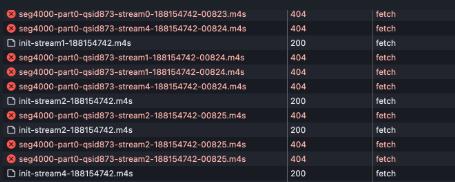
The issue was first noted by monitoring system and later confirmed by end-users as intermittent buffering and stalled playback.- CDN Logs: CDN reported
404errors received from the upstream. - Player: Analysis showed
404 Not Foundfor specific.m4s(DASH) segments. - Initial Assumption: Because segments were missing, it was initially suspected to be a transcoding issue or a JIT Packager failure.
Real-time Investigation Lifecycle
- Traffic Audit: We confirmed that segments were indeed missing from the origin buffer, not just the CDN cache.
- Ingester Validation: Using SRT statistics, we noted that the bitrate remained stable, but “Late packet” drops were occurring exactly during source transitions.
- PTS/DTS Analysis: We deployed our internal PTS/DTS stream monitor and detected that the PTS stalled and lost for several frames during the switch from the placeholder loop to the SDI feed.
Solution: Real-Time Monitoring & Config
1. Gcore PTS/DTS Stream Monitor
We developed a dedicated stream monitor worker for PTS/DTS analysis that performs real-time timestamp analysis. This worker proactively flags AV sync drifts (>200ms) and timeline stalls, allowing us to notify broadcasters before small drifts become major 404 errors. Below is an excerpt from the monitor logs demonstrating the exact moment of the timeline stall:2. SRT Latency & Stability
Correctly sizing the SRTlatency parameter is critical. In the analyzed case, the encoder was initially using the default value of 120ms—a setting optimized for low-jitter local networks (Ethernet).
While 120ms works in a controlled lab environment, it leaves almost no room for packet retransmission over the public internet. During even minor network fluctuations or high-CPU source switches, packets that arrived “late” (after 120ms) were dropped by the ingest layer, resulting in the 404 errors observed in the segments.
3. Encoder Configuration Best Practices
The investigation concluded that two critical adjustments were required to ensure seamless hot-swapping: For AWS Elemental Live:- Timecode Source: Must be set to System-Clock. This ensures a monotonic timeline and prevents PTS stalls during source switches (e.g., from placeholder to SDI).
- Setup: Configured in “Pass-through” mode for internal transport to minimize latency, with hardware-accelerated encoding only for the final handoff.
- SRT Parameters: Use a
latencyof 2000-2500ms (minimum) for public internet transport andmode=caller. This provides the necessary buffer for ARQ retransmissions, ensuring 100% data integrity before processing. - Keyframe Interval: Must be set to 1 second on the encoder side to ensure rapid recovery and synchronization during hot-swapping events.
Conclusion & Resources
Mastering a 24/7 broadcast requires treating your ingest as a precision-timed system. By utilizing SRT’s selective retransmissions and ensuring monotonic timestamps, you can handle complex source transitions with 100% confidence. Our Recommendation: Before any major 24/7 live event, always perform a full-scale test-run including simulated “hot-swaps” between your primary and fallback signals. At Gcore, our advantage is our client-oriented service. If you are planning a high-profile broadcast or need assistance with your encoder configuration, don’t hesitate to reach out to our engineers. We are here to help you build the most resilient pipeline for your audience.Further Reading
- SRT Protocol: Detailed setup for software and hardware encoders.
- PTS/DTS Timestamps: Why invalid timestamps break CDN delivery and DASH packaging.
- RTMP vs SRT Comparison: Choosing the best protocol for your unstable uplink.