



5 insights on AI infrastructure from Nexus Luxembourg 2026
- June 12, 2026
- 3 min read

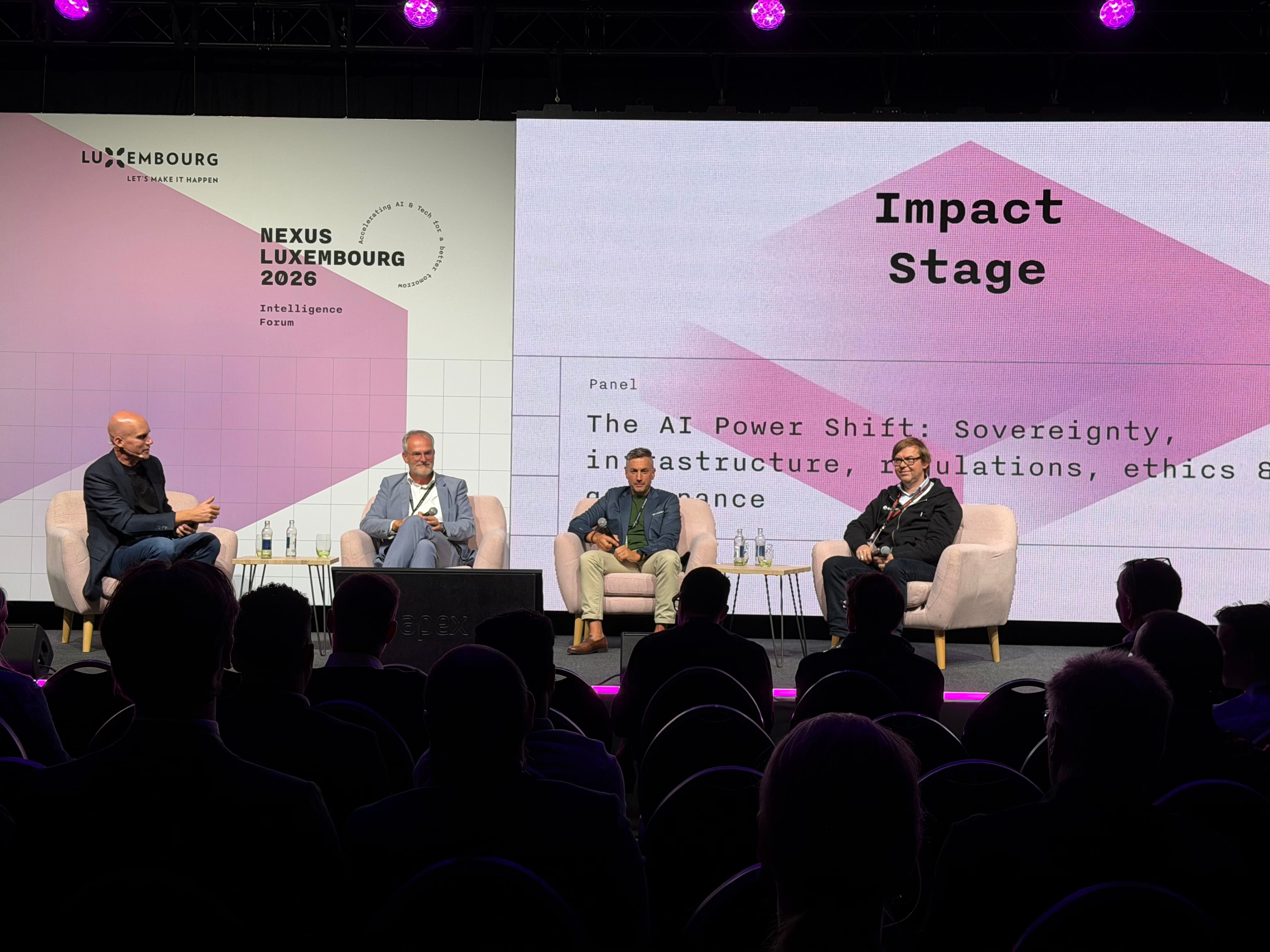
Nexus Luxembourg is Europe's premier AI and technology summit, and this year's edition brought together more than 10,000 visitors, 150+ speakers, and 250 startups from over 50 countries. Gcore CEO Andre Reitenbach joined LuxProvide's Arnaud Lambert and Loïc Didelot, founder and CEO of Mixvoip, for a panel on the state of AI infrastructure in Europe.
The conversation covered sovereign compute, energy constraints, and the gap between AI demos and production-ready deployments. Here are five things worth taking away.
1. Edge AI and centralized AI are complementary, not competing
Reitenbach drew a distinction that often gets lost in the infrastructure conversation. Centralized AI — large GPU clusters in a single data center — handles training and heavy compute. Edge AI is the delivery layer: getting models and inference as close as possible to where they're needed. For industrial applications, autonomous systems, and physical AI agents, the latency and data residency requirements make centralized-only approaches unworkable. European companies in particular have strong reasons to care about where their AI actually runs — and edge infrastructure is a significant part of that answer.
2. A common standard for AI delivery is coming — and Europe should have a seat at the table
Reitenbach pointed to an emerging conversation in the industry around what he called an "intelligent grid": a shared standard for delivering AI tokens across distributed infrastructure, routing on bandwidth, latency, and cost the way networking protocols do today. This is still forming, but the direction is clear. Gcore's position — 200+ points of presence worldwide, with deep roots in European infrastructure — puts it well-placed to help shape that standard from a European perspective, rather than inherit one built elsewhere.
3. Energy availability is now the binding constraint
The panel's consensus was blunt: the limiting factor in AI infrastructure growth is no longer talent or capital — it's power. Customers are asking for 10-megawatt deployments, and 10 megawatts is currently hard to find. Lambert noted that even MeluXina AI, Luxembourg's next-generation supercomputer, will launch with GPU-level power caps. Europe has industrial sites and existing grid infrastructure that could be repurposed, but permitting, build-out, and energy aggregation remain slow. Whoever solves the energy question fastest shapes the continent's AI capacity — and that's a sovereign question as much as a commercial one.
4. Data sovereignty is becoming an architectural decision, not a compliance checkbox
Reitenbach described a large industrial customer building a private AI backbone specifically to prevent its IP from being exposed to the public internet or scraped by foundation model providers. The solution: a geographically distributed private installation, fine-tuned models hosted locally, no public internet exposure. This is what sovereignty looks like when it moves from talking point to engineering requirement — and it's a pattern Gcore expects to see more of as enterprises get serious about where their data goes.
5. The gap between demos and production is still real
The panel's most honest moment came from Loïc Didelot, whose company Mixvoip builds AI-driven telephony. Despite significant investment, he was direct: AI handles 80–90% of calls adequately, but the failure cases create more work than they save — and that's not good enough for production. This isn't a reason to slow down, but it is a reason for European companies building on AI to be clear-eyed about readiness, and to choose infrastructure partners who are as serious about reliability as they are about capability.
European AI needs infrastructure built for Europe
The thread running through the panel — distributed infrastructure, energy sovereignty, data residency, production reliability — maps closely to the problems Gcore was built to solve. As European AI moves from experimentation to deployment at scale, the infrastructure decisions companies make now will define how much control they retain over their data, their models, and their competitive position. Gcore's view is that sovereignty and performance aren't a trade-off — and that's what European digital infrastructure should look like.
As a European-founded, European-operated infrastructure provider, Gcore is built around exactly the principles this panel discussed. Find out more about our approach to European digital sovereignty.

Related articles


Earlier this year we brought NVIDIA Dynamo to Gcore — one-click disaggregated inference that delivered up to 6× higher GPU throughput and 2× lower latency inside a deployment, by separating prefill and decode and routing each request to the

For many startups, infrastructure decisions are mostly about performance, pricing, and developer experience. For Melious AI, they are also about trust.Melious AI is a German startup building a European AI platform around privacy, transparen

As enterprises move AI from experimentation into production, they face a new infrastructure challenge. AI applications, models, and data are no longer confined to a single cloud or data center. Instead, they are distributed across multiple


2025 quietly became the year DDoS stopped being a "big company" problem. The bandwidth record was broken several times in a single year, each new peak holding for weeks rather than years. In one quarter alone, providers blocked roughly 20 m
Subscribe to our newsletter
Get the latest industry trends, exclusive insights, and Gcore updates delivered straight to your inbox.