



AI sovereignty isn’t politics: it’s a sales requirement
- June 3, 2026
- 5 min read
Across Europe, I keep seeing the same pattern in public sector deals, regulated industries, and anything that smells like critical infrastructure: "AI sovereignty" has moved from a nice-to-have to the first real checkpoint in the deal. Not a geopolitical debate. A procurement reality.
Sitting close to infrastructure conversations at Gcore, I've watched security reviews and vendor questionnaires evolve. I've also seen how founders underestimate these requirements until late-stage enterprise talks—when the fixes are expensive, timelines slip, and momentum dies.
The shift is simple: buyers aren't asking "How smart is your model?" first. They're asking "How controllable is your system?" Where does data live? Who can access it? Which subprocessors touch it? Can you prove what happened when something goes wrong—and do it fast?
Sovereignty isn't one checkbox. It's a spectrum of operational control: data residency, processing location, encryption and key management, audit logs, incident response, business continuity, and the chain of vendors behind you. Teams that treat it as a first-class GTM constraint don't just "pass compliance." They open Ideal Customer Profiles (ICPs) that their competitors can't enter, shorten security reviews, and win deals that never reach the pricing conversation for everyone else.
Sovereignty isn't politics — it's procurement hygiene.
Why sovereignty has surfaced now (and why it's not going away)
Three forces collided.
First, procurement got stricter. Public sector and regulated buyers increasingly run vendor selection through repeatable controls: data location, auditability, incident reporting obligations, resilience testing, and third-party risk. In other words, the contract is no longer just legal language—it's operational truth you must demonstrate.
Second, sensitivity went up. More workloads now include personal data, business-critical telemetry, or regulated information that triggers privacy and security scrutiny. Under GDPR, for example, the processor–subprocessor chain is not a hand-wave; controllers expect control and visibility over additional processors and changes in that chain. GDPR Article 28 explicitly addresses authorization and obligations around subprocessors.
Third, lock-in anxiety became mainstream. Buyers worry about being trapped in opaque stacks where they can't trace data flows, can't negotiate subprocessor terms, and can't exit cleanly. Whether you call that "sovereignty," "risk management," or "resilience," it shows up as the same set of questions in the sales cycle.
And the EU regulatory environment is reinforcing this direction. The EU AI Act, for instance, puts weight on traceability and record-keeping for high-risk AI systems through logging requirements—exactly the kind of evidence procurement teams want when evaluating AI deployments.
What buyers actually ask (in plain language)
When founders hear "sovereignty," they often imagine a philosophical debate. What buyers ask is much more concrete—and usually comes as a questionnaire with 80 to 300 rows.
They ask where customer data is stored and processed, and whether you can commit to a specific region. They ask how data is encrypted in transit and at rest, and whether keys are managed by you, the customer, or a third party. They ask whether you have immutable audit logs and how long you retain them. They ask who can access production, under what approval flow, and how that access is recorded.
They also ask about model control: where model weights live, whether third parties can access them, whether support engineers can touch them, and what happens when you fine-tune or run inference on customer data. If you're using external model providers, they'll ask the same questions about your provider—and then they'll ask you to prove your contract terms.
And then there's the supply chain question: list every subprocessor involved—cloud, CDN, observability, MLOps, incident tooling, support, ticketing, even basic collaboration tools if they touch customer data. Under GDPR, subprocessor use is a governed area, not a casual implementation detail, and buyers increasingly expect you to demonstrate that governance.
Finally, they ask what happens on a bad day. What's your incident response process? Who is on call? What's the SLA? What's your business continuity and disaster recovery story? In Europe, incident reporting expectations are tightening in multiple domains. Under NIS2, for example, reporting obligations include rapid timelines (with formal requirements described in the Directive's text).
This is why "sovereignty" quickly becomes a sales requirement: it's the buyer's way of translating risk into terms they can approve.
A founder-friendly sovereignty scale: three levels of control
It helps to stop treating sovereignty as binary and start treating it as levels. Not because buyers love frameworks, but because it lets you pre-qualify deals and avoid surprise late-stage failure.
Level 1 is basic: EU hosting plus appropriate contracts and clear data residency commitments. You can answer the "where is it stored?" question confidently, document your subprocessors, and show your security baseline.
Level 2 is where many regulated buyers start leaning in: EU processing (not just storage), tighter control over encryption keys, fewer and more transparent subprocessors, and stronger auditability. This is where "proof" matters: logs, access controls, key management approach, and the ability to demonstrate traceability.
Level 3 is the "sovereign stack" end of the spectrum: options like local models, dedicated environments, or air-gapped/isolated deployments, depending on the context. Not every company needs this. But if you sell into sensitive government or critical infrastructure contexts, you will meet buyers who do.
One reason this is getting attention is that Europe is also working on harmonized cybersecurity assurance for cloud services. ENISA's work on the EU Cloud Services Scheme (EUCS) is one visible signal of how cloud assurance is being formalized, and it has been actively debated in industry.
The takeaway for founders: your target market determines the sovereignty level you must support. If you try to sell Level 1 into a Level 2 or Level 3 buying process, you won't "negotiate your way through." You'll stall.
How sovereignty changes GTM
Sovereignty reshapes go-to-market in three ways: it changes which ICPs are open to you, it changes your sales motion, and it can become a moat.
First, ICP expansion. Once you can answer sovereignty questions cleanly, entire categories become reachable: public sector, banking and insurance, healthcare, critical infrastructure, and regulated enterprise. Without that readiness, you might still win startups and SMBs—but you'll keep bouncing off the "enterprise gate."
Second, sales cycles and pricing. A strong sovereignty posture can shorten security reviews dramatically because you reduce back-and-forth. But it can also justify premium pricing, because you're not selling "compute" or "AI features." You're selling controllability and risk reduction. In regulated markets, architecture is part of your go-to-market.
Third, defensibility. Many teams treat compliance as a tax. In practice, "compliance-ready" can become a competitive advantage: if your competitor can't clearly explain their subprocessors, key management, audit trail, and incident response posture, they don't have a product in the eyes of procurement—they have a risk.
A short security review is a hidden growth advantage.
And this isn't theoretical. Regulatory regimes like DORA explicitly focus the financial sector on ICT risk management and third-party risk, pushing vendors deeper into procurement scrutiny.
The one artifact that speeds deals: the Sovereignty One-Pager
If there's one practical move I recommend founders make early, it's building a single artifact that sales can attach on day one: a Sovereignty One-Pager.
Not a marketing PDF. A deal-enablement sheet that pairs each claim with the evidence a security reviewer will ask for. Think of it as "procurement hygiene in one page."
It should state your data residency and processing locations in plain language. It should describe encryption and key management, and whether customers can bring or control keys (or what your equivalent control story is). It should describe audit logging: what you log, how you protect logs, how long you retain them, and how quickly you can produce them. It should list subprocessors and categorize them (core processing vs. ancillary), with links to their security posture or contractual commitments. It should outline incident response: who responds, how you notify, what your SLA targets are, and your DR posture.
If you sell AI, it should also cover model access: where weights live, who can access them, how you isolate customer data, and what happens in fine-tuning or inference flows.
The point is not to "sound compliant." The point is to make it easy for the buyer's security team to say "yes" without starting a two-month archaeology project.
The founder conclusion
Europe is making something clear: sovereignty is not an opinion. It's a sales requirement that shows up as deal terms, questionnaires, and operational evidence.
If you treat it as a late-stage hurdle, you'll pay for it in stalled deals, long security cycles, and retrofitted architecture. If you treat it early—as part of your product and your GTM—you'll unlock ICPs others can't even approach.
Buyers don't ask "How smart is your model?" first. They ask "How controllable is your system?"
If you're building for European enterprise and want infrastructure that passes the sovereignty checklist from day one — EU data residency, transparent subprocessors, audit logs, the full stack — that's exactly what the Gcore Startup Program is built for.

Related articles
Earlier this year we brought NVIDIA Dynamo to Gcore — one-click disaggregated inference that delivered up to 6× higher GPU throughput and 2× lower latency inside a deployment, by separating prefill and decode and routing each request to the
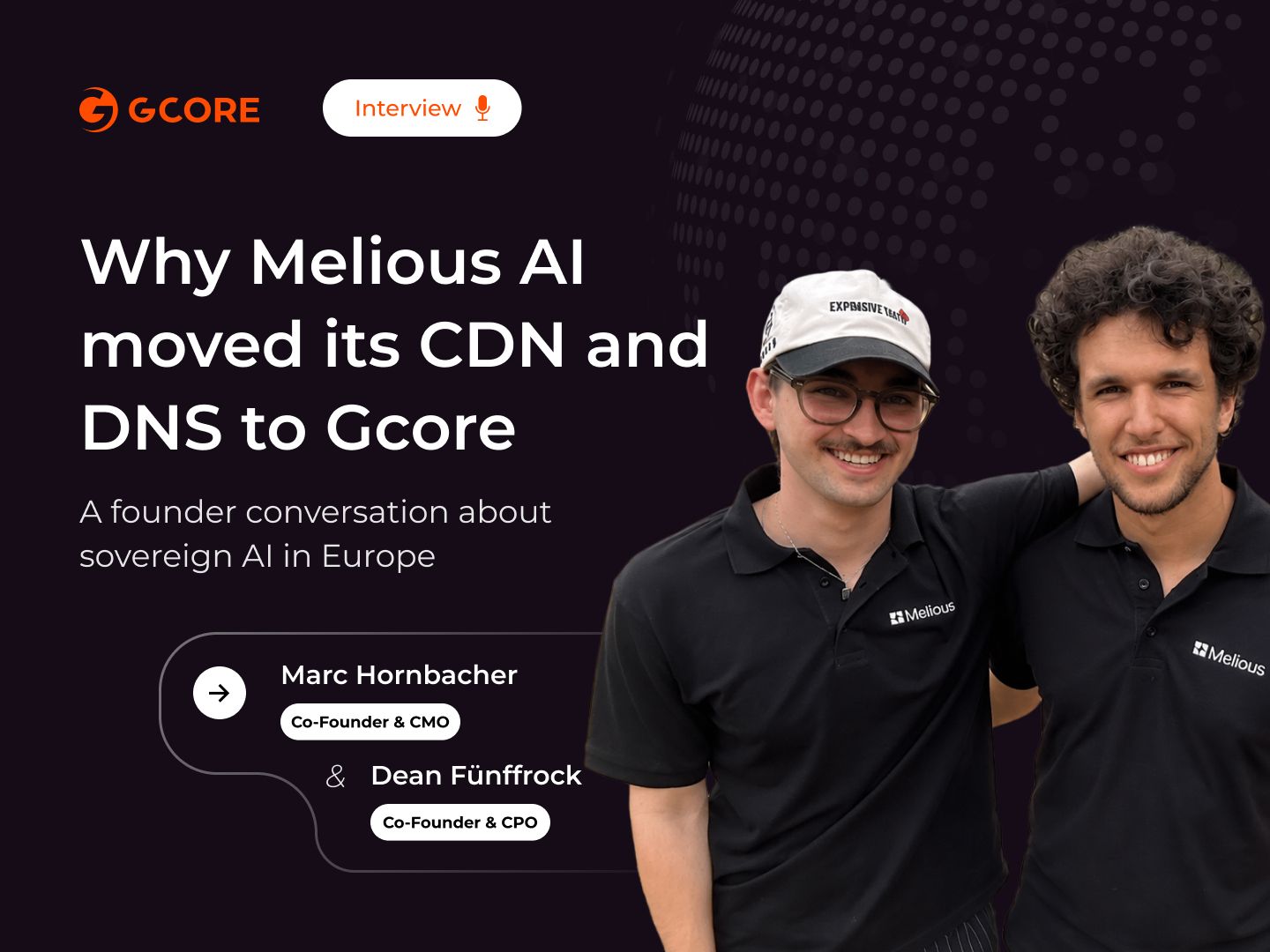
For many startups, infrastructure decisions are mostly about performance, pricing, and developer experience. For Melious AI, they are also about trust.Melious AI is a German startup building a European AI platform around privacy, transparen
As enterprises move AI from experimentation into production, they face a new infrastructure challenge. AI applications, models, and data are no longer confined to a single cloud or data center. Instead, they are distributed across multiple

2025 quietly became the year DDoS stopped being a "big company" problem. The bandwidth record was broken several times in a single year, each new peak holding for weeks rather than years. In one quarter alone, providers blocked roughly 20 m
Subscribe to our newsletter
Get the latest industry trends, exclusive insights, and Gcore updates delivered straight to your inbox.