



Before anyone pressed download: how Gcore prepared for GTA VI
- November 24, 2026
- 5 min read
The network engineering and cooperation behind one of the biggest digital game releases in history.
On November 19, millions of players were ready to enter the world of Grand Theft Auto VI. For the engineers responsible for moving the game across the Internet, the most important work had begun long before launch night.
A download looks simple from a console: select the game, press a button, and watch a progress bar. Behind it is a chain of decisions involving content platforms, distributed caches, routing systems, interconnection points, and broadband providers. At this scale, any weak link can affect the experience.
Gcore was one of the content delivery networks involved in Xbox downloads. Our job was not to deliver the entire game to every player; it was to make sure the requests directed to our network could be served efficiently, and that the data could reach the broadband networks carrying it to players.
The challenge was timing, not just file size
Rockstar said the GTA VI preload could require up to 212 GB, depending on the console. Digital preloading began on November 10, with Xbox using a global start time and PlayStation following local time zones ahead of the November 19 release.
Preloading distributed demand across several days, but it didn't make the workload ordinary. Large downloads create long-lived transfers, and demand can cluster in particular regions and ISPs as players come online. Meanwhile, the rest of the Internet still needs to support everyday streaming, calls, work, and everything else people depend on.
The solution wasn't one giant server. It was coordinated delivery across multiple CDNs, each with a distributed set of caches and network connections. Independent RIPE Atlas measurements of the preload period showed several providers serving the console ecosystems, including Gcore among those observed for Xbox.
The quiet work that happens before a launch
The most visible moment in a major release is the traffic spike. The less visible story is the infrastructure built before that spike arrives.
Across the 14 months leading up to the launch, Gcore's total external connectivity increased by approximately 69%. That growth reflects a larger effort to extend the network's ability to reach other networks, rather than simply adding more servers.
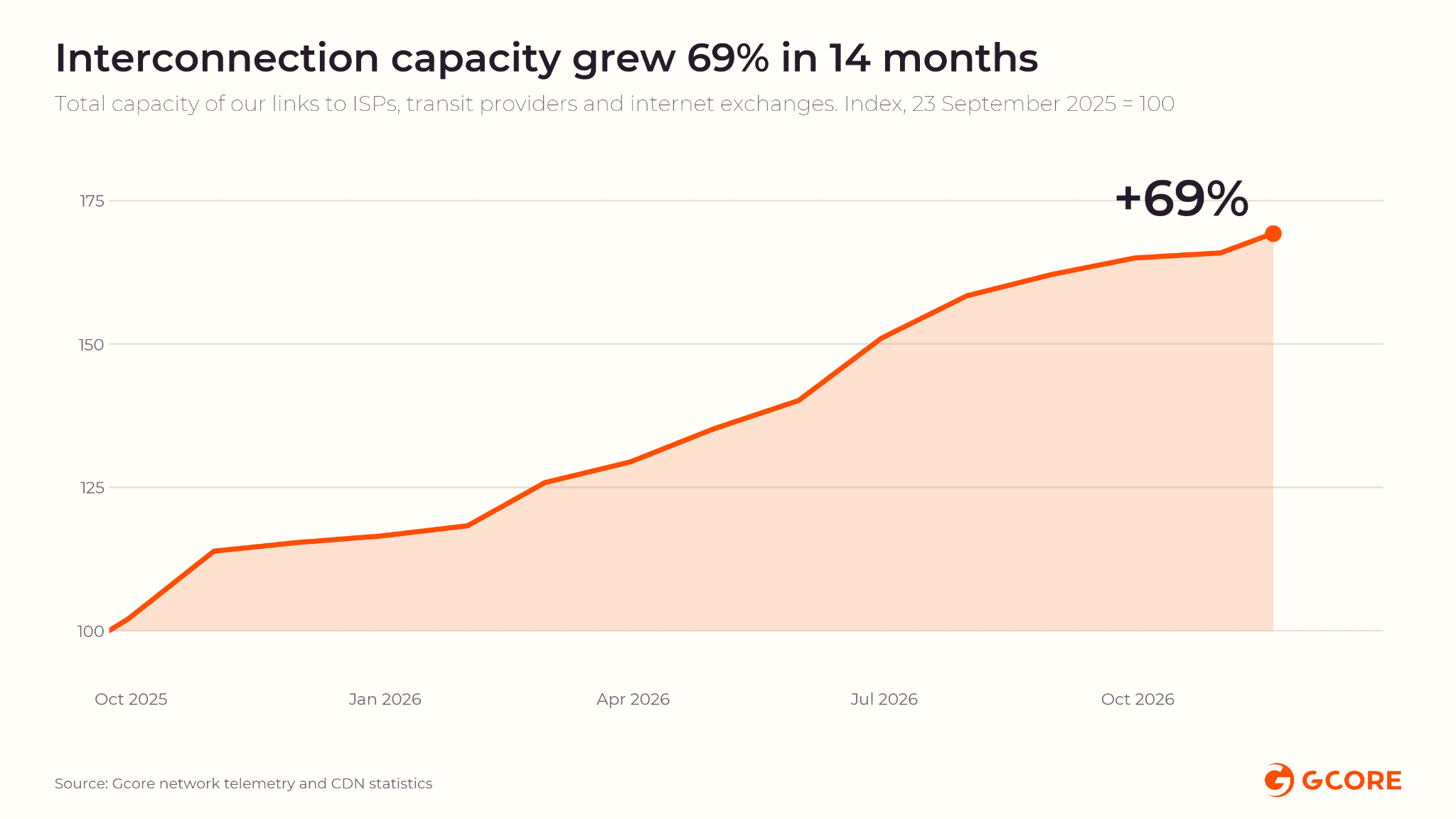
Gcore total external connectivity, indexed to September 23, 2025 = 100. This relative view does not disclose absolute capacity or how connectivity is distributed between network types.
Capacity only becomes useful after a great deal of coordination: forecasting demand, ordering connections, installing and validating equipment, configuring BGP sessions, testing reachability, and ensuring traffic can take the intended path. Each change needs to fit into a global network that continues carrying customer traffic while it grows.
That is why we think of launch preparation as ongoing network engineering, not a last-minute capacity scramble. The goal is to have options available before demand makes them necessary.
A cache nearby is only the beginning
CDNs reduce the need to fetch the same content repeatedly from a distant origin. By holding copies at distributed edge locations, they can serve subsequent requests closer to users and avoid unnecessary long-distance transfers.
But proximity alone isn't enough. A cache might be geographically close to a player while the path to that player's broadband provider is inefficient. Another location with better interconnection could deliver a more consistent experience.
Several layers influence the final result. The content platform can distribute requests among CDNs. Within its own network, a CDN can steer requests toward appropriate caches. Then Internet routing determines which networks carry the bytes between the cache and the subscriber. Those are different decisions, and all of them matter.
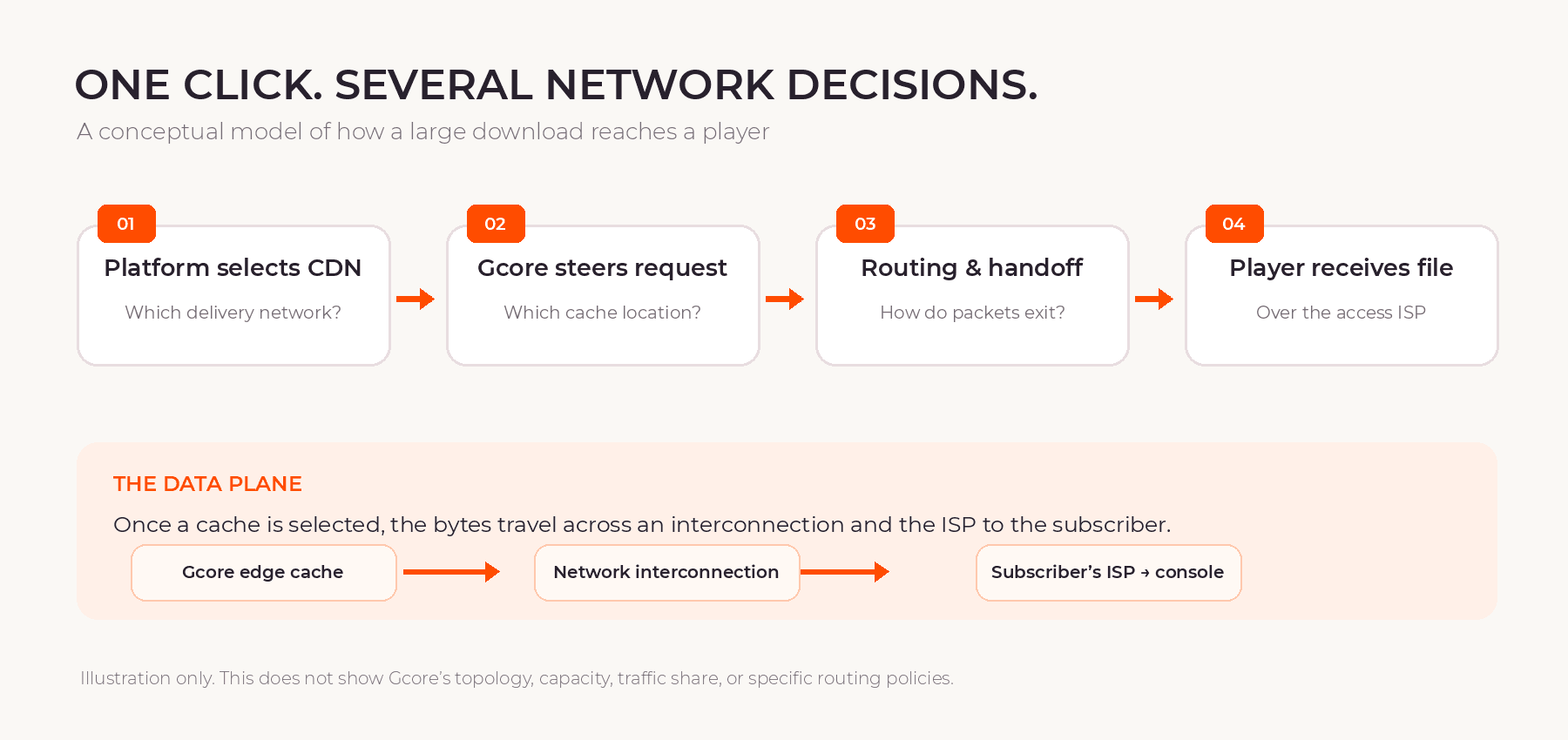
Conceptual delivery flow. The diagram explains the roles of CDN selection, cache steering, and network interconnection; it does not describe Gcore’s actual traffic mix or network topology.
This is what makes traffic engineering such a consequential part of content delivery. Adding capacity helps, but engineers also need to understand path quality, congestion, packet loss, and the throughput players actually experience. A high-capacity connection somewhere in the network cannot compensate for a bottleneck everywhere else.
Why working with broadband providers matters
The final stretch of a game download is outside the CDN: the data crosses into the player's Internet service provider and travels across its access network to the household. Delivering content at this scale therefore depends on cooperation between companies that operate different parts of the Internet.
Spectrum is an important example. Spectrum is the broadband brand operated by Charter Communications, one of the largest connectivity companies in the United States. After Charter's combination with Cox Communications, the company reported approximately 34.3 million Internet customers as of September 30, 2026 — making it the nation's largest Internet provider by customer count. For a major digital launch, that reach makes Spectrum a particularly consequential part of the delivery ecosystem.
Gcore and Spectrum are direct peering partners. Peering is the arrangement through which independently operated networks exchange traffic with one another. In our case, Gcore serves content from its CDN caches, while Spectrum operates the broadband network reaching its subscribers. At shared interconnection points, the two networks exchange routing information using BGP and can pass traffic directly between them rather than sending it through an intermediate transit provider for that segment of the journey.
That direct handoff matters because it gives both operators more control over available capacity and how the traffic enters Spectrum's network. It does not magically eliminate every possible bottleneck or guarantee the fastest path for every user: route selection, network conditions, and the customer's own access connection still matter.
Over the year preceding GTA VI, our network engineering teams worked closely together to expand Gcore's direct interconnection capacity with Spectrum by more than sevenfold. That growth reflects ongoing collaboration: planning capacity, provisioning connections, validating BGP routes, monitoring performance, and adjusting traffic policy as the network evolved.
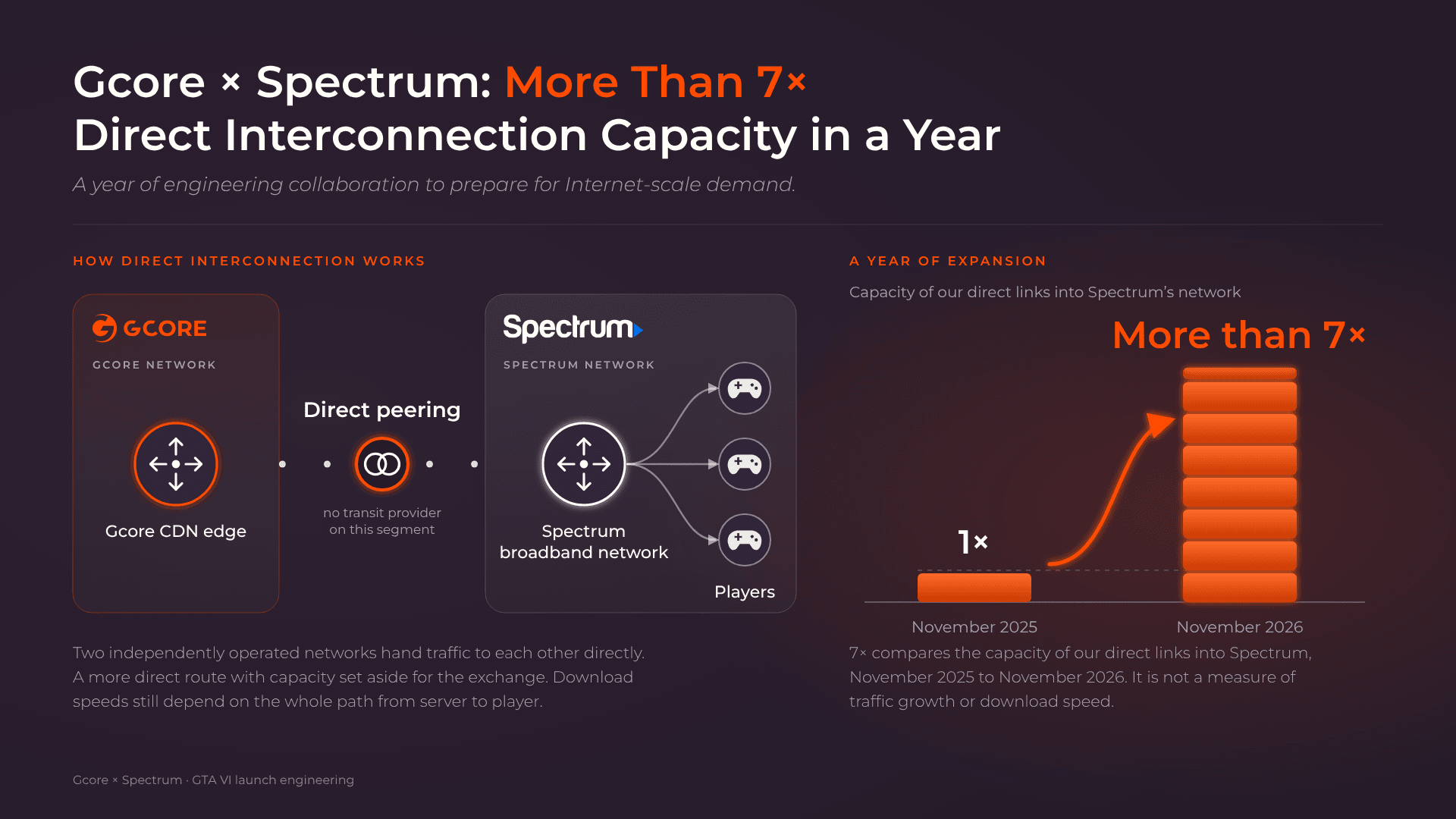
How direct peering connects Gcore's CDN to Spectrum's broadband network, alongside an indexed comparison showing more than sevenfold growth in direct interconnection capacity. Conceptual diagram; no actual topology or absolute capacity disclosed.
Spectrum was making its own preparations at the same time. Ahead of GTA VI, it offered eligible customers a temporary speed upgrade and subsequently reported extraordinary gaming demand during preloading and launch. These were different parts of a shared delivery challenge: getting content from the edge to the people who wanted to play.
“Collaboration is the MVP here! The content owners, the content distributors and ISPs all have high stakes in this to deliver and I think we did deliver on a massive scale.”
— Danny Young, Senior Manager, Network Engineering, Spectrum
Danny's observation captures something essential about how the Internet works. Content owners plan distribution, CDNs position and serve the data, and broadband providers deliver it to subscribers. Each organization sees a different part of the system, but the customer experiences the result as a single download.
Preparation meets real demand
When preloading began, planning became an operational exercise. For a CDN, healthy aggregate traffic doesn't automatically mean every subscriber has a healthy experience. Network teams must look at where demand is landing, how caches are behaving, whether interconnections retain headroom, and how transfers perform across different access networks.
The monitoring is continuous because the traffic isn't static. Download patterns shift as local evenings begin, new groups of players come online, and delivery platforms adjust how requests are distributed. The ability to observe problems and change course is every bit as important as the capacity deployed beforehand.
The GTA VI launch gave the wider Internet community a visible demonstration of that work. Network operators reported extraordinary traffic, yet the event was handled by a distributed system rather than any single provider acting alone. For us, it was also a reminder of why reliable engineering relationships across network boundaries matter.
The invisible infrastructure behind an ordinary click
For a player, the best possible outcome is unremarkable: the download finishes, the game starts, and the infrastructure disappears into the background.
For the teams building and operating that infrastructure, it's the result of months of capacity planning, caching strategy, traffic engineering, and cooperation with partners. We're proud of Gcore's contribution to GTA VI and grateful to the broadband operators, platform teams, and engineers who helped make delivery at this scale possible.
The next enormous release may be a game, a software update, a live event, or a new class of digital content. The details will change. The foundation is the same: prepare early, measure carefully, and build the relationships that allow an interconnected Internet to work as one.
Preparing for a major content launch? Learn how Gcore CDN helps deliver large downloads during traffic spikes.
Sources and further reading

Related articles




For many startups, infrastructure decisions are mostly about performance, pricing, and developer experience. For Melious AI, they are also about trust.Melious AI is a German startup building a European AI platform around privacy, transparen

Subscribe to our newsletter
Get the latest industry trends, exclusive insights, and Gcore updates delivered straight to your inbox.