



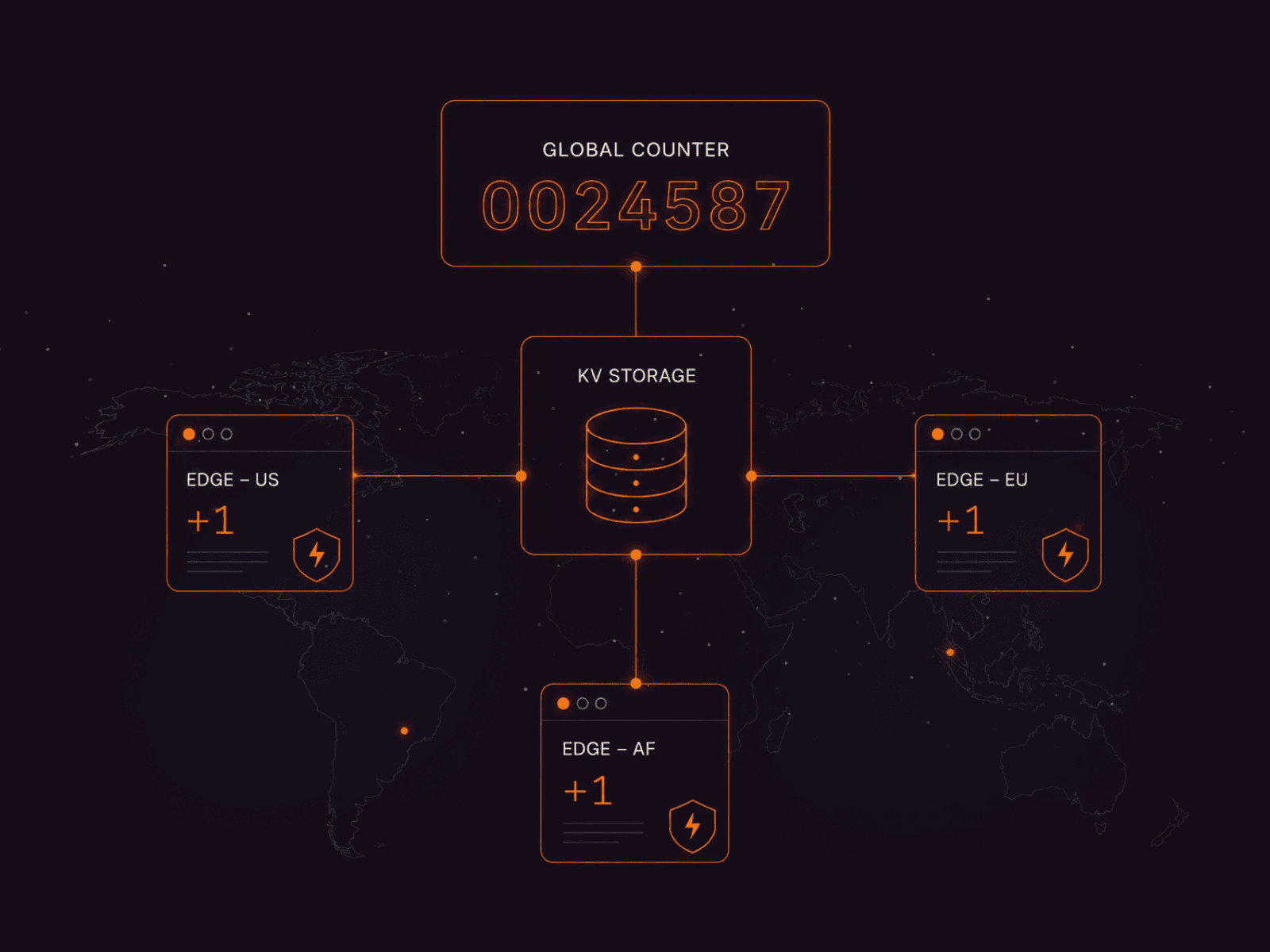
FastEdge provides distributed edge KV storage that lets you read and write data from any edge location worldwide. Unlike traditional centralized databases, edge KV stores data close to users — reads are served from the nearest PoP, making them extremely fast regardless of where the data was written.
This post covers Edge Counter with Global KV Storage — a foundational pattern for stateful edge applications.
How It Works
A globally distributed atomic counter using FastEdge's edge KV storage. Track page views, API calls, or metrics at global scale.
Edge KV storage is eventually consistent. Writes are propagated asynchronously across the global edge network. This means a write in London might take a few hundred milliseconds to be readable in Sydney — but local reads from the same PoP are immediate.
Implementation
Here is a complete example of reading and writing to edge KV storage in Rust:
Use Cases
- Feature flags — enable or disable features globally without redeploying your worker.
- Session state — persist data across requests without a central database.
- Rate limiting — aggregate request counters across the edge network.
- Configuration — store per-tenant settings that update without code changes.
- Cache — store computed results close to users for sub-millisecond retrieval.
Consistency Model
Edge KV is eventually consistent with read-your-writes semantics at the local PoP. If you write a value, subsequent reads from the same edge location will see the update immediately. Reads from other locations may briefly see the old value until the write propagates, typically within 100–500 milliseconds.
Related articles

Subscribe to our newsletter
Get the latest industry trends, exclusive insights, and Gcore updates delivered straight to your inbox.