



Take control of your traffic: Cybersecurity Month at Gcore
- October 1, 2026
- 4 min read
October is Cybersecurity Awareness Month. At Gcore, we’re marking it with a range of activities to help you understand security threats and protect your websites, applications, and infrastructure. The data is clear on why this topic is more important than ever. For example, our recent Gcore Radar report shows how quickly attacks can grow in scale and leave teams with little time to react. In the last quarter of 2025, Gcore Radar counted 1.3 million DDoS attacks, up from 512,000 a year earlier, while the largest attack reached 12 Tbps, compared with 2.2 Tbps the year before. Three in four network-layer attacks lasted less than a minute, often too quickly for a person to detect and mitigate manually.
That’s why throughout October, we’re combining product updates with opportunities to test our security products and learn practical ways to protect your services: €25 in WAAP credit, a DDoS webinar, a live security Q&A, a Bot or Not? quiz on Discord, weekly comics, and guides you can use on your own infrastructure. At the end of the month, we’re also heading to Nuremberg for the it-sa Expo&Congress, an IT security trade fair. Here are more details about what’s coming up.
A month of product updates, sessions, and a trip to Germany
We’ve spent the past few months preparing for October. There are product updates, a practical DDoS webinar, a live security Q&A, a bot-spotting game on Discord, weekly comics, and guides you can use on your own infrastructure. At the end of the month, we’re also heading to Nuremberg for it-sa. Here is where to start.
Our security products: Explore ways to protect your infrastructure
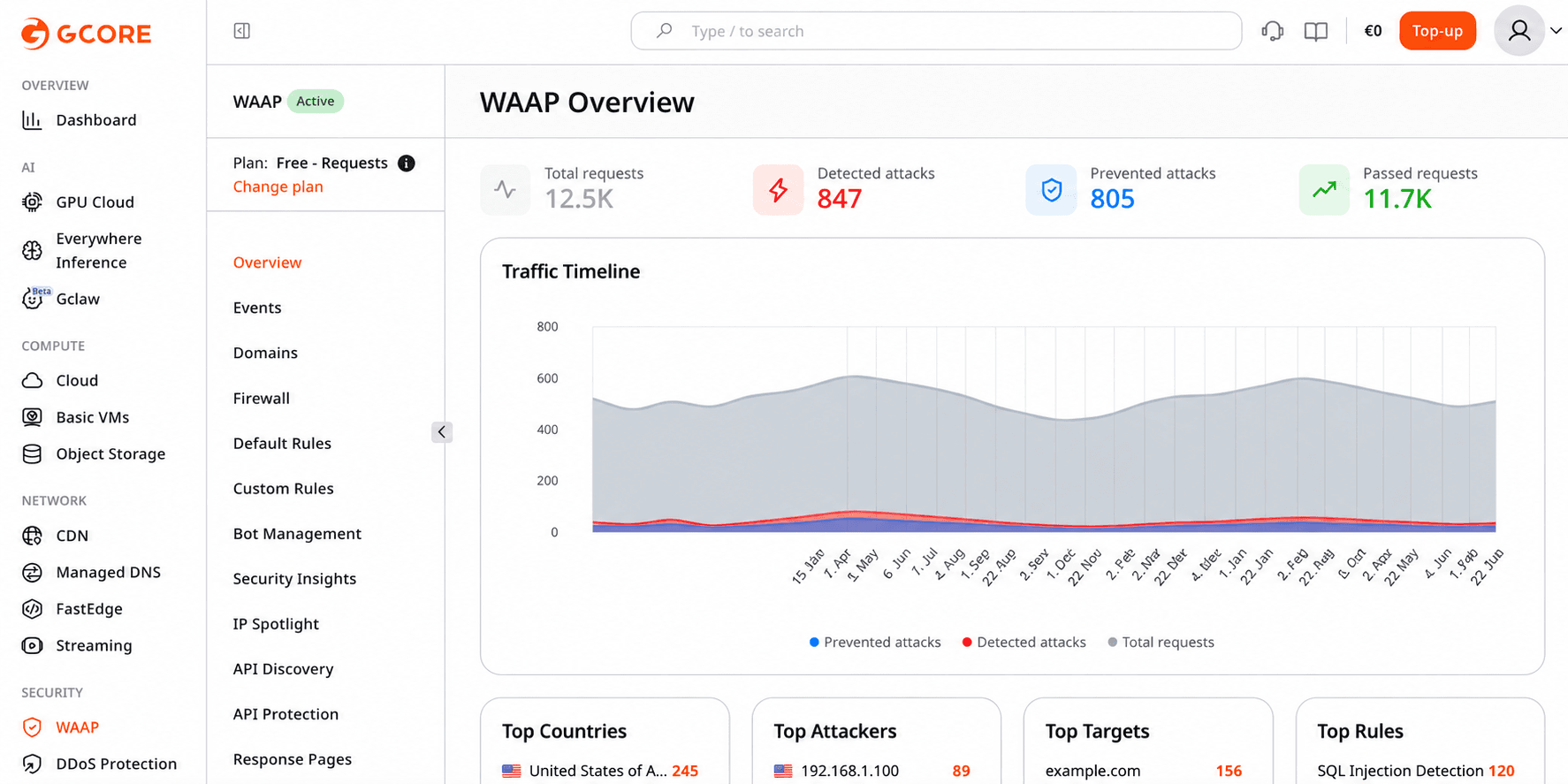
One practical place to start is with the requests reaching your websites and APIs. Gcore WAAP (Web Application and API Protection) protects websites, web applications, and APIs from malicious requests at the edge, including common web attacks, abusive bots, and application-layer DDoS traffic. During October, you can claim €25 in Gcore credit for WAAP. WAAP Start costs €25 a month and covers up to five domains, so the credit lets you protect real sites for a month, monitor the requests, bots, and attacks reaching them, and decide what to allow, challenge, or block.
Claim your €25 credit and activate WAAP Start by October 31. Your free month then runs for a full month from the activation date.
While WAAP focuses on threats targeting web applications and APIs, TrafficGate and Edge Proxy address different needs: TrafficGate helps control which sources and how much traffic reach your infrastructure, while Edge Proxy filters DDoS attack traffic before it reaches TCP or UDP services.
TrafficGate is designed for traffic that may not be an attack but can still consume resources: AI crawlers collecting content, scrapers, or legitimate clients repeatedly calling resource-intensive API endpoints. It helps teams monitor which sources are using capacity and decide what gets served, limited, or stopped at the edge. We’re opening TrafficGate to early adopters, who will also help shape the product as it develops.
Edge Proxy brings DDoS protection to services that do not sit on a network you own, such as a rented game server or an application running in the cloud. You provide an origin IP, port, and protocol, and Gcore returns a protected address that filters attack traffic before it reaches your service, with no ASN, BGP, or GRE tunnel required. During Cybersecurity Month, we’ll take a closer look at how to use the latest version to protect cloud-hosted and rented services without having to run your own network.
Live sessions and quizzes: Learn how to keep your service online
On October 20 from 17:00 to 18:00 CEST, we’re hosting Gcore Security, Live: Ask the Product Managers in the Gcore Discord community. Gcore product managers and their representatives will answer questions about security, the products we’re building, and the challenges teams are dealing with in practice. Join the Gcore Discord to take part.
On October 15 at 17:00 CEST, we’ll host A Practical Guide to DDoS Protection, a webinar about protecting cloud and hosted servers, choosing the right protection, and avoiding common setup mistakes that can leave services exposed.
The Gcore Discord is also where our daily Bot or Not? quiz runs through the first half of the month. Each day, we’ll share an anonymized traffic scenario and ask you to work out what’s behind it: a person, a useful crawler, or a threat.. The answer and practical lesson follow the next day, and the series ends with a live competition.
Checklists, articles, and customer stories: helpful and practical guides
We’ll also be publishing more practical material on the Gcore blog throughout October: a developer security checklist covering DNS, exposed origins, rate limits, APIs, bot policies, and incident visibility; a customer security story; and a technical breakdown of a major DDoS attack stopped by Gcore.
That DDoS article will look at how the attack unfolded, what traffic was involved, the mitigation decisions, and what the protected service saw.
Every Friday, Security, Simplified will explain one related idea in comic form, from what a DDoS attack actually does to how edge filtering keeps real users connected while an attack is underway.
Live events: Meet Gcore in person at it-sa in Nuremberg
From October 27 to 29, we’ll be at it-sa Expo&Congress in Nuremberg, Europe’s largest trade fair for IT security. If you’re there, come and talk to us about DDoS protection, bots, application security, traffic control, or whatever is keeping your team busy, and pick up a sticker while you’re there.
Meet Gcore at it-sa
Put preparation into practice this Cybersecurity Month
“Attacks are becoming faster, more automated, and increasingly AI-driven—allowing adversaries to adapt techniques, identify weaknesses, and scale attacks at a speed traditional defenses were never designed for. Security teams need real-time visibility across applications, APIs, and infrastructure, combined with intelligent controls that can detect, understand, and mitigate threats before they turn into incidents.”
- Andre Reitenbach, Chief Executive Officer, Gcore
Three in four network-layer attacks in our data lasted less than a minute. At that speed, the critical decisions need to be made well before an attack is underway: what to allow, what to block, and which protections are already in place. Cybersecurity Month is a good time to test those decisions before an attacker does.
Want to discuss protecting your applications and infrastructure? Get in touch with Gcore.

Related articles
“There’s smoke coming under the door. I’m on the third floor. No, the fourth. There are kids in the building.” Imagine that call reaching a fire and rescue control room, with the caller struggling to get their account straight. The ope


A rented game server or cloud application may give you little more than an IP address and a port. Traditional routed DDoS protection usually assumes much more: an ASN, your own /24 of IPv4 addresses, a signed Letter of Authorization, and a

Gcore's CDN, cloud, and AI services increasingly need to move traffic between regions, sometimes across continents. For customers, those journeys should be largely invisible: applications need predictable connectivity whether traffic is mov

Subscribe to our newsletter
Get the latest industry trends, exclusive insights, and Gcore updates delivered straight to your inbox.