



Gcore Connect: discussing the future of AI in Europe
- July 24, 2026
- 2 min read

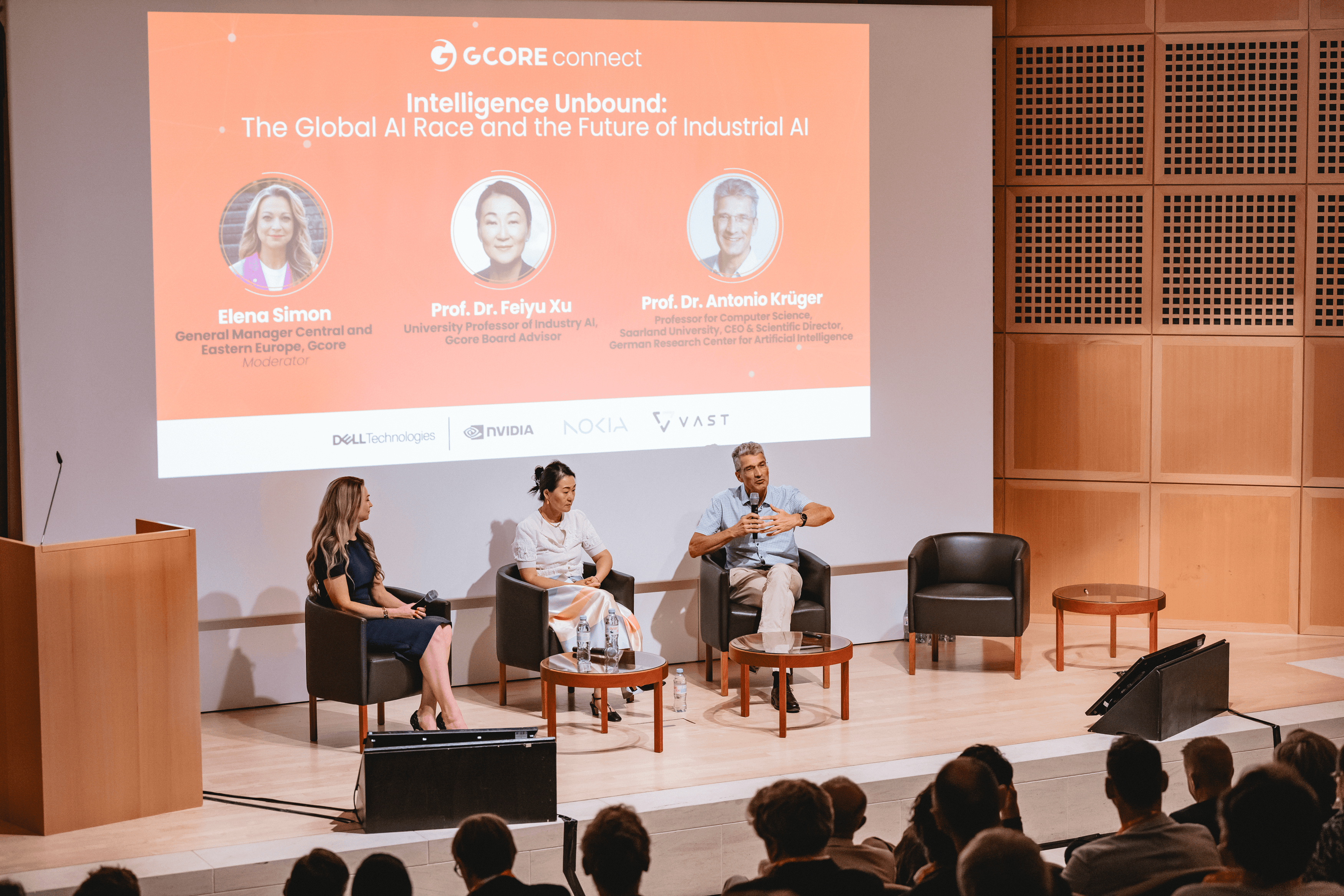
The first-ever Gcore Connect forum took place on 6 and 7 July 2026 in Luxembourg. Held in collaboration with Nokia, Dell, and VAST, it brought together policymakers, academics, and business leaders. The invite-only event, hosted at the Mudam Museum of Modern Art, focused on where Europe stands in the AI race and where it could go next. Speakers included former German vice-chancellor Philipp Rösler, Luxembourg's justice minister Elisabeth Margue, AI professor Feiyu Xu, as well as senior industry leaders. The conversations ranged widely, but a few themes stood out.

Europe is still in the game
Several speakers pushed back on the narrative that Europe has already lost the AI race. The consensus: Europe won't out-build the US or China on raw scale, and trying to copy their playbook isn't the answer. Instead, speakers pointed to Europe's strengths — strong academic institutions, established enterprises, and a genuine (if under-funded) innovation base — as the foundation for a different kind of AI strategy, one built around collaboration and open source rather than head-to-head competition.
There was also a reminder that being first isn't always winning. Being a fast follower, done well, can be just as strong a position — especially in a market still working out what "winning" even looks like.
Energy costs are the real bottleneck
If there was one practical, urgent point raised again and again, it was this: Europe's energy costs are roughly double those in the US and China, and that gap will price European AI out of the game before it even gets going. Fixing energy costs isn't a side issue — several speakers framed it as the precondition for everything else Europe wants to do in AI.
Sovereignty is more complicated than it sounds
The idea of "sovereign AI" came up often, and speakers were candid about how tangled that concept really is. Even Europe's most advanced tech companies depend on components, tools, and supply chains that sit outside Europe. The more useful framing, several argued, isn't about total independence, but about creating enough valuable European IP to trade on equal footing with the US and China — value creation over value protection.

Continuing the conversation
Feedback from attendees was overwhelmingly positive. Many described the event as a rare opportunity to have honest, cross-industry conversations about AI in Europe, free from the usual conference small talk. The mix of perspectives, from policy to aerospace to telecoms, gave the discussions a depth that's often missing from single-sector events, and there was a clear appetite for more of this kind of exchange.
All in all, the first Gcore Connect delivered exactly what it set out to: a candid, high-level conversation about Europe's AI future, hosted in a country well placed to help shape it. We're already looking forward to the next one.

Related articles

A rented game server or cloud application may give you little more than an IP address and a port. Traditional routed DDoS protection usually assumes much more: an ASN, your own /24 of IPv4 addresses, a signed Letter of Authorization, and a


Gcore's CDN, cloud, and AI services increasingly need to move traffic between regions, sometimes across continents. For customers, those journeys should be largely invisible: applications need predictable connectivity whether traffic is mov


Subscribe to our newsletter
Get the latest industry trends, exclusive insights, and Gcore updates delivered straight to your inbox.