



How Gcore Everywhere AI is enabling distributed AI to fire and rescue call handling - In an emergency call, a late answer is a missing answer
- October 22, 2026
- 4 min read
“There’s smoke coming under the door. I’m on the third floor. No, the fourth. There are kids in the building.”
Imagine that call reaching a fire and rescue control room, with the caller struggling to get their account straight. The operator needs to establish the address, follow the department’s protocol, and keep track of details that change as the caller speaks. Then another call comes in about the same building.
A human-supervised AI assistant could transcribe those exchanges, structure them into a clearer record and suggest the next question for the operator to review. But it has to keep pace. A useful answer that arrives after the operator has moved on has already lost much of its value.
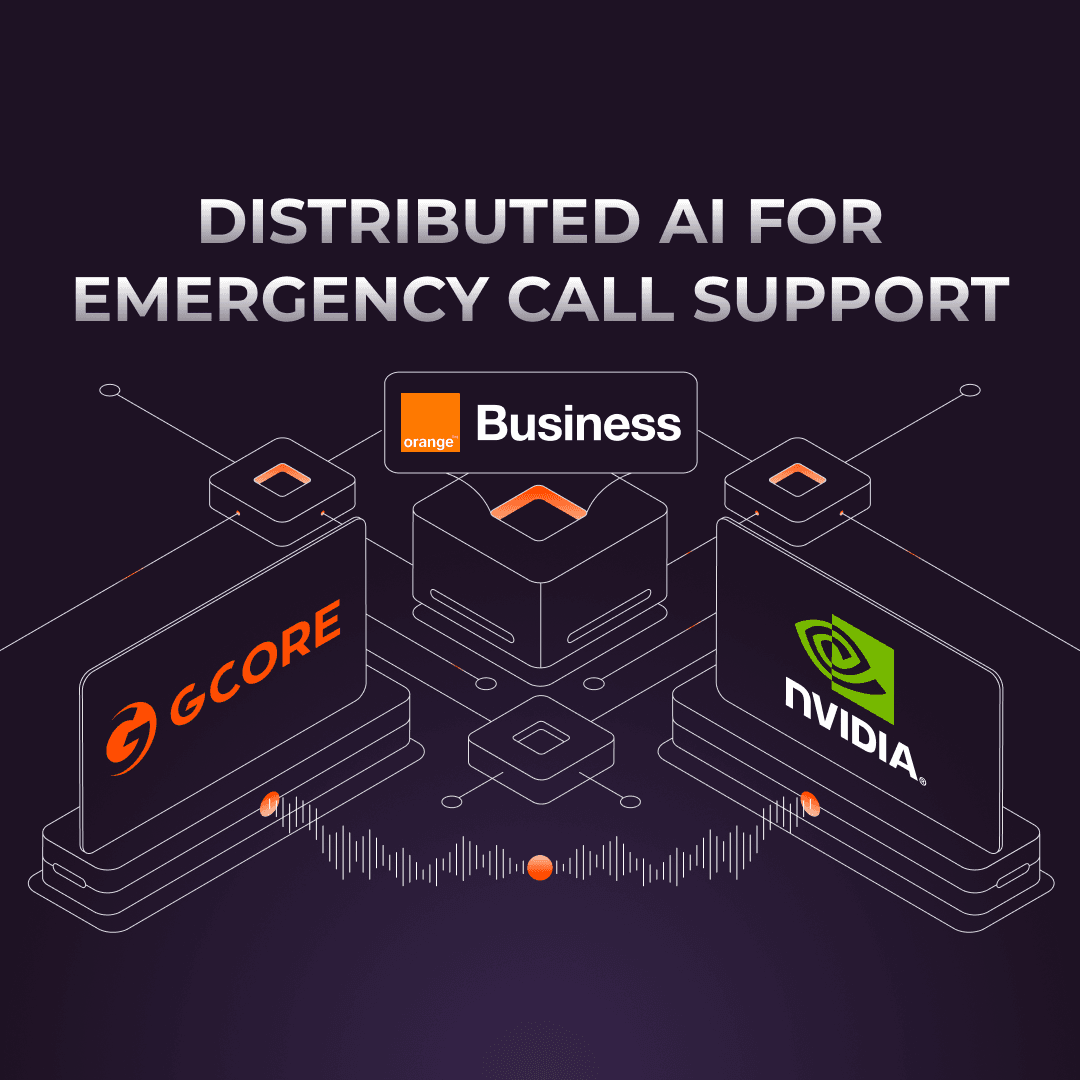
That pressure is the starting point for Gcore’s work with Orange Business and Nvidia. Together they are exploring a human-supervised emergency call assistant in proof of concept. To build the solution, Gcore uses it’s Everywhere AI, Orange Business brings Cloud Avenue which is its cloud infrastructure and Live Intelligence, its trusted AI platform and NVIDIA enables this further via Dynamo, an open-source framework for distributed AI inference. For Gcore, the challenge reaches beyond a single exchange: It has to stay fast as calls build up, send overflow to spare capacity at another site, reuse earlier context within the call, recover when a site fails and keep every site on the same approved configuration.
“AI infrastructure earns trust through its ability to deliver real-world solutions under pressure. Building on our technology partnership with NVIDIA, Orange Business prototyped a public emergency scenario with Gcore’s Everywhere AI orchestration showcasing how response time really matters. With our inference routing capabilities, AI services can adapt as demand changes, use GPU capacity efficiently and ensure service resilience across locations. Emergency call handling gives this demonstration a clear purpose for technology and paves the way to more sovereign distributed AI use cases”, says Nicolas Bugault, Lead Product Manager of AI Infrastructures at Orange Business.
When a pause feels too long
To support the operator in real time, the system must transcribe speech, interpret the request, and check the suggested questions against the departments' protocol. If the caller and operator speak different languages, translation adds another step. Each step takes time, and so does move between services. The proof-of-concept targets milliseconds from the end of the caller’s sentence to a suggestion on the operator’s screen. Gcore’s Everywhere AI, the platform for distributed inference across Points of Presence decides how to best split the various speech and language services for a call, to ensure fastest response.
Each participating Orange Point of Presence (PoP) would host a complete copy of the stack. Because Everywhere AI manages all sites from a single control panel, the department does not have to configure each one separately. For a fire department, the goal is straightforward: give the operator assistance while it is still relevant to the conversation.
When one incident becomes many calls
Return to the building. As more callers report smoke, the nearest site running the AI models may become busy. Another site may have capacity, but that capacity only helps if requests can reach it at the right time.
Everywhere AI’s Global Router sits above all the sites and decides where each request goes among the data centres the department has approved. It weighs each site’s readiness, load, current latency, and whether a site already holds a reusable model context. With the benefit of NVIDIA Dynamo integration, Everywhere AI selects which GPU worker handles the request.
This matters because distance is only part of response time. A nearby server with a long queue may answer later than a slightly more distant server that is idle. The department can use spare capacity at any approved Point of Presence as demand shifts. Let each exchange build on the last. As the call continues, each new question builds on what has already been said, Leveraging key-value (KV) cache lets the model reuse calculations for matching portions at the start of each prompt, reducing repeated processing
Everywhere AI cache-aware routing would direct a request to a site where that work is already available, weighing the saving against network delay and current load. Inside one site, Dynamo already routes by cache; Everywhere AI extends the idea across sites. Less repeated prompt processing can shorten the wait before an answer begins, reduce GPU work per turn, and lower the compute cost of serving the conversation. Saving depends on how much context can be reused; cache availability alone does not make a distant or overloaded site the best choice. Everywhere AI can direct the inference request taking into account what context the various data centre locations have.
Keeping help within reach when a site fails
What happens if a site becomes unavailable halfway through a call? A second Point of Presence gives the AI somewhere else to run, but the call context has to get there too. Everywhere AI design pairs cross-site routing with a proposed recovery process built around a saved call record: the transcript, confirmed facts, pending question and last completed turn. The application would reconnect to an eligible site and reconstruct the context, with the operator able to see the interruption and decide how to proceed.
The department can then plan resilience around various requirements: how much load the surviving site can carry, and how quickly assistance needs to return. That lets the team test failover in drills against agreed targets. The emergency call never depends on the assistant: if the AI is unavailable, the operator carries on as they would without it. One approved service across every Point of Presence
Distributed infrastructure also creates a management question. When the department changes an approved prompt, updates a model or revises a policy, how does it keep the sites aligned?
Gcore Everywhere AI would manage model and application configuration across all Point of Presences. That would help the department deploy approved versions consistently and trace which configuration supported a particular interaction. Routing would operate within the Points of Presence permitted by department. For the control room, consistency matters as much as capacity. Every site runs the same approved set up, so operators work with the same environment whichever site answers.
The operator stays in control
The purpose of this work is to give call operators useful support: a clearer record and timely suggestions, backed by infrastructure that adapts as demand changes. The operator remains in control of every call: the assistant suggests, and the operator decides. Gcore’s Everywhere AI contribution is the proposed cross-site routing, cache-aware placement, failover and configuration management across the participating sites. Together with Orange Cloud Avenue and NVIDIA Dynamo integration, this gives fire and rescue services a practical basis for evaluating AI assistance against their own protocols and operating conditions. Talk to Gcore about designing distributed inference for your critical workflows.

Related articles

A rented game server or cloud application may give you little more than an IP address and a port. Traditional routed DDoS protection usually assumes much more: an ASN, your own /24 of IPv4 addresses, a signed Letter of Authorization, and a

Gcore's CDN, cloud, and AI services increasingly need to move traffic between regions, sometimes across continents. For customers, those journeys should be largely invisible: applications need predictable connectivity whether traffic is mov

Subscribe to our newsletter
Get the latest industry trends, exclusive insights, and Gcore updates delivered straight to your inbox.