



Java4Shell: what to patch now, and where a WAF can help
- November 19, 2026
- 4 min read
About three hours after Java4Shell was publicly disclosed on November 17, Gcore observed the first scan carrying the vulnerability's characteristic pattern in our infrastructure. For teams responsible for Java applications, that is a short window to identify affected systems and begin patching.
Java powers many of the systems behind websites, including banking, airline and telecom infrastructure, single sign-on, CI/CD, and enterprise software. Java4Shell (CVE-2026-114938) is a memory-corruption vulnerability in the Java runtime's hardware-accelerated Base64 decoder. Under specific conditions, it can allow attackers to crash applications, expose process memory or execute code remotely. The risk is serious, although not every Java application or server is vulnerable.
Gcore WAAP is already blocking the published exploit and known scanners at the HTTP perimeter. That helps while organizations update affected Java runtimes, which remains the essential fix.
What happened inside Java
Java's usual memory-safety guarantees protect application code from many classic buffer errors. The runtime itself also uses low-level, hardware-specific optimizations for speed. Java4Shell is in one of these paths: the accelerated Base64 decoder used on certain x86-64 processors.
Base64 carries binary data as text, including credentials in Authorization headers, tokens, single sign-on messages and file uploads. On CPUs using AVX-512 VBMI, the accelerated decoder processes data in 64-byte chunks. The researchers' concrete trigger is 64 “A” characters followed by a single “=”. That is malformed Base64: sixteen complete groups followed by stray padding. The decoder calculates a negative output length for the tail and writes 64 bytes, with 62 landing beyond the allocated buffer. Java rejects the input afterward, when neighboring memory may already have been corrupted.
The researchers demonstrated how this corruption can lead to memory disclosure and, with application-specific exploitation, remote code execution. They reported unauthenticated exploitation paths in certain single sign-on, CI, artifact repository, issue tracking, and wiki deployments. Other scenarios require authentication. There is also a client-side risk when a Java application processes data received from a malicious server.
The researchers assess the vulnerability at 9.2 under CVSS 4.0. Oracle's November 2026 advisory explicitly lists CVE-2026-114938 with a CVSS 3.1 score of 8.1 and high attack complexity. The scores use different CVSS versions.
Which systems are affected
Three conditions must come together: an unpatched Java build, a processor running the affected accelerated decoder, and attacker-controlled Base64 data reaching it. Java 17 builds from 17.0.6 through 17.0.21 and unpatched Java 21, 25, and 27 builds are affected. Oracle Java SE 8 Enterprise Performance Pack 8u511-perf is also affected; standard Java 8 and 11 builds are generally not.
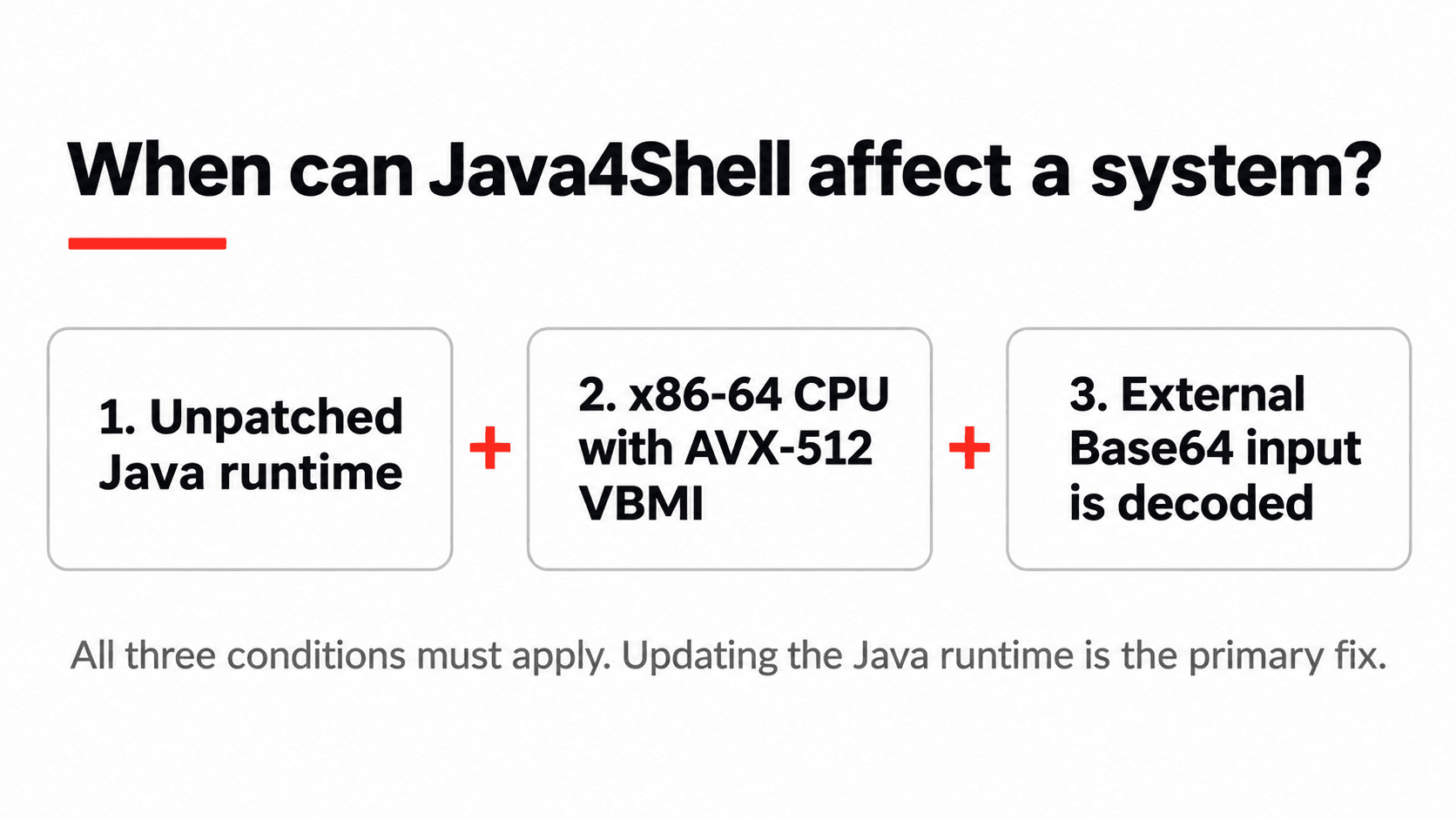
The processor must be x86-64 with AVX-512 VBMI support, including suitable Intel Xeon Ice Lake or newer and AMD Zen 4 or newer systems. ARM deployments do not use this affected instruction path. A container may therefore be exposed on one host but not on another, even when the Java image is identical.
Do not rely on the server's Java package list alone. Applications, containers, appliances, and third-party products may bundle their own runtimes. And a processor change can alter exposure without changing the application.
Why the response window is shrinking
Java4Shell follows PHP2Shell in PHP and Node2Shell in Node.js. It is the third critical vulnerability in a core web technology in less than a month. According to the researchers, they used AI to find the flaw in about an hour and built a working exploit two hours later, at a reported total cost of under $200.
There is no universal exploit. Each affected application needs its own chain, and the attack is sensitive to network conditions. A failed attempt usually crashes the process. Denial of service is easier to achieve than remote code execution. Still, the falling cost of finding and exploiting vulnerabilities leaves defenders less time to respond.
What Gcore saw after disclosure
The scans Gcore observed contained the characteristic malformed Base64 pattern associated with Java4Shell. They reached our infrastructure while teams were still assessing which systems needed patching, showing how little time there can be between disclosure and real-world probing.
Where a WAF helps, and where it stops
The malicious request can look much like an ordinary token. It has no script fragments, SQL or commands, and the telltale difference in the published example is one stray “=” at the end of a Base64 string. Blocking every unusual padding character would also interfere with legitimate authentication and uploads.
Gcore WAAP blocks the published exploit and known scanners at the perimeter. Those rules are live in production. They give security teams visibility into attempts and a way to block recognized HTTP-based attacks while updating exposed Java runtimes.
A WAF cannot inspect every place an application decodes Base64. Internal services such as message brokers and search clusters often sit outside the external HTTP perimeter. A Java client connecting to an attacker-controlled server may also be exposed without any inbound HTTP request passing through a WAF.
A WAF reduces the chance of a successful attack, but it doesn't remove the vulnerability. Only updating Java does that.
What security teams should do now
- Inventory the Java runtimes actually running in production. Include runtimes bundled into applications, containers, appliances, CI systems, and third-party software. Check the executable each process uses, not just the system-wide version.
- Identify affected hardware. On Linux, try grep -m1 -o 'avx512vbmi' /proc/cpuinfo as an initial check. The vulnerable path requires all four flags: avx512f, avx512bw, avx512vbmi, and bmi2. To inspect the active JVM setting, run java -XX:+UnlockDiagnosticVMOptions -XX:+PrintFlagsFinal -version | grep -i UseBASE64Intrinsics. Use these checks to prioritize systems, and verify the runtime each application actually starts.
- Start with Internet-facing systems that grant access: single sign-on, CI/CD platforms, artifact repositories, issue trackers and enterprise wikis. A compromise there can spread to every system that trusts them. Also review internal services and Java clients that process externally controlled data.
- Patch the runtime and redeploy the application. Oracle's corrected builds include 17.0.21.1, 21.0.13.1, 25.0.5.1, and 27.0.1.1, plus 8u513-perf for the Java 8 Enterprise Performance Pack. Check your Java vendor's specific advisory and fixed package; rebuild container images and restart processes to ensure the updated runtime is in use.
- If patching is delayed, assess the temporary JVM option -XX:+UnlockDiagnosticVMOptions -XX:-UseBASE64Intrinsics, which disables the accelerated decoder. Another option, -XX:UseAVX=2, is for x86-64 hosts only: ARM JVMs do not recognize it and may fail to start. These changes require a restart and can slow applications that decode large volumes of Base64, so test them first. Be careful with workarounds circulating online: some prevent the JVM from starting or address a different, older bug. Follow your Java vendor's advisory and plan to patch.
- Review monitoring for unusual Base64 decoding errors, unexpected JVM crashes, and suspicious requests. Their absence does not demonstrate safety, so monitoring should support, rather than delay, remediation.
Defense in layers while you patch
Defense comes in layers: see the attack early, block at the perimeter what can be blocked safely, and update exposed infrastructure. A WAF buys time. A patch closes the hole.
Sources: Calif's Java4Shell research; Oracle's November 2026 security advisory; CERT-EU advisory; Gcore WAAP product page.

Related articles

ARTEX's Internet-visible footprint grew from three matching services in June 2026 to 1,255 on November 3. ARTEX is an AI-powered security testing framework whose agents can coordinate a series of technical tasks with less human intervention
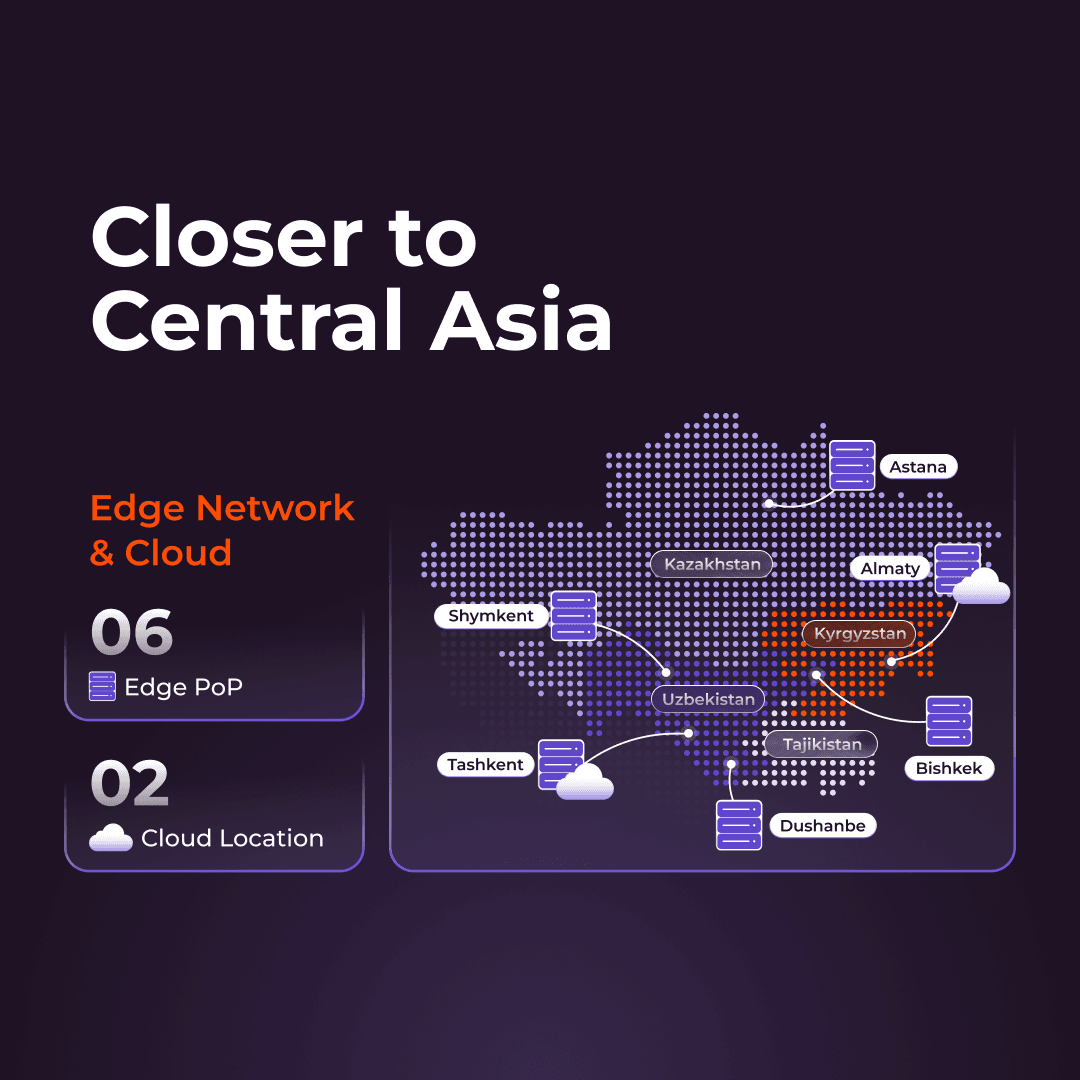
Gcore took part this autumn in the Luxembourg Chamber of Commerce Trade Mission to Kazakhstan and Uzbekistan, its second since the first mission three years ago. Dainis Lukasevics, Senior Business Development Director, visits Kazakhstan two


“There’s smoke coming under the door. I’m on the third floor. No, the fourth. There are kids in the building.” Imagine that call reaching a fire and rescue control room, with the caller struggling to get their account straight. The ope


Subscribe to our newsletter
Get the latest industry trends, exclusive insights, and Gcore updates delivered straight to your inbox.