



Europe’s AI can suddenly compete. But who will run it?
- October 12, 2026
- 4 min read
Anyone following developments in artificial intelligence tends to look towards California – to OpenAI, Google, and Anthropic. But it is increasingly worth looking towards Paris, Heidelberg, London and Freiburg.
Over the past few months, a remarkable group of AI companies has emerged in Europe. Mistral is developing large language models in France, while Heidelberg-based Aleph Alpha is building models for businesses and public authorities. ElevenLabs, founded by two Polish programmers and headquartered in London, is working on synthetic voice technology and Freiburg-based Black Forest Labs is among the best-known developers of generative image models.
All four companies are demonstrating just how quickly the industry is moving. Mistral is working on “Le Chonk”, a new large open-weight model. It is expected to have around one trillion parameters, although its mixture-of-experts architecture means that only a fraction of them are active at any given time. According to the company, the model was trained on 4,000 Nvidia Grace Blackwell GPUs in European data centres.
Meanwhile, Aleph Alpha has released Kolibri-1. The model has 78 billion parameters, of which only around 3.5 billion are activated per token. It supports German and English, can call tools and process very large amounts of context. Most importantly, however, is that its weights are openly available. Companies can download the model and run it on their own infrastructure.
ElevenLabs is tackling a problem that sounds less abstract but is immediately noticeable in everyday use: the brief pause between asking a question and receiving a response from a voice assistant. Its new v4 Turbo model aims to reduce this delay even further. In voice AI, a few hundred milliseconds can make a huge difference between a conversation that feels natural and one that still feels like talking to a machine.
In Freiburg, Black Forest Labs is working to develop its successful FLUX image models into systems that understand more about the world than individual images. The models are intended to process different forms of media and, in the longer term, become relevant for applications in which AI not only generates content but also interprets and responds to its environment.
However, such announcements should not be overinterpreted. AI benchmarks are snapshots in time, and hardly a week goes by without a new model surpassing a previous record somewhere. Nevertheless, the individual announcements point to a bigger picture.
Europe is now developing serious AI technology across several fields simultaneously. But that alone does not solve Europe’s AI problem. Rather, it shifts it.
After the model comes the infrastructure
As long as the AI debate was primarily about who could train the largest language model, the situation seemed relatively straightforward. Those with enough GPUs, data and capital had an advantage.
But now AI is moving out of research labs and into everyday business operations. Models answer customer enquiries, write software, analyse documents and power voice assistants. In these environments, there are other elements that matter more than a position on a benchmark leaderboard. For example:
How quickly does a response arrive? How much does a request cost? Where is the data processed? What happens when a hundred times as many users than normal suddenly access a service? And which model is actually needed for which task?
That last question, in particular, is becoming increasingly important.
It would make little economic sense to run every translation, summary or classification task through the largest available model. A smaller model is sufficient for some tasks. Others require complex reasoning. Still others must run on specific infrastructure or in a particular region for data protection reasons.
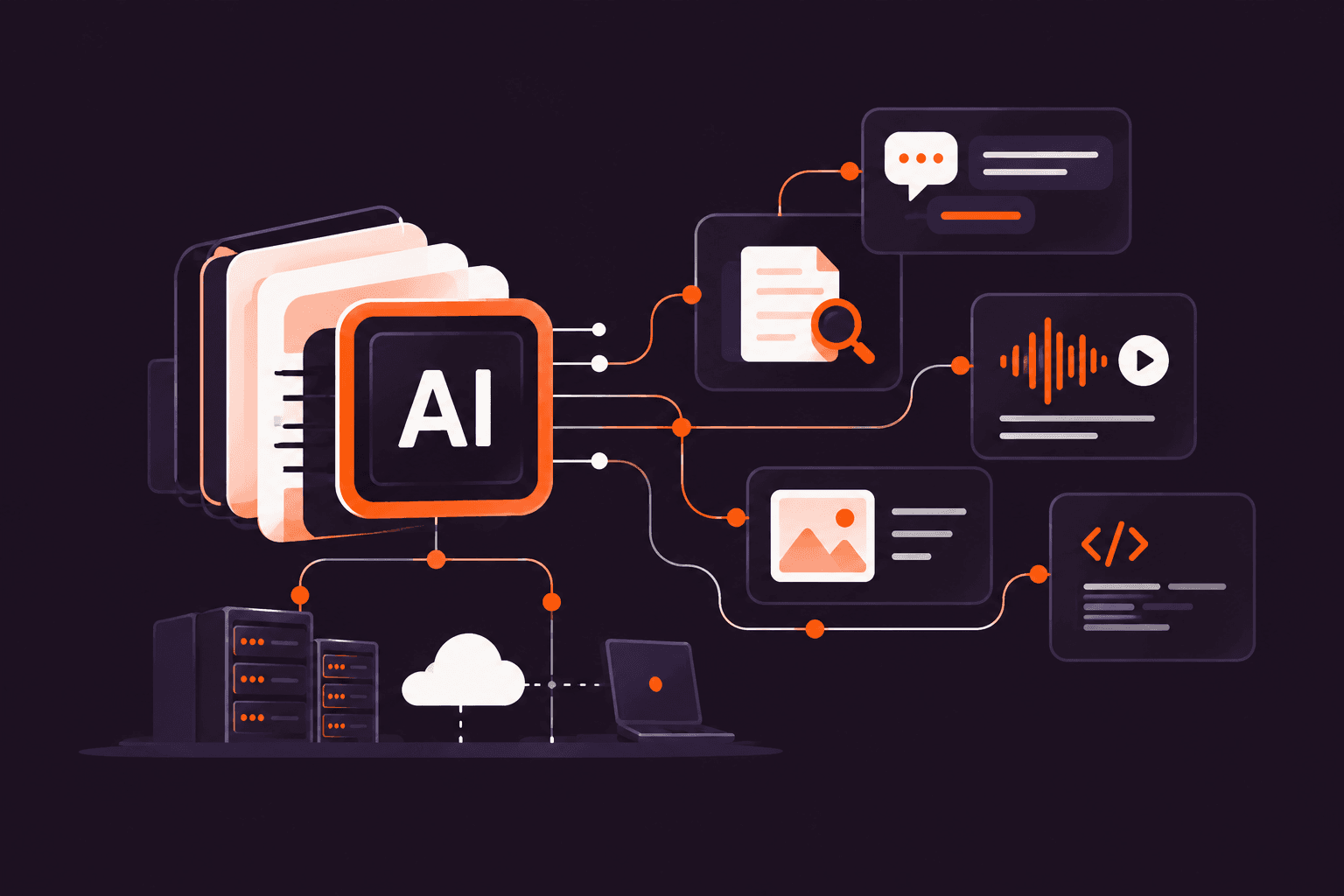
The result is an AI landscape that is becoming considerably more complex than the previous idea of a single large model in the cloud.
Companies will use multiple models simultaneously. Some open, others closed. Some in centralised data centres, others closer to users. The key will be to route requests to wherever the right balance of quality, speed and cost can be achieved.
What started as a model problem is therefore increasingly becoming an infrastructure problem.
Open does not automatically mean independent
The infrastructure problem is particularly evident with open-weight models such as Kolibri or those developed by Mistral. They give companies back something that was at risk of being lost in recent years: freedom of choice.
Anyone using a closed AI model exclusively through a provider’s API is largely dependent on that provider’s technical infrastructure. With open models, by contrast, companies can decide for themselves where the models run, which hardware is used and in which region data is processed.
This is particularly relevant for Europe, where the debate about technological sovereignty often stops at the origin of a model.
However, a European AI model does not automatically mean European AI infrastructure.
A model needs to be trained. It requires GPUs. It must run in data centres and be delivered to users through high-performance networks. And if it is to become a product serving millions of users, all of this needs to work simultaneously and with as little disruption as possible.
Europe can therefore develop its own powerful models while still remaining dependent on others in different areas.
Perhaps the more interesting question in the coming years will no longer be whether Europe can produce its own OpenAI. That question may be too narrow in the first place.
Mistral, Aleph Alpha, ElevenLabs and Black Forest Labs demonstrate that an independent European AI ecosystem is taking shape, with different companies, models and areas of specialisation.
The question now is whether the infrastructure needed to support the growth of this ecosystem will emerge as well.
Building European AI goes beyond developing models. Explore how Gcore supports European digital sovereignty through its infrastructure solutions.

Related articles

A rented game server or cloud application may give you little more than an IP address and a port. Traditional routed DDoS protection usually assumes much more: an ASN, your own /24 of IPv4 addresses, a signed Letter of Authorization, and a


Gcore's CDN, cloud, and AI services increasingly need to move traffic between regions, sometimes across continents. For customers, those journeys should be largely invisible: applications need predictable connectivity whether traffic is mov


Subscribe to our newsletter
Get the latest industry trends, exclusive insights, and Gcore updates delivered straight to your inbox.