


Building a human-centered European social network: interview with Christos Floros, founder of Monnett
- May 26, 2026
- 13 min read
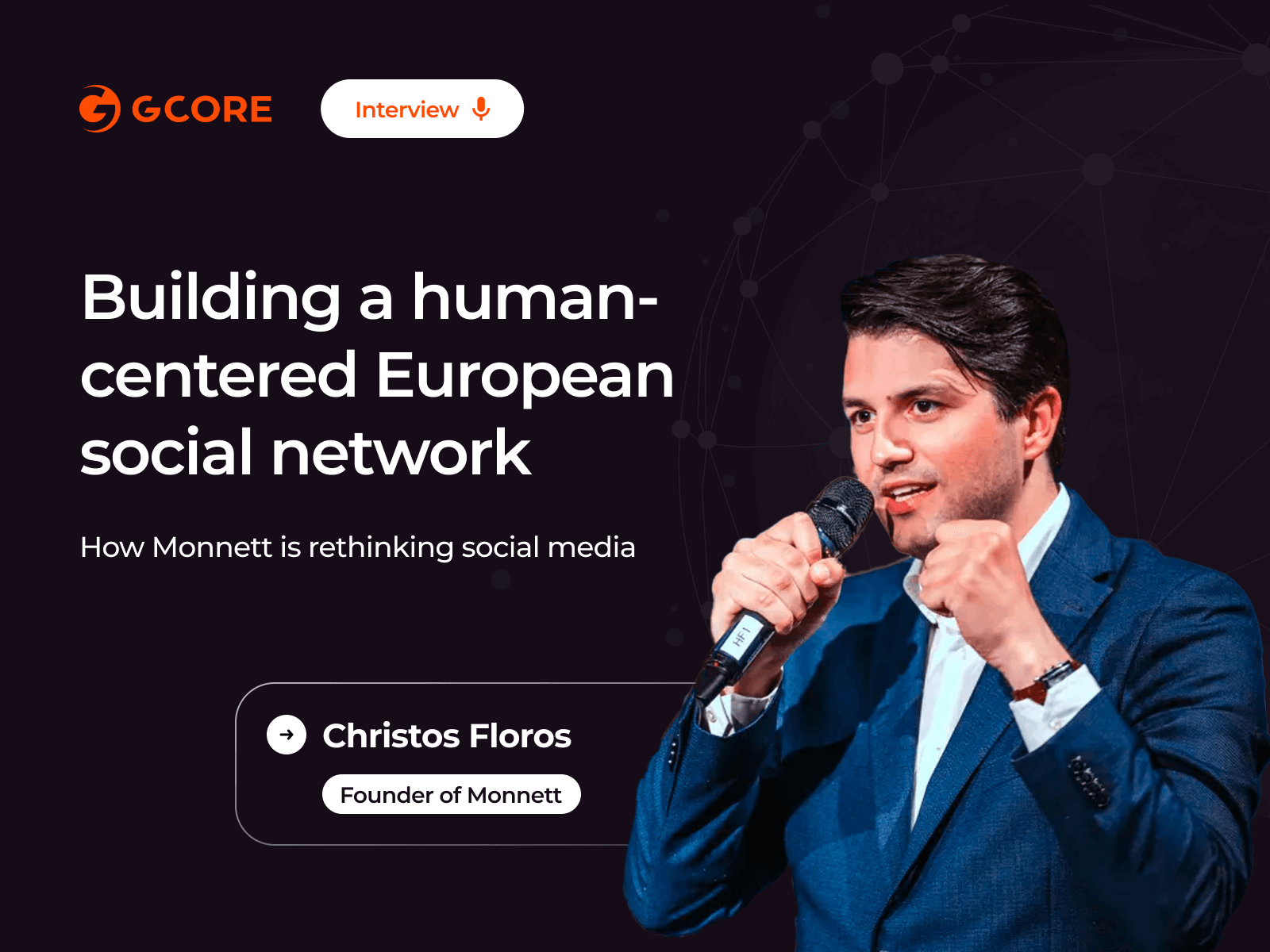
Social media has become one of the most powerful layers of modern civic life. It shapes how people communicate, how public opinion forms, how trust spreads — and how manipulation can scale. For Christos Floros, founder of Monnett, this is not just a product opportunity. It is a societal challenge.
Christos has moved through architecture, acting, media, politics, and technology. At first glance, that may look like an unusual path for a startup founder. But in conversation, the pattern becomes clear: each step has been connected to the same question — how can one contribute to making society better?
Monnett is his answer to that question today: a European social network built around human agency, trust, privacy, European data sovereignty, and a business model that does not depend on addictive algorithms.
Dima Maslennikov: Christos, let's start with your background. Who are you, and how did you arrive at Monnett?
Christos Floros: I am a second-generation Luxembourger. I grew up with a strong connection to Europe, to Luxembourg, and to our social safety nets. Over the years, I have worked in media, in traditional media, and in tech and social media analytics. I have also been involved in politics because I believe we have a responsibility toward our societies.
Now I have started a company building a social network because I believe social networks are critical civic infrastructure. They are places where Europeans shape public opinion. And I believe we should continue to be able to shape public opinion ourselves, instead of allowing algorithms to shape it for us.
DM: You also trained as an actor. How does that part of your life connect with what you are building now?
CF: I spent three years training as a professional actor in the UK, and after that I worked as an actor.
That experience is very connected to what I do now. I very much believe in being human, in our humanity flourishing. I believe in the arts. I believe that everything we do, including technological innovation, should ultimately be done because we want to improve life. So we need to focus on life.
DM: You once performed in Richard III. When I looked at your background, I had the feeling that this also connects to Monnett. Richard III manipulates the audience directly. Monnett, on the other hand, seems to be about building something that does not manipulate people. Is that connection fair?
CF: I love the way you see it. I did perform in a production of Richard III in the UK, and Ian McKellen — Gandalf — actually came to see us on the night of the UK elections, which was phenomenal.
And yes, Richard III comes out on stage and starts talking directly to the audience. He complains. He tells people that society has become too soft, that people do not understand how hard things are. That is very topical today.
Increasingly, politicians tell us we should prepare for more difficult times. They push people toward extremes. At the same time, algorithms are dividing us. So the only way to push back is to rediscover the more essential things in life. And you can only do that when you reconnect people with each other, instead of letting algorithms dictate the relationship.
DM: When I look at your path — architecture, acting, politics, media, and now technology — I see one timeline. Architecture of physical spaces, architecture of digital spaces, performance, public opinion, and now a social network designed not to distract people but to reconnect them. Is that how you see it too?
CF: Most people do not see that, but I agree.
When you look at my background and ask one simple question — what is this guy trying to do? — the answer is clear. I am trying to make society around me better. I am trying to contribute to society.
When I was young, I thought I was going to do that through architecture. Then I realized that people listen to actors a lot more, so I wanted to be on stage and be seen. Then, when I saw clowns enter politics, I said: we cannot leave politics to clowns. So I entered politics.
But being in politics showed me that politics does not move fast enough. Not because politics is bad — democracy is very good, and I am a Democrat. But unfortunately, technological powers move much faster and innovate much faster than the technology of democracy itself.
So we need to offer technological tools that sustain our democracies.
DM: Let's step back. What exactly is Monnett? What is the origin of the name? Is it connected to Jean Monnet?
CF: The connection goes back a long way.
My mother used to work for the European Commission in the Jean Monnet building here in Luxembourg. So Jean Monnet was always very present in my life. He was also instrumental in my education because when the European Schools of Luxembourg were founded, he was an early supporter of those schools as well.
There is a quote often attributed to that vision: Europeans educated side by side in Luxembourg would build Europe forward while still looking at their home countries with love. That idea stayed with me.
After the European elections in 2024, where I ran with the Democratic Party in Luxembourg, I realized that I was talking a lot about AI, technology, and AI sovereignty — but I was not happy with just talking about it. I needed to do more.
Then I was invited by the U.S. State Department to visit the United States and tour military bases as part of a NATO-related exercise. There, top military generals kept saying that one of the most important aspects of a country's resilience — and its ability to defend itself — is civilian resilience. That means the ability of people to communicate with each other and to trust what they are seeing in the media and on social media.
We already live in a world where Donald Trump has said TikTok should be banned in the U.S. The United States looked at a foreign algorithm influencing what its citizens see and said: we do not want that. Benjamin Netanyahu called social media one of the most important weapons. I am not defending his politics, but the point is clear: world leaders understand what social media has become.
So I came back to Luxembourg and said: we need a Project Monnet for Europe. Just as Jean Monnet called for the reconstruction of France after World War II, we need a Project Monnet for Europe's social platforms, because they are civic infrastructure.
The name also works as "Mon Network" — my network — with a French feel. That is where Monnett comes from.
DM: So what are you building in practical terms?
CF: We are building a social network in Europe. It is a European company, governed by the laws of the European Union, with data hosted by European providers like Gcore. But more importantly, we are building a product and a business model based on a different set of values.
The current business model of social media is broken because it is advertising-based. More time on the platform means more money. Therefore, addictive algorithms are profitable. That means the business is not aligned with the wellbeing of the user.
We are stripping that back. We are changing the business model. And we are removing algorithms from the product.
Instead of building better algorithms, we are saying: there should be no algorithm deciding what you see. People should see things in a humane way. When you post, your followers see the latest posts from the people they follow. You have human agency. You have your own brain. You have your own intelligence. You do not need an algorithm to notice that your girlfriend broke up with you and then show you ten videos that make you feel worse about it.
In a way, yes — we want to make social media great again.
DM: You mentioned NATO and resilience. Does that mean Monnett can also be seen as a dual-use product?
CF: Absolutely. We are absolutely dual-use.
But in order to have that secondary use, we first need to win the primary use: to become a social network with a strong social graph.
Once we become a reputable and trusted platform for people, then we absolutely become dual-use. Governments need trusted platforms through which they can communicate with citizens. They need platforms where people know who is actually present.
That is why human verification is so important to us. By changing the business model, we are also able to build verification into the platform. Part of that is basic verification through subscription. But we are also working on a blockchain-like technology of our own that would allow us to verify who is on the platform through clusters of users verifying other clusters of users in the background, without creating friction for people.
We want to build a social network where only human beings are participating. We already know that on major social platforms, a huge portion of activity comes from bots and fake accounts. We want to get rid of that.
DM: The business model sounds morally right: no addictive algorithms, no manipulative advertising, a feed based on real connections. But do people actually pay for social media? Have you proven that users will pay €3, €4, or €5 per month for this?
CF: Let me answer honestly.
If Facebook, Threads, or other major platforms copied us and moved toward a healthier model, my investors would probably be unhappy. But personally, I would be happy, because I would still achieve my goal of making society a little bit better.
However, I do not think that is likely in the short term. Big corporations, especially on the other side of the Atlantic, are very greedy. I do not think they are willing to experiment with losing their massive cash cow.
I often think about the Battle of Salamis, where the Persians came with big boats and the Greeks defeated them with smaller boats. The big platforms are too big to change. Not too big to fail — too big to change.
That said, we are building a freemium model. People can come in, try Monnett, experience a better social network, and then we upsell them once the network becomes valuable.
The experience is quite different. It is about seeing what the people you follow are posting. It is about connecting with friends. It is about rebuilding the private social layer with the people you actually care about. We are not a passive consumption platform.
I also like what Spotify did in Sweden. Spotify did not hide the fact that the free version had limitations. It clearly encouraged people to upgrade to Premium. On current social networks, you often do not even realize how many ads you are seeing. On Instagram, every second story may be an ad, and suggested posts are mixed into the feed.
We want to be transparent. We may have advertising, but it will be non-targeted and contextual. For example, someone may advertise Luxembourg. But you will not be able to target a 16-to-19-year-old who recently broke up with someone because of a keyword.
And when the platform becomes valuable to a user, we can say: if you want to go beyond a certain number of connections, become a member. We want to make it cheap enough that people choose to become members.
DM: Let me give you two scenarios. First, I have 1,000 friends and all of them post once per day. Without algorithms or ranking, what do I do with that volume? Second, what if my friends do not post anything and only consume content? Today's social media is driven by influencers and passive scrolling. What is your answer to both cases?
CF: These are two very different edge cases.
In the first case, on Monnett you can have an overview of posts. You do not have to scroll one by one. You can see what was posted today in a quick-view format. Since our goal is not to maximize retention, we do not need to trap you in endless scrolling. You can quickly see what is relevant and decide what you want to engage with.
In the second case, where your friends are not posting, you still win because you have a great encrypted messaging service inside Monnett. You can exchange things that are happening elsewhere, but you are not constantly being asked for your time.
Our core geographies are Europe and North America. That is over one billion people. But we are specifically looking at the roughly 200 million people who already pay for some kind of social media or digital subscription. From that group, Monnett becomes a unicorn if we can convince 10 million people to pay.
Of course, that requires more total users, but we have run the numbers. We do not need everyone to subscribe. What matters is the network effect. The most important thing is that you join Monnett together with your seven to ten closest friends. If we can achieve that, we can grow.
We are in the network effect business.
DM: Network effects are exciting for investors, but they are also binary. Either they work or they do not.
CF: Exactly. Everyone is aware that this is binary. Either it works or it does not.
That is why we are in a very high-risk business. For the last year of my life, every day I wake up and go from "shit, shit, shit" to the end of the day, after I have done the work, thinking: okay, I did my best today, and I still believe in myself and in my ability to do this.
But every day is a challenge of conquering your own self-doubt.
DM: You are not a classic technical founder. You are a founder, a hustler, a storyteller, a public person. How did you build the product side?
CF: I am definitely a nerd in my own way — I have had a T-shirt since 2010 that says that — but no, I am not a self-taught engineer.
I have a great team. Most of us are based in Luxembourg. We also have talented people in Greece, Poland, and Switzerland. But having the core team in Luxembourg has been very important.
The entrepreneurial journey is hard. There are people who quit at the first feeling that something might not work. Entrepreneurship is not for that kind of person. Unfortunately, that is also why many talented engineers do not start companies.
You need to be willing not to quit every time you fail, because you fail every day.
I started this project coming out of Talkwalker, one of Luxembourg's most successful scaleups. I wanted to find a co-founder from that company. The person was brilliant, absolutely brilliant. But the moment we got the first check signed, he felt the pressure and left.
After that, I needed to de-risk the project and find more people. I found a CTO and outsourced part of the work. I was pushing too fast because I was hustling. What I ended up with was a product that could not scale, but I had already marketed it heavily.
So I launched an incomplete product in October 2025, and more than 20,000 people signed up in the first week. We had to keep that product alive while it was failing every day, and at the same time we were telling people we were making improvements.
In reality, we were completely rewriting and refactoring both the backend and the frontend.
But that is the thing: you hustle with honesty. We were not lying to people. But you need to get it done because investors will often say: I need traction to fund you. If I do not build traction, I cannot raise funds. If I do not raise funds, I cannot hire the team.
So it has required a huge amount of sacrifice, from me and from the entire team.
DM: You mentioned the ecosystem around you. How important has that been?
CF: It has been hugely important.
The way we met is a good example. We met through the ecosystem. André, your CEO at Gcore, called me because of an introduction from the founder of LetzAI. André spoke with me three or four times. I know how much he works, so the fact that he took that time said everything.
Some people will not give you five minutes. But here was the CEO of a large scaleup taking time for me.
That matters. Some larger companies come to incubators like Luxembourg City Incubator and throw money at startups. But I cannot call their CEO when I am stuck. I cannot have that relationship.
When you are a startup founder, every day you may feel like you have a 1% chance of success, and you need to work on that 1%. Any logical person might quit. So the relationships around you matter enormously.
That is why I am thankful for the patience we have had from Gcore, for the explanations, and for the time your team has taken with our engineers. For us, that is hugely important.
DM: To be more specific, are you a solo founder or do you have co-founders?
CF: Filip (Gaman, Co-founder and CPO) joined the project after my previous co-founder left. Filip has been incredible. I could not do this without him.
I may be the person who runs the show, but you need people behind you. Filip has been a rock for me. He has received all the punches from the tech team. He took ownership of the product so that I could focus on everything else.
He owns the product, and he has designed an incredible product. I cannot wait for everyone to experience it.
In July, we will release the first full version of the platform we really want. We had the alpha, we now have the beta, and in July we expect to have the first true version. Then, in Q3, if everything goes well, we will have the web platform, localization, multiple language support, and several other things.
We are also currently planning a partnership with another European startup building a social network. We are considering investing in each other because we want to offer an alternative to big tech made in Europe.
DM: Let's talk about investors. Some of your investors come from big tech companies like Microsoft and Amazon. How do people from big tech end up backing a product that challenges the logic of big tech?
CF: We are fundraising right now. We have just started raising our second round. We raised our first round at the end of last year.
Among our angel investors, we have executives from Microsoft, Amazon, JD, and other major companies. What they have in common is that they are Europeans working in big tech. They understand that big tech may be feeding their families, but it is also actively harming their children.
Many of them have young children, or are planning to have children. A lot of them have young daughters. And social media has been incredibly destructive for young women.
It is interesting because we initially expected young people to be our early adopters. But actually, adult women became early adopters. Women are really fed up with current social media.
Traditional media has been criticized for years for manipulating women and creating unrealistic standards. But imagine what social media has done.
DM: As a parent, I feel the damage too. You can set limits on YouTube, but it is very hard to block Shorts specifically. Short-form content can be incredibly destructive for children's attention and self-control. How are you thinking about children and safety on Monnett?
CF: Trust is extremely important for us.
Right now, we do not allow children on the platform. Monnett is 18+. Not because we have adult content in the usual sense, but because we cannot yet satisfy our own benchmark of saying: we will never expose children to something they should not see.
For me, even one child seeing something they should not see is one child too many.
Until I can provide that level of safety, I will tell everyone the platform is 18+.
For us, it is very important to put out a product that is respectful of the societal change we want to be part of. You said earlier that I am an architect of physical spaces now designing a digital space. The rules of engagement are very important to me.
I have been inspired by people like Henri Lefebvre, bell hooks, and David Harvey. That is also what investors saw. They did not just see a tech founder. They saw someone determined to act toward society. The app is the expression of that intention.
Intentions matter. In a startup environment, where the risk of failure is huge, intent really matters.
DM: What kind of support do your investors bring beyond capital?
CF: They bring experience in how to structure a company, how to structure operations, and how to think clearly.
They are active or at least reactive when I need something. They are not slowing me down or telling me what to do. But when I have a question, they can say: this is how we do it where I work.
For example, I am obsessed with Amazon-style memos. They are very clear. Write a narrative memo. Do not just give me bullet points. Explain things. Put line items on the left so anyone can say: on line 174, you wrote this — what did you mean?
I like that clarity. I wish I was as organized in my own emotions as I am when running a company.
DM: Is there anything you have not shared publicly before, or something you want other founders to hear?
CF: The last year has taught me a lot about entrepreneurship, relationship-building, and networking. But more than anything, it has taught me a lot about myself.
Nobody tells you this when you start something: you will challenge yourself so much. You will challenge your assumptions. You will see parts of your character you have never experienced before — some great, and some absolutely terrible.
The pressure of building a company flows somewhere. If you are not aware of where that pressure is going, it will flow without your control. That is the most difficult part.
You can have all the right intentions, but if you do not control where the pressure goes, someone will receive it. It can be yourself. It can be your loved ones. It can even be your dog not getting all the walks she deserves.
Working a lot can serve the mission, but in order not to lose sight of the mission, you need to take time to know yourself.
I am very thankful to many of my investors who take time to check in on me, ask about my health, and ask me questions. I have been lucky to meet wonderful people.
DM: Final question. If you had to define Monnett in one sentence, what would it be?
CF: Monnett is a European social network built to reconnect people as human beings — without addictive algorithms, without manipulative targeting, and with trust, sovereignty, and civic responsibility at its core.
Dima Maslennikov: Christos, thank you for this honest, direct, and deeply insightful conversation.
Christos Floros: Thank you so much. And thank you for coming all the way to Luxembourg City Incubator.
How we help founders build
Monnett's journey — from a bold idea rooted in European values to a platform rebuilding trust in digital public life — is exactly the kind of mission Gcore for Startups was built to support.
Whether you're rethinking social infrastructure, building AI-native tools, or tackling the next civic challenge with technology, the right infrastructure partner can make the difference between scaling and stalling.
If you're a founder working on something that matters, apply to Gcore for Startups at gcore.com/infrastructure-for-startups.
Related articles

A rented game server or cloud application may give you little more than an IP address and a port. Traditional routed DDoS protection usually assumes much more: an ASN, your own /24 of IPv4 addresses, a signed Letter of Authorization, and a


Gcore's CDN, cloud, and AI services increasingly need to move traffic between regions, sometimes across continents. For customers, those journeys should be largely invisible: applications need predictable connectivity whether traffic is mov
Subscribe to our newsletter
Get the latest industry trends, exclusive insights, and Gcore updates delivered straight to your inbox.