



Mission Space chooses European sovereignty: why the Luxembourg space startup moved to Gcore
- April 15, 2026
- 8 min read
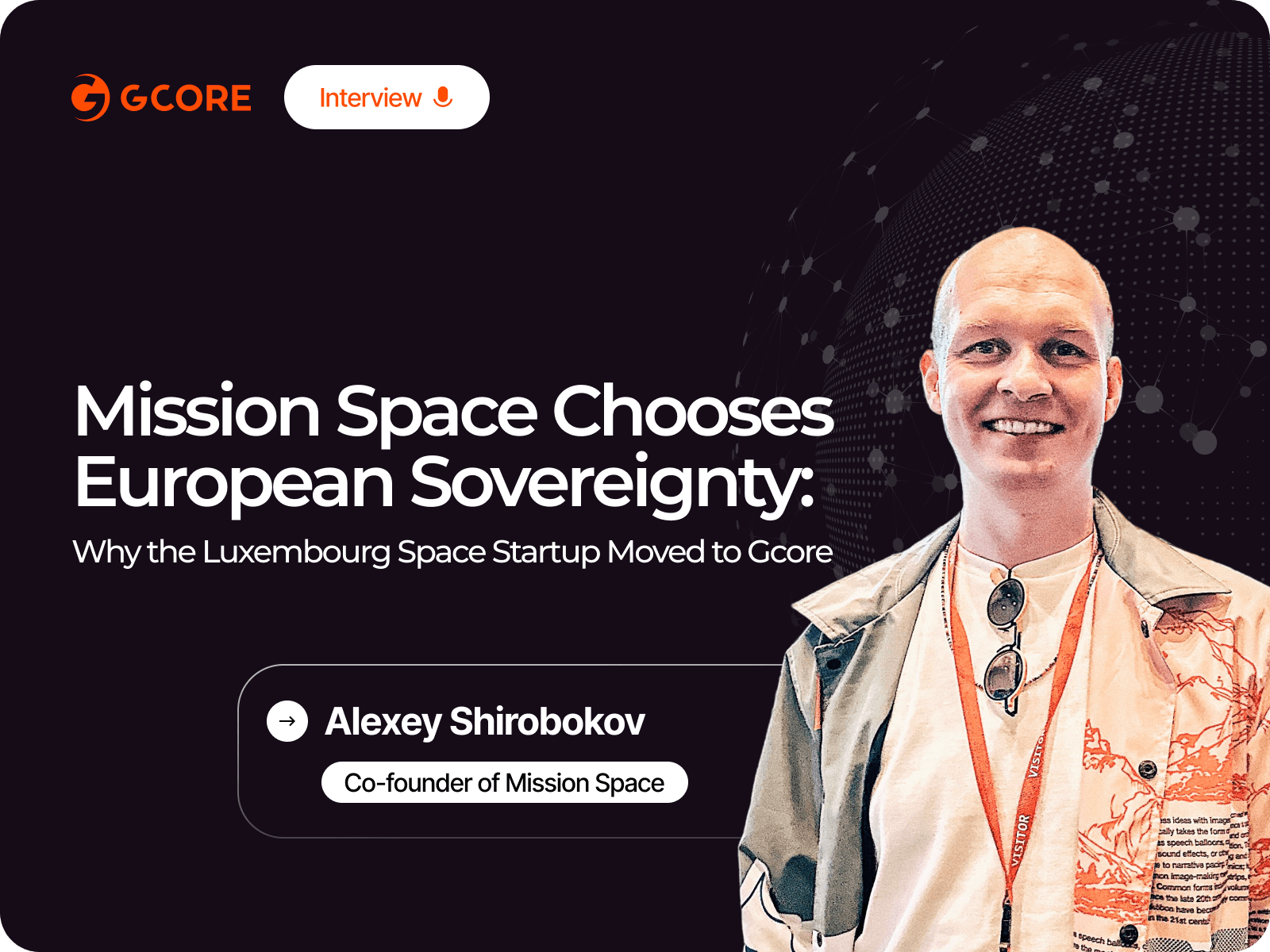
An interview with Alexey Shirobokov, CEO & Founder of Mission Space with Dima Maslennikov, Head of Startups at Gcore, recorded at House of Startups, Luxembourg.
At Gcore, we work closely with startups building at the edge of deep tech and frontier infrastructure. Every so often, we sit down with founders whose work deserves more than a press release. This is one of those conversations.
A powerful solar event hit recently—rated G4 out of G5 on the geomagnetic storm scale. For most people, it's a headline. For critical infrastructure operators, satellite companies, aviation, and anyone dependent on GNSS (GPS/Galileo), it's a serious operational risk.
Mission Space, a Luxembourg-based startup, is building a product that turns "space weather" from a scientific phenomenon into something decision-makers can act on. Their goal is not just predicting geomagnetic activity—but translating it into operational guidance: what to switch, reduce, postpone, or protect—and when.
I spoke with Alexey Shirobokov, Mission Space's CEO and founder, about the real economic impact of solar storms, why the biggest bottleneck is data quality, how the company is building its own orbital sensing layer, and why European data sovereignty will matter more over the next five years.
The moment space weather becomes business risk
Dima Maslennikov (DM): Alexey, thanks for joining. Introduce yourself and Mission Space in two or three sentences.
Alexey Shirobokov (AS): I'm the founder of Mission Space. We've been in Luxembourg for four years, building a tool for predicting geomagnetic storms and space weather. And you're interviewing at the right time— we recently had a major solar event, G4 out of G5. We haven't seen that intensity in about twenty years. In a couple of days, we'll understand the consequences for both space and ground infrastructure.
DM: Did you predict this event?
AS: Of course—after it happened. And that's the point: the real value isn't just knowing "a storm occurred." The value is producing forecasts that help operators make decisions.
From Kp-index to "what should I do at 3 a.m.?"
DM: What kind of economic impact can events like this have? Who are your customers and what problem do you solve?
AS: Let's start with history. In 1989, a solar storm of a similar scale caused a massive blackout in Quebec—people were without electricity for a week because a transformer failed. These events induce currents in power grids and transformers. Equipment can't handle it and burns out. When a large high-power transformer fails, whole regions can go dark.
Our idea is to make forecasting not only accurate but actionable. It's not enough to say "the Kp-index will be X." Grid operators need to know whether they should switch something, reduce load, enter a controlled shutdown—or do nothing. It depends on their equipment, location, predictable load, and timing. If the peak hits at 3 a.m., that's one scenario. If it hits at 7 p.m., that's a different one.
And power grids are only one segment. In general, we serve industries tied to radio communications, satellite operations, and GNSS.
DM: Telecom operators?
AS: Yes—especially satellite telecom operators. Also aviation: communications and navigation are sensitive to what happens in the ionosphere. And then there's autonomous machinery relying on GNSS for precise positioning. In effect, a solar event can resemble GPS jamming: no reliable signal, no reliable positioning, and machines behave poorly. If you're planning operations for autonomous systems, you'd like to know in advance what's coming.
DM: Does this connect to defense tech as well?
AS: Absolutely. Space weather events affect huge territories and create confusion for equipment. In defense scenarios, in peacetime, you at least have context and warnings. With space weather, it's random—unless you monitor it properly.
A real-world story: tractors, drifted GPS lines, and insurance losses
AS: Here's a memorable example from the U.S. A year ago, many tractors—often with operators—were following GPS lines in fields. During short-lived space weather spikes, GNSS quality degraded and positioning drifted. That led to planting errors and misapplied chemicals. I believe insurers recalculated losses in the hundreds of millions of dollars range.
DM: That's expensive.
AS: Very. Insurance is an underappreciated customer segment here. In many ways, these events resemble extreme weather—except we all observe Earth weather, while space weather is far less visible operationally.
And if you look forward: humanity is clearly heading back to the Moon, and later to Mars. Private stations—Starlab, Axiom—are coming. The share of economic activity generated in space will grow. There are already discussions about orbital data centers. But this entire system becomes much harder if you're not monitoring and managing how solar events affect space infrastructure.
DM: So when my kids fly to Mars, we'll check "space weather" like a forecast?
AS: Exactly. It will become a normal operational tool. In a future where you travel between—say—an office on the Moon and an office on Earth, that is the weather that matters.
Why now: cheaper launches, better computing, and ML that finally makes sense
DM: Why did you start Mission Space? Are you building it solo or with co-founders?
AS: The story is simple. We met excellent researchers in this niche field. Not many people work on it. We realized the timing was right to move from government research projects toward commercialization.
Several things made it possible: the falling cost of launching payload to orbit, improved computing, and mathematical models—especially machine learning—becoming more feasible. A major part of our know-how is our detectors—hardware that measures relevant parameters in orbit. We made them small enough that you don't need "millions and millions" per deployment. Roughly speaking, it's around the lower bound of about a million dollars to launch a unit in the way we design it.
DM: How do you actually deploy these detectors in orbit?
AS: We mount them on satellites via partner platforms. We have two programs where we launch detectors alongside partner missions.
DM: You already launched something, right?
AS: Yes. In March last year we launched our first platform—our first mission. It wasn't long, but it was crucial: validate survivability (launch stresses, radiation), confirm the detectors operate, and find bottlenecks—data transmission, compatibility with different equipment. This year we plan two launches, and next year I expect three to five.
The long-term idea is to have more than ten orbital data collection points so we can process and improve models close to real time. In our case, "real time" is a key lever for forecast quality.
The hardest part is not "more data"—it's clean data
AS: For real-time forecasting, we need serious storage. We collect data from our own detectors, but also from existing detectors on Earth and in space. One of our core goals is to consolidate this into our own data lake and make it the world's largest dataset on space weather.
The big problem is data cleaning. Scientific and sensor data can be noisy: broken feeds, missing timestamps, drifting sensors, intermittent sources. You have to restore gaps and normalize streams. If you train ML on dirty data, you get wrong outputs.
That's actually a key reason ML wasn't widely used in this domain before: collecting and cleaning the data is extremely labor-intensive. Volumes are already in terabytes, and raw datasets across the ecosystem could reach petabytes. Meanwhile, some of the most widely used models are still "old"—designed in the 70s and 80s, when modern computing simply wasn't available.
DM: So your full stack is: collect, store, clean, model, product?
AS: Exactly. We aggregate data, clean it at scale, and apply modern machine learning to deliver products for satellite constellation operators, ground communications infrastructure, and GNSS-dependent and autonomous systems.
Business model: subscriptions plus high-resolution feeds
DM: How do you monetize? Subscriptions, API access, enterprise deployments?
AS: We charge for two things. First, the end product—typically as a subscription integrated into the customer's operations. Second, access to specific localized indicators and granular feeds, especially for customers who build their own models.
DM: Can you share a rough price range?
AS: Our estimate is ~€10,000/year for basic system access. For granular data feeds for sophisticated customers, it can go into the hundreds of thousands per year.
DM: Do you already have paying customers?
AS: Yes. We have several satellite-focused companies where we run joint PoCs and research collaborations with commercial contracts.
Why Luxembourg: density, visibility, and a "business-minded" space agency
DM: You've been in Luxembourg for four years. Why Luxembourg?
AS: Luxembourg is one of the few places in Europe where working with space infrastructure is relatively accessible. The density of space professionals is high, and the space industry is significant relative to the economy. It's also easier to be visible here and avoid getting lost in the bureaucracy and noise you might face in larger ecosystems.
DM: How important is the Luxembourg Space Agency?
AS: Very. The Luxembourg Space Agency has scaled rapidly—more people, more projects. And unlike some larger European space agencies historically built as scientific-bureaucratic structures, here it acts more like a business partner that helps push product development and commercialization. We expect our first fully supported project this year—we're moving through the gates now.
DM: What about the wider ecosystem—House of Startups, LCI?
AS: It matters. If you want to be part of the ecosystem, you need to be in the flow. House of Startups gives convenient access to events and stakeholders. We're based in the Luxembourg City Incubator, which does a good job connecting stakeholders.
This year, the ecosystem also introduced a 20% tax deduction on early-stage investments—similar to the UK model—which can meaningfully unlock smaller checks.
DM: Like €50–100k angel checks?
AS: Exactly. Ten people investing €50k is already half a round. When part of the risk is effectively softened through tax incentives, early-stage decisions become easier.
Infrastructure and the hyperscaler trap: why Mission Space moved to Gcore
DM: Let's talk infrastructure. What triggered the move to Gcore?
AS: We want infrastructure support to be simple and require minimal manual effort. Scaling was becoming more costly in terms of effort, and scalability had limits.
We need scalability without paying astronomical amounts. With major hyperscalers, there's a well-known trap: you burn through credits quickly, then costs spike, and you're locked into their ecosystem. Also, despite "startup-friendly" messaging, reaching real support can be hard—especially from Luxembourg, which can feel like a peripheral market to them.
Data sovereignty: why it matters more in the next five years
DM: As a Luxembourg company building a global product, how important is data sovereignty for you?
AS: Our product value increases with more data. So it's critical that data ends up in our data lake. At the same time, data sovereignty is becoming more relevant. I believe the ability to separate and manage data by sovereignty constraints will be essential over the next five years.
If you look at future regulations and programs, European projects may require data to be local. Then it becomes an advantage if your infrastructure and processing are already inside Europe.
It also depends on customers. For European public-sector customers, it's very relevant. In the U.S., it's already happening: certain scientific or orbital data is hard to move outside the American perimeter.
Can Europe become a single market? Not without solving capital and language fragmentation
DM: Europe is slow and bureaucratic, or Europe is accelerating—where do you stand?
AS: It depends on whether Europe can truly unify. Today, borders are still very real. In venture, many funds have sovereign LPs—national money—so they face constraints. French money tends to invest in France, German money in Germany. Cross-Europe investments exist, but often marginally.
That makes it hard to treat Europe as a single market. I struggle to imagine a major shift where taxpayers in one country broadly fund startups in another without a very clear accountability mechanism.
There's also the language barrier. Even with English, people gravitate toward local-language networks and markets. Regulation reinforces this fragmentation.
What's next: from a beta+ product to lunar space weather infrastructure
DM: Give me three key milestones for the next 12–36 months.
AS: First, migrating fully to Gcore infrastructure, building a powerful data lake, and rolling out a solid beta+ product this year.
Second, launching more detectors—two missions this year and expanding further next year.
Third, a lunar mission around 2027–2028. We want to start building space weather infrastructure around the Moon, where monitoring is still minimal today.
Over a five-year horizon, we aim to have several mature, commercialized products in the directions we discussed—strong enough to replace legacy operational approaches with actionable forecasting.
DM: Alexey, thank you. I hope you hit these milestones faster than your plan—and we'll do a follow-up interview in six months to compare notes.
AS: Thank you!
Key takeaways for founders and operators
- Space weather is infrastructure risk: power grids, aviation, satellites, telecom, autonomous systems, and insurance all feel the impact.
- Actionability beats raw indices: operators need “what do I do” guidance, not only a Kp number.
- Data quality is the moat: cleaning noisy scientific streams is one of the hardest, most defensible parts of the product.
- Orbit becomes your proprietary data layer: more detectors = better real-time modeling and differentiated products.
- Sovereignty will shape access to data and contracts: especially in public-sector and regulated programs.
If you're thinking about your infrastructure provider and where your data lives, Gcore offers European sovereignty, global edge performance, and none of the lock-in that comes with the hyperscaler default. With data centers across Europe and beyond, it's infrastructure built for companies that take their data strategy seriously. Get in touch.
Related articles

Earlier this year we brought NVIDIA Dynamo to Gcore — one-click disaggregated inference that delivered up to 6× higher GPU throughput and 2× lower latency inside a deployment, by separating prefill and decode and routing each request to the
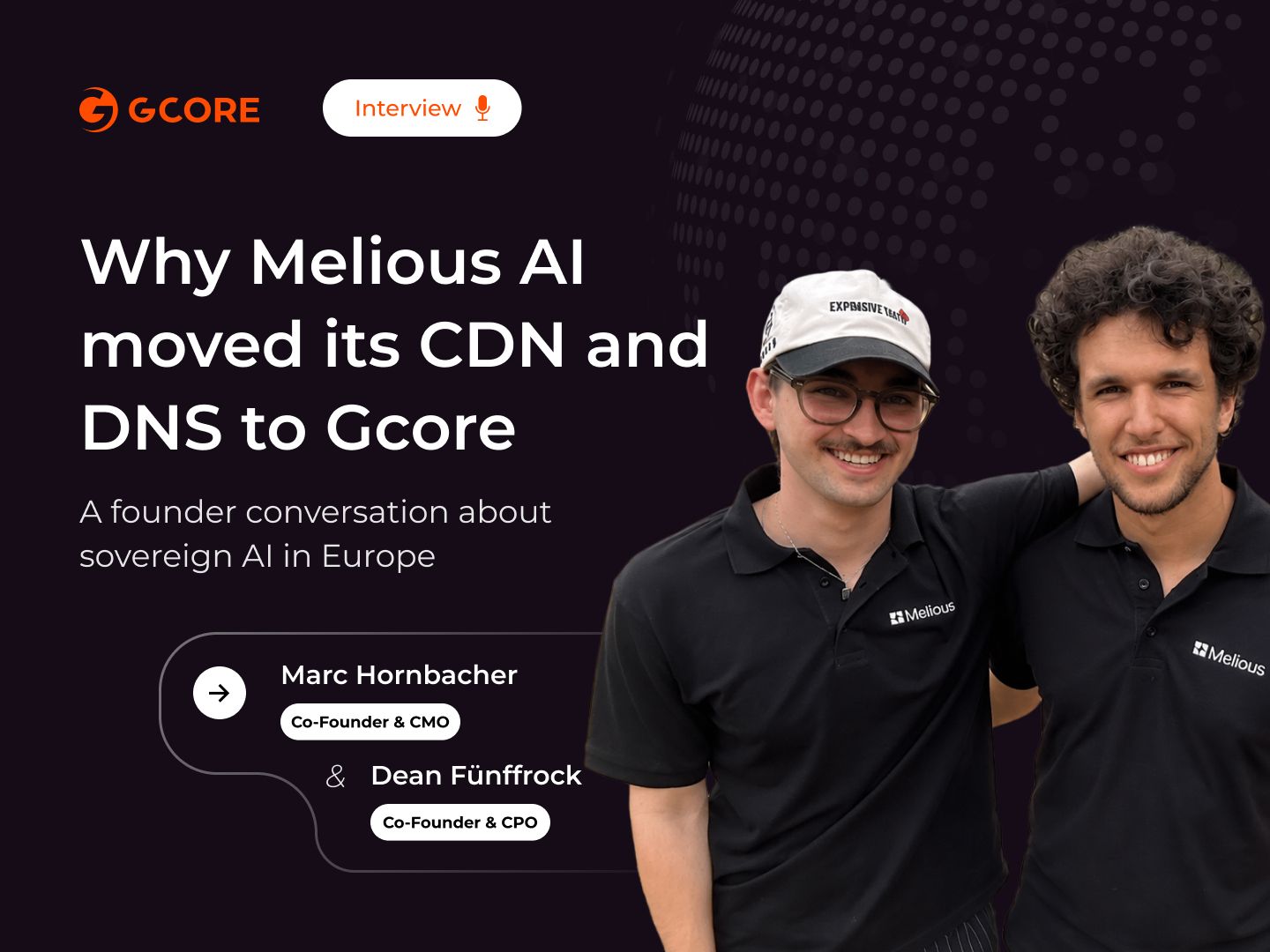
For many startups, infrastructure decisions are mostly about performance, pricing, and developer experience. For Melious AI, they are also about trust.Melious AI is a German startup building a European AI platform around privacy, transparen
As enterprises move AI from experimentation into production, they face a new infrastructure challenge. AI applications, models, and data are no longer confined to a single cloud or data center. Instead, they are distributed across multiple


Subscribe to our newsletter
Get the latest industry trends, exclusive insights, and Gcore updates delivered straight to your inbox.