



VPS vs Dedicated Server: Which One Do You Need?
- April 17, 2026
- 9 min read

Your site is humming along fine, until it isn't. Traffic spikes, page loads crawl, and your hosting plan buckles under pressure right when it matters most. Choosing between a VPS and a dedicated server isn't just a technical checkbox. It's a decision that directly shapes your site's performance, security, and bottom line. Get it wrong, and you're either overpaying for raw power you don't need, or squeezing a growing workload into a setup that can't keep up.
The stakes are real. Dedicated servers can handle 64 GB to 512 GB or more of RAM with 10 TB to 100 TB or more of monthly bandwidth, while VPS plans offer a wide range from entry-level configurations up to dozens of vCPUs and hundreds of gigabytes of RAM, depending on the provider, and the cost gap between the two is just as dramatic. Yet for plenty of workloads, a VPS that spins up in minutes with on-demand scaling is exactly the right call.
Here's what you'll find in this guide: how each hosting type actually works, where the key differences lie in performance and security, how costs compare at every tier, and the specific scenarios that should push you toward one option over the other.
What is a VPS vs dedicated server?
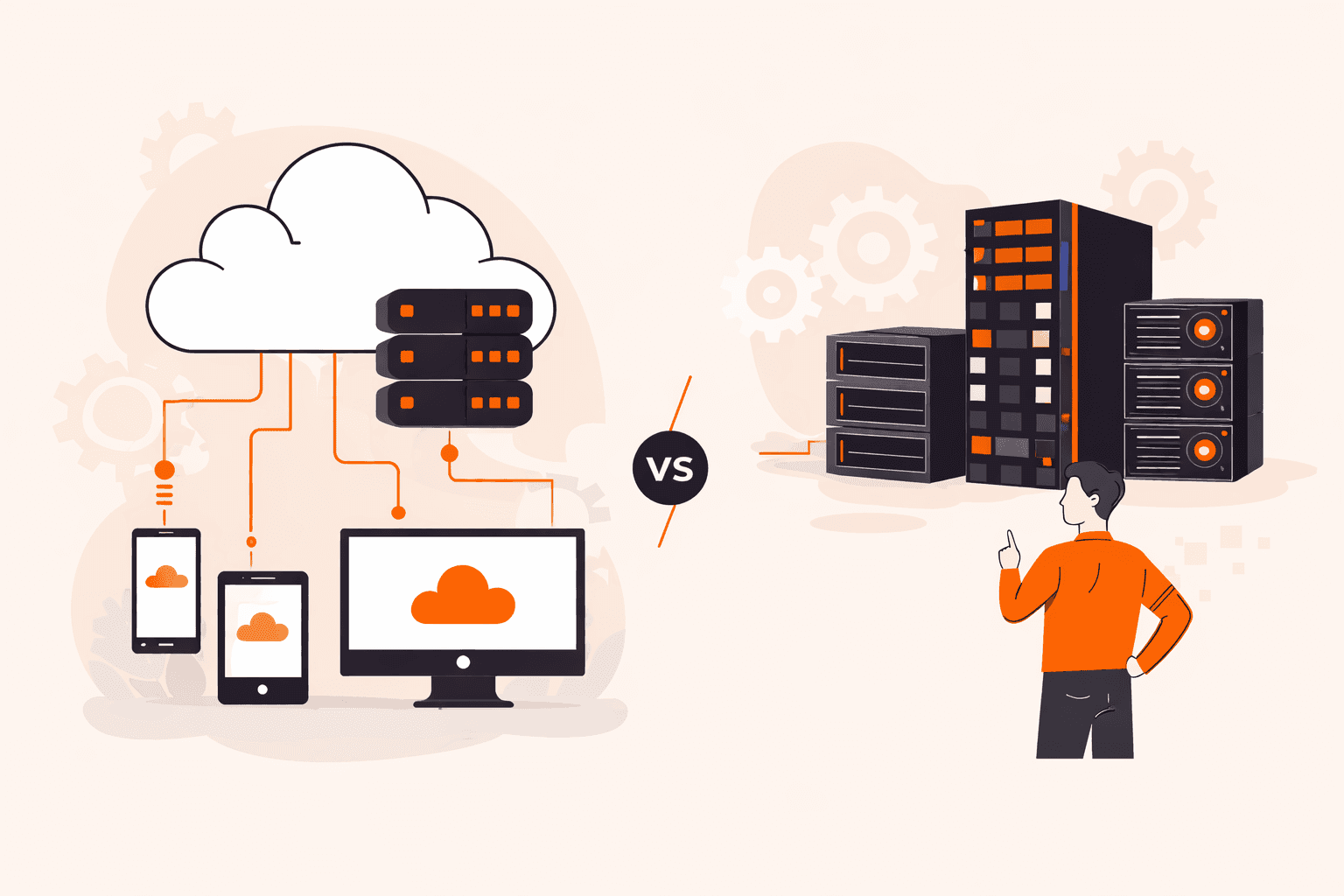
A VPS (Virtual Private Server) is a virtualized slice of a physical machine, while a dedicated server gives you the entire physical machine to yourself. With a VPS, the underlying hardware is shared, but your partition is isolated, so you get your own OS, root access, and allocated resources. A dedicated server removes that shared layer entirely. You get every CPU core, every gigabyte of RAM, and full control over the hardware configuration.
The practical difference comes down to resource ownership. A VPS can range from two vCPUs and a few gigabytes of RAM for entry-level plans up to 48 or more vCPUs and several hundred gigabytes of RAM at the high end, enough for most growing workloads. A dedicated server offers additional headroom beyond that, with 32+ physical cores and up to 512 GB RAM or more, no virtualization overhead, and no risk of a noisy neighbor eating into your performance.
In simple terms: A VPS rents you a private section of a shared server, while a dedicated server means the whole machine is yours and nobody else's.
How does each hosting type work?
VPS hosting runs a hypervisor on a physical machine, splitting that hardware into isolated virtual environments. Each VPS gets a fixed or burstable allocation of CPU, RAM, and storage. Your workloads run inside that virtual boundary, completely separate from other users on the same host. Need more resources? You scale them through your control panel, often in minutes, with no hardware changes, though most providers require a brief reboot to apply CPU and RAM changes.
Dedicated servers work differently. There's no hypervisor layer between your workloads and the hardware. Your OS talks directly to the physical CPU cores, RAM, and storage controllers. That direct access is what gives dedicated servers their performance consistency. Every cycle is yours, with nothing sharing the pipeline.
Setup time reflects this difference too. You can spin up a VPS in minutes. A dedicated server takes longer to provision because physical hardware needs to be allocated, racked, and configured for your specific needs.
In simple terms: A VPS slices one machine into several virtual ones using software, while a dedicated server runs your workloads straight on the hardware with nothing in between.
What are the key differences between a VPS and a dedicated server?
The core differences come down to three things: resource ownership, performance consistency, and hardware access.
With a VPS, you're sharing physical hardware with other tenants. The hypervisor keeps workloads isolated, but the underlying CPU, RAM, and network are split between multiple users. A dedicated server gives you the entire machine. Every core, every gigabyte, every I/O cycle belongs exclusively to you.
That distinction really shows under load. When traffic spikes on a VPS, physical resource contention with other tenants on the same host can affect your performance, depending on how your provider allocates and enforces resource limits. A dedicated server doesn't have that problem. There's no contention, so performance stays consistent. For e-commerce sites during peak traffic or gaming applications that need predictable latency, that consistency is what you're actually paying for.
Entry-level VPS configurations start at around 2 to 8 vCPUs and up to 64 GB RAM, but high-end VPS plans from major providers reach 48 to 192 vCPUs and up to 768 GB RAM. Dedicated servers remain the choice when you need the highest single-machine performance, physical isolation, or specialized hardware configurations that virtualized environments can't match.
Cost reflects all of this. VPS is cheaper to start and easier to scale incrementally. Dedicated servers cost more per month, but for sustained high-resource workloads, the per-unit performance often justifies it.
| Feature | VPS | Dedicated server |
|---|---|---|
| Resource ownership | Shared physical hardware | Exclusive hardware access |
| CPU | 2 to 48+ vCPUs (varies by provider) | 8 to 32+ physical cores |
| RAM | 2 GB to 512 GB+ (varies by provider) | 64 GB to 512 GB+ |
| Monthly bandwidth | 1 TB to 10 TB | 10 TB to 100 TB+ |
| Scaling | Minutes, brief reboot typically required | May require hardware changes |
| Performance consistency | Variable under shared load | Consistent, no contention |
What are the advantages and disadvantages of a VPS?
VPS advantages and disadvantages come down to flexibility versus limitations. Here's what each side actually looks like in practice.
Advantages:
- Fast provisioning: Spinning up a VPS takes minutes, not hours. That speed matters when you're testing a new project or need to scale quickly without waiting on hardware procurement.
- Granular scaling: RAM, CPU, and storage can be adjusted through the control panel without physical hardware changes. Most providers require a brief reboot to apply CPU and RAM resizes, but the process is still far faster than dedicated server scaling.
- Lower entry cost: VPS packages start well below dedicated server pricing. For startups or growing sites with moderate traffic, that cost difference lets you allocate budget elsewhere while still getting root access and full OS control.
- Root access and software control: You get full administrative control over your environment. Install custom software, configure your firewall, manage your OS exactly how you need. No sharing decisions with other tenants.
- Replication and redeployment: VPS environments are easy to snapshot, clone, and redeploy. That agility is genuinely useful for dev/staging workflows or disaster recovery setups.
- Hypervisor isolation: Your workload stays logically separated from other tenants on the same host. It's not physical isolation, but a well-configured hypervisor keeps your data and processes contained. Hypervisor vulnerabilities are rare, though they do represent a shared-hardware risk that physical isolation eliminates.
Disadvantages:
- Shared physical resources: The underlying CPU, RAM, and network are split across multiple users. Under heavy load, noisy neighbors can degrade your performance, and you can't control what they're doing.
- Resource limits: While high-end VPS plans from major providers can reach 48+ vCPUs and several hundred GB RAM, they still have upper limits. If your workload demands the absolute maximum single-server resources, full hardware customization, or physical isolation, you'll need dedicated hardware.
- Limited hardware customization: While GPU-attached VPS instances are now widely available (including from Gcore), options like custom RAID configurations and specialized network interfaces remain limited in virtualized environments compared to dedicated servers.
- Variable performance: Consistent latency is harder to guarantee. For applications where predictable response times matter, such as gaming, financial transactions, or real-time processing, that variability is a real problem.
- Lower bandwidth ceiling: VPS plans typically offer 1 TB to 10 TB monthly transfer. High-traffic applications that push beyond that need dedicated infrastructure to avoid overage costs or throttling.
| Term | What it does | Best for |
|---|---|---|
| Fast provisioning | Spins up in minutes | Testing, quick deployments |
| Granular scaling | Adds resources with brief reboot | Growing, unpredictable workloads |
| Lower entry cost | Reduces upfront infrastructure spend | Startups, moderate traffic sites |
| Root access | Full OS and software control | Custom application environments |
| Replication and redeployment | Snapshot and clone environments easily | Dev/staging, disaster recovery |
| Hypervisor isolation | Keeps tenants logically separated | Multi-tenant security baseline |
| Shared physical resources | Splits hardware across users | Risk for high-load applications |
| Resource limits | Caps vary by provider (up to 48–192 vCPUs) | Outgrown by the most resource-intensive workloads |
| Limited hardware customization | Custom RAID and NIC options limited | Less suited for deep hardware control |
| Variable performance | Latency fluctuates under shared load | Poor fit for real-time applications |
| Lower bandwidth ceiling | Tops out at 10 TB monthly | Insufficient for high-traffic sites |
What are the advantages and disadvantages of a dedicated server?
Dedicated servers flip most of those VPS trade-offs. Here's what you actually gain and give up.
Advantages:
- Exclusive hardware access: Every CPU core, gigabyte of RAM, and storage byte is yours alone. No resource contention, no noisy neighbors, no performance surprises caused by other tenants sharing your machine.
- Consistent performance: Nothing is shared, so your application gets predictable throughput and latency under any load. That reliability is exactly why dedicated servers are the default choice for e-commerce, gaming, and financial workloads.
- Massive resource headroom: Dedicated server hosting scales up to 32 or more physical CPU cores and 512 GB or more RAM. If your workload has outgrown a VPS ceiling, dedicated hardware gives you room to run.
- Full hardware customization: Choose and configure specific RAID levels, network interfaces, and storage controllers to match your exact workload. While GPU access is now available in both VPS and dedicated environments, dedicated servers offer deeper control over the full hardware stack.
- High bandwidth capacity: Monthly transfer limits reach 10 TB to 100 TB or more. High-traffic applications won't hit the walls that VPS plans impose.
- Physical isolation: Your data lives on hardware no other customer touches. For regulated industries like finance, healthcare, and government, that physical separation simplifies compliance and audit requirements considerably.
Disadvantages:
- Higher cost: Dedicated servers cost significantly more per month than comparable VPS packages. If your workload doesn't fully use the hardware, you're paying for capacity that sits idle.
- Slower provisioning: Spinning up a dedicated server takes hours or days, not minutes. If you need infrastructure fast, that lead time is a real friction point.
- Harder to scale quickly: Adding resources means physical hardware changes, including ordering, installing, and configuring new components. You can't just dial up RAM on demand the way you can with a VPS.
- Migration complexity: Moving a dedicated server workload to new hardware is more involved than snapshotting a VPS. Redeployment takes planning, not just a few clicks.
- Deeper management responsibility: Beyond OS and software, you're responsible for hardware-level decisions like firmware, RAID configurations, and drive replacements. Managed options reduce that burden, but they add cost.
| Term | What it does | Best for |
|---|---|---|
| Exclusive hardware access | Eliminates resource contention entirely | Any performance-sensitive workload |
| Consistent performance | Delivers predictable latency under load | Gaming, finance, real-time apps |
| Massive resource headroom | Supports 32+ cores, 512 GB+ RAM | Large-scale, resource-intensive applications |
| Full hardware customization | Enables custom RAID, NIC, storage controllers | Workloads with specific infrastructure needs |
| High bandwidth capacity | Handles 10 TB to 100 TB+ monthly | High-traffic sites and media delivery |
| Physical isolation | Keeps data on single-tenant hardware | Regulated and compliance-driven industries |
| Higher cost | Increases monthly infrastructure spend | Poor fit for underutilized or test environments |
| Slower provisioning | Takes hours to days to deploy | Unsuitable for rapid scaling needs |
| Harder to scale quickly | Requires physical hardware changes | Risk for unpredictable or spiky workloads |
| Migration complexity | Involves more steps than VPS redeployment | High-effort for workload portability |
| Deeper management responsibility | Adds hardware-level administration tasks | Requires experienced infrastructure teams |
When should you choose a VPS vs a dedicated server?
Go with a VPS when your workload is growing but unpredictable. Traffic spikes, test environments, projects that need to scale from 2 vCPUs to 8 vCPUs quickly, these are classic VPS scenarios. If your monthly budget is tight and you don't need more than 64 GB RAM or 1 TB SSD storage, a VPS gives you the flexibility to right-size as you go.
Dedicated servers are a different story. You want one when your resource usage is consistently high and predictable. Running an e-commerce platform through sustained peak traffic? A gaming backend that needs GPU acceleration? A financial application with strict compliance requirements? In those cases, the performance ceiling and physical isolation of dedicated hardware justify the higher cost.
Here's a practical threshold to watch for: if you're regularly maxing out your VPS resources, or your application can't tolerate any neighbor-induced latency, that's your signal to move. Don't wait until performance degrades. Provision dedicated infrastructure before the bottleneck hits.
How do VPS and dedicated server costs compare?
VPS and dedicated servers sit at very different price points, and the gap widens as your resource needs grow.
VPS is the cheaper entry point. You're sharing physical hardware with other users, so providers can offer smaller resource packages, from a few vCPUs and a couple of GB RAM up to dozens of vCPUs and hundreds of GB RAM, at a fraction of dedicated server pricing. That shared model keeps costs low when you don't need the full machine.
Dedicated servers cost more because you're renting the entire physical machine. High-end configurations with 32+ cores and 512 GB RAM can reach mid to high triple-digit monthly fees. Even the smallest dedicated servers cost more than larger VPS packages, so there's no overlap at the budget end.
Here's the cost trade-off that actually matters: VPS is cheaper per month, but dedicated can be more cost-effective per unit of performance under constant high load. If your application runs at 80% to 90% capacity around the clock, you're paying for VPS overhead that a dedicated server simply eliminates.
It's not just the base price, either. Bandwidth limits differ significantly. VPS plans typically cap at one to 10 TB monthly, while dedicated servers can reach 100 TB or more. For data-heavy applications, that difference affects your total cost.
In simple terms: VPS costs less upfront, but if you're consistently pushing your limits, a dedicated server often delivers better value for the money.
How can Gcore help with VPS and dedicated server hosting?
Gcore offers both VPS hosting and dedicated server hosting, so you can start where your workload demands and scale without switching providers.
On the VPS side, you get fast provisioning, granular resource scaling, and root access. That's useful when you're testing new projects or managing variable traffic. When your application scales past what virtualized resources can handle consistently, Gcore's dedicated servers give you full hardware control, no resource contention, and the predictable performance that high-load workloads need.
The real difference is flexibility without compromise. Whether you need a VPS with 8 vCPUs to handle a growing web app or a dedicated server with 32+ cores for a latency-sensitive gaming platform, you're running on Gcore's global infrastructure across 210+ PoP.
Explore Gcore Edge Cloud to find the right fit for your workload.
Frequently asked questions
What is the main difference between a VPS and a dedicated server?
A VPS shares physical hardware with other users through virtualization, while a dedicated server gives you an entire physical machine to yourself. That distinction drives everything else: performance consistency, resource limits, customization depth, and cost.
Is a VPS or dedicated server more secure?
Dedicated servers offer stronger isolation by default. Physical separation eliminates shared-hardware risks from other tenants, which simplifies compliance for regulated industries like finance and healthcare. That said, security on either option ultimately depends on how well you configure your OS, firewall, and access controls.
Can you upgrade from a VPS to a dedicated server?
Yes, you can migrate from a VPS to a dedicated server, though it's not an instant upgrade. You'll need to back up your data, provision the new server, and redeploy your applications manually.
Which is better for high-traffic websites: a VPS or dedicated server?
Dedicated servers handle high-traffic sites better. With 64 GB to 512 GB+ RAM and no resource contention from neighboring users, you get consistent performance even during traffic spikes that would slow a VPS down.
How much does a VPS cost compared to a dedicated server?
VPS hosting is significantly cheaper than dedicated servers. Entry-level VPS configurations start at around 2 to 8 vCPUs and up to 64 GB RAM, but high-end VPS plans from major providers reach 48 to 192 vCPUs and up to 768 GB RAM. Bare metal servers and dedicated servers remain the choice when you need the highest single-machine performance, physical isolation, or specialized hardware configurations that virtualized environments can't match.
What are the performance differences between a VPS and a dedicated server?
Dedicated servers deliver consistent, predictable performance because you're not sharing CPU, RAM, or storage with anyone else. No noisy neighbors, no resource contention. VPS performance is solid for moderate workloads, but shared physical hardware means a spike from another tenant can affect your response times.
Is a dedicated server worth it for small businesses?
No, a dedicated server rarely makes sense for small businesses. The cost is hard to justify when a VPS handles most moderate workloads comfortably, with plans ranging from a few vCPUs up to dozens depending on your provider. Start with a VPS and migrate to dedicated only when you consistently hit resource ceilings.

Related articles


Imagine discovering that migrating your company's data to a new cloud provider will cost hundreds of thousands of dollars in egress fees alone, before you've even touched the re-engineering work. Or worse, picture being in Synapse Financial


Subscribe to our newsletter
Get the latest industry trends, exclusive insights, and Gcore updates delivered straight to your inbox.