



What Is a High Availability Server?
- April 22, 2026
- 10 min read
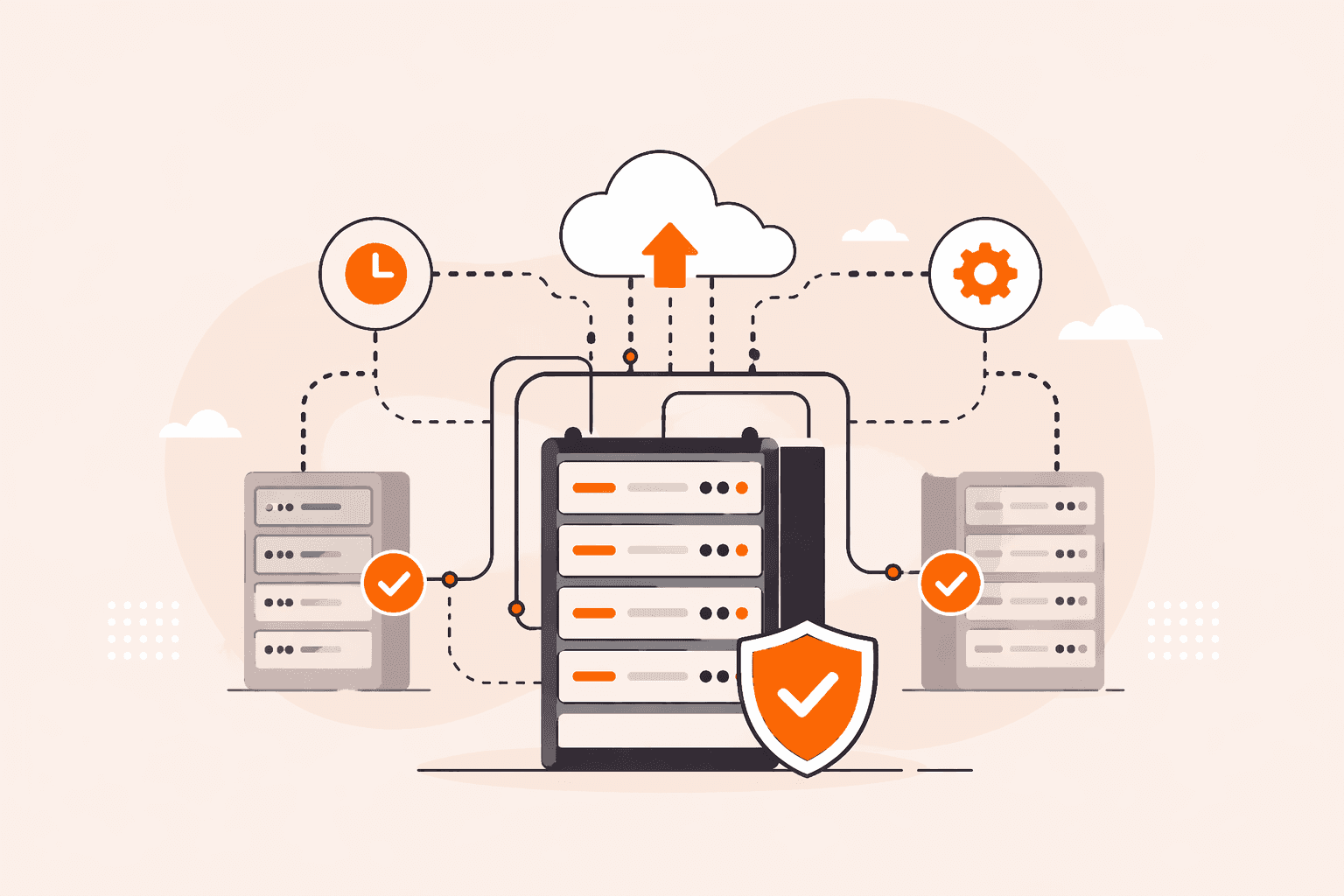
Every minute your servers are down, your business is bleeding. For e-commerce sites, healthcare platforms, and revenue-critical applications, an outage isn't just an inconvenience. It's a direct hit to your bottom line, your reputation, and potentially your customers' safety. Yet most infrastructure is still built with hidden vulnerabilities that a single hardware failure, network hiccup, or power surge can exploit in seconds.
The standard for modern resilient infrastructure is 99.99% annual uptime, what engineers call "four nines." Miss that target, and you're looking at more than 52 minutes of downtime per year. Push for five nines (99.999%), and that window shrinks to just 5.26 minutes. The gap between those numbers sounds small until you're the one watching orders fail and support tickets pile up.
Here's what you'll get from this guide: a clear explanation of how high availability servers actually work, what components make continuous operation possible, how to measure and hit the right uptime tier for your workload, and what challenges to expect when building resilient infrastructure. All of it so you can make smarter decisions before the next failure hits.
What is a high availability server?
A high availability server is a system designed to keep your applications running continuously, even when individual components fail. It achieves this through redundancy (multiple servers, network paths, and power supplies), so there's no single point of failure that can bring everything down. When one server fails, workloads shift automatically to a healthy node, often without users noticing anything went wrong.
The standard benchmark is 99.99% annual uptime (four nines), which translates to less than an hour of downtime per year. The most resilient systems target 99.999%, just 5.26 minutes of downtime annually, achieved through multi-region deployment, redundancy at every infrastructure layer, and automated failover — often built on high-performance infrastructure like bare metal servers and cloud instances working together in clusters. That level of reliability matters most in industries like healthcare and e-commerce, where an outage doesn't just inconvenience users, it costs money or puts people at risk.
In simple terms: A high availability server keeps your applications online by automatically switching to backup systems the moment something fails, so your users experience minimal or no disruption.
How does a high availability server work?
A high availability server continuously monitors every component in your stack, including servers, applications, and network paths, and automatically reroutes workloads the moment something fails.
Here's the basic flow: your application runs on a primary server while one or more secondary servers stay on standby. A health-monitoring process checks the primary constantly. If it detects a failure, it triggers failover and moves your workload to a healthy node. Done right, users experience minimal disruption, though brief interruptions can occur depending on failover speed and application state.
The architecture typically follows one of two patterns. Active-passive clustering keeps standby nodes ready to take over. Active-active clustering runs workloads across multiple nodes simultaneously. Active-active is harder to configure, but it delivers higher throughput and faster failover because no node is sitting idle.
Load balancing ties it all together. It distributes traffic across Gcore servers so no single node gets overwhelmed, which prevents failures before they happen. Pair that with data replication across nodes, and you're protected against both server failure and data loss.
In simple terms: Gcore servers watch each other constantly, and when one fails, the others automatically pick up the work. No manual intervention needed.
What are the key components of high availability infrastructure?
Think of HA infrastructure as a collection of building blocks, each one designed to keep your system running when something goes wrong. Here's what those building blocks actually are.
- Redundant servers: No single machine should be a point of failure. A common model is N+1, meaning one extra server beyond what you need, so the system can handle a single failure without interruption. For the most demanding workloads, 2N (fully duplicated servers) or even 2N+1 (full duplication plus one extra) provides stronger protection at significantly higher cost.
- Health monitoring: Dedicated monitoring processes check server, application, and network path status continuously. Application-level monitoring goes deeper than a simple ping, it watches whether the app itself is responding correctly.
- Automated failover: When monitoring catches a failure, the system shifts workloads to a healthy node without waiting for human intervention. That speed is what keeps downtime within 99.99% uptime targets.
- Data replication: Every node holds synchronized copies of your data. If a disk fails or a server goes down, no data is lost because the other nodes already have it.
- Load balancing: Traffic distributes across servers based on capacity and health. This prevents any single node from getting overwhelmed, stopping failures before they start.
- Redundant network paths: Multiple network connections mean a single link failure doesn't cut off a server. Traffic reroutes automatically through healthy paths.
- Redundant power supplies: Dual power supplies on each server protect against power unit failures that would otherwise take a node offline entirely.
- Tiered cluster architecture: Servers organize into tiers: load balancers at the front, application nodes behind them, data nodes at the back. Each tier has its own redundancy, so a failure at any layer doesn't cascade through the whole system.
| Component | What it does | Best for |
|---|---|---|
| Redundant servers | Eliminates single points of failure | Mission-critical workloads |
| Health monitoring | Detects failures before users notice | Application-level fault detection |
| Automated failover | Shifts workloads without human input | Reducing downtime during incidents |
| Data replication | Keeps synchronized copies across nodes | Preventing data loss on failure |
| Load balancing | Distributes traffic to prevent overload | High-traffic web applications |
| Redundant network paths | Reroutes traffic around link failures | Multi-site and edge deployments |
| Redundant power supplies | Protects against hardware power failure | Always-on infrastructure |
| Tiered cluster architecture | Isolates failures within each layer | Complex enterprise environments |
What are the benefits of a high availability server?
High availability servers deliver real business value, not just uptime for its own sake. Here's what you actually get.
- Minimal downtime: HA systems target 99.99% annual uptime, which works out to under 53 minutes of downtime per year. The most demanding environments push for 99.999%, leaving just 5.26 minutes of total downtime annually.
- Automatic recovery: When something fails, the system doesn't wait for someone to notice. Workloads shift to healthy nodes in seconds, so your users often experience minimal disruption, or none at all.
- Data protection: Every node holds synchronized copies of your data, so a crashed server or failed disk doesn't mean lost records. Your data stays intact and accessible throughout the incident.
- Consistent performance: Load balancing spreads traffic across your server pool, so no single node gets overwhelmed. You get stable response times even during traffic spikes or partial failures.
- Business continuity: For healthcare systems, e-commerce platforms, and any revenue-generating service, staying online during incidents isn't optional. HA minimizes downtime for those services, reducing the financial and operational damage that extended outages would otherwise cause.
- Reduced operational risk: Automated failover and health monitoring handle failure scenarios that would otherwise require emergency intervention. The Gcore team responds to incidents instead of racing to restore service manually.
- Scalability under pressure: Active-active clustering lets multiple nodes handle requests simultaneously, so you can absorb sudden load increases without degrading service. That's a real advantage over active-passive setups when throughput matters.
- Fault isolation: Tiered cluster architecture keeps failures contained within a single layer. A problem in one application node doesn't cascade into your data tier or take down your load balancers.
| Benefit | What it does | Best for |
|---|---|---|
| Minimal downtime | Targets 99.99% or better annual uptime | Mission-critical services |
| Automatic recovery | Fails over without human intervention | Reducing mean time to recovery |
| Data protection | Keeps synchronized copies across nodes | Regulated and transactional workloads |
| Consistent performance | Balances load to maintain stable response times | High-traffic applications |
| Business continuity | Keeps revenue-generating services online | E-commerce and healthcare |
| Reduced operational risk | Automates failure response at the system level | Teams with limited on-call capacity |
| Scalability under pressure | Active-active clustering absorbs traffic spikes | High-throughput environments |
| Fault isolation | Contains failures within individual tiers | Complex multi-tier architectures |
How do you measure high availability?
You measure high availability by calculating the percentage of time a system stays operational over a given period. The formula is simple: divide your total uptime by the sum of uptime and downtime, then multiply by 100.
Here's what that looks like in practice. Say a server runs for 8,751 hours in a year but goes down for nine hours. That's 99.9% availability, or three nines. Cut downtime to under 53 minutes and you've hit 99.99%. Get it down to 5.26 minutes and you're at 99.999%.
Not all downtime counts the same way, though. Planned maintenance, unplanned outages, and partial degradation each affect your calculation differently, depending on how your organization defines "available." Some teams measure availability at the application level: if the app responds correctly, it's up. Others measure at the infrastructure level, which can mask real user impact.
Raw uptime percentage only tells part of the story. You'll also want to track mean time between failures (MTBF) and mean time to recovery (MTTR). MTBF shows how reliable your system is between incidents. MTTR tells you how fast you recover when something breaks. Together, those two numbers give you a much clearer picture than uptime percentage alone.
In simple terms: You measure high availability by calculating what percentage of time your system stays operational, then tracking how often it fails and how quickly it recovers when it does.
How to achieve high availability for Gcore servers?
High availability comes down to one thing: removing every single point of failure from your Gcore infrastructure and building in automatic recovery at each layer.
- Deploy redundant servers in a cluster. Run at least two servers on the same application so if one fails, another takes over immediately. For most workloads, an N+1 model (one extra server beyond what you need) is sufficient. For mission-critical environments, consider 2N (full duplication) for stronger protection.
- Choose your clustering architecture. Active-passive keeps a standby server ready to take over when the primary fails. Active-active runs workloads across all nodes simultaneously, giving you higher throughput and faster failover. It's harder to configure, but you get better performance under normal conditions.
- Add a load balancer in front of Gcore servers. It distributes incoming traffic across your cluster and automatically routes requests away from any node that stops responding. Without a managed load balancer, failover still happens at the server level, but users feel the interruption.
- Replicate your data across nodes. Every server in your cluster needs access to the same data. Use synchronous replication for databases where data loss is unacceptable, or asynchronous replication where you can tolerate a small lag in exchange for better performance.
- Eliminate single points of failure at the hardware level. Redundant power supplies, multiple network interface cards, separate network paths: all of it matters. A perfectly configured software cluster still fails if both servers share one power source.
- Monitor application health, not just server health. Infrastructure monitoring tells you if a server is running. Application-level monitoring tells you if your app is actually responding correctly. These aren't the same thing. Configure health check monitoring checks that test real application behavior, not just whether the process is alive.
- Automate your failover. Manual failover is too slow. Configure your cluster to detect failures and shift workloads automatically, without waiting for human intervention. Then test it regularly so you know exactly how long the switchover takes under real conditions.
- Test failure scenarios before they happen. Intentionally take nodes offline in a staging environment to verify your failover works as expected. Many teams discover gaps in their HA setup only when a real incident hits. That's the wrong time to find out.
The key thing to remember: HA isn't a single feature you switch on. It's a layered design decision that touches Gcore servers, networking, storage, and monitoring all at once.
What are the common high availability challenges?
Most high availability problems don't show up in the middle of your system. They show up at the edges, where components meet, where team responsibilities blur, or where your assumptions about reliability turn out to be wrong.
- Split-brain syndrome: Drop the network connection between cluster nodes and something ugly happens. Each node assumes the other has failed and tries to claim the primary role. Both start writing data independently, and now you've got conflicting versions that are a nightmare to reconcile. You need a quorum mechanism or a dedicated fencing device to force one node offline before this becomes a real problem.
- Failover latency: Automated failover is great, but it's not instant. Depending on your health check intervals and cluster configuration, users might hit several seconds of disruption during a switchover. Applications holding open connections or maintaining session state feel this the most.
- Data replication lag: Asynchronous replication keeps performance high but creates a gap between what the primary has written and what the replica knows about. If the primary fails during that gap, you lose the unsynced data. Choosing between consistency and performance is one of the harder trade-offs in HA design, there's no free lunch here.
- Cascading failures: One overloaded node can start a chain reaction. When a server fails, the remaining nodes absorb its traffic. If they're already running near capacity, they fail too. Proper capacity planning and load limits on each node are what keep one failure from turning into a total outage.
- Configuration drift: Servers in a cluster diverge over time. A patch applied to one node but not another, or a config file edited manually on the primary, creates hidden inconsistencies. When failover happens, the replica may behave differently than expected, because it's not actually identical to the primary anymore.
- Incomplete failure detection: Health checks that only ping a port or verify a process is running can miss real problems. An application might accept connections while returning errors on every request. If your monitoring doesn't validate actual behavior, your cluster won't trigger failover when it should.
- Shared infrastructure dependencies: Your core servers may be redundant, but if they share a single switch, storage array, or power circuit, that shared component is your real single point of failure. Server-level HA doesn't protect you from failures in the underlying physical infrastructure.
- Geographic concentration: Clustering servers in one data center protects against hardware failure, but not against facility-level events like power outages, network cuts, or physical disasters. True resilience requires nodes distributed across separate locations with independent connectivity.
- Complexity and misconfiguration: HA systems have a lot of moving parts. The more components involved, the more ways the configuration can go wrong. Teams often discover misconfigurations only during an actual incident, when the failover they assumed would work silently doesn't.
| Challenge | What it does | Best for |
|---|---|---|
| Split-brain syndrome | Two nodes claim primary role simultaneously | Clusters with quorum or fencing |
| Failover latency | Brief disruption occurs during node switchover | Latency-sensitive applications |
| Data replication lag | Unsynced writes lost if primary fails | High-consistency workloads |
| Cascading failures | One failure overloads remaining nodes | Capacity planning reviews |
| Configuration drift | Cluster nodes diverge from each other silently | Automated config management |
| Incomplete failure detection | Bad health checks miss real app failures | Application-level monitoring |
| Shared infrastructure | Common hardware negates server redundancy | Full-stack redundancy audits |
| Geographic concentration | Facility-level events take down entire cluster | Multi-region deployments |
| Complexity and misconfiguration | More components mean more failure points | Regular failover testing |
How can Gcore help with high availability servers?
Gcore helps you build high availability server infrastructure through bare metal hosting and cloud instances deployed across 210+ global Points of Presence, with redundancy built in at every layer: compute, network, and storage. If a node fails, you can configure workloads to shift automatically to healthy instances, reducing the need for manual intervention.
Geographic distribution is where Gcore's infrastructure makes a real difference for HA. Spreading your cluster nodes across multiple Gcore locations means a facility-level event in one region doesn't take down your entire deployment. That's exactly the kind of single point of failure that server-level redundancy alone can't protect against.
Explore Gcore Edge Cloud to see how it fits your high availability deployment.
Frequently asked questions
What is the difference between high availability and disaster recovery?
High availability keeps your systems running during a failure through redundancy and automatic failover, while a disaster recovery service is what you activate after a major outage to restore systems from backup. Think of HA as prevention and DR as the cure.
How many nines of availability do I need for my business?
It depends on your risk tolerance and what downtime actually costs you. E-commerce and healthcare typically need 99.99% (four nines) or higher, while less critical internal tools might be fine at 99.9%. Each additional nine dramatically shrinks your allowable downtime: four nines gives you roughly 52 minutes per year, five nines just 5.26 minutes.
What is a high availability cluster and how does it work?
A high availability cluster is a group of servers where your application runs on a primary node and automatically fails over to a secondary node if something breaks, with no manual intervention required. Most clusters use either active-passive (one standby node ready to take over) or active-active (all nodes handling traffic simultaneously) configurations to eliminate single points of failure.
How much does a high availability server setup cost?
HA server setup costs vary widely, from a few thousand dollars for a basic two-node cluster to hundreds of thousands for enterprise-grade multi-region deployments, depending on hardware redundancy, licensing, and whether you're running on-premises or in the cloud. Your biggest cost drivers are typically the redundant storage, network infrastructure, and any application-level monitoring software required to meet your uptime targets.
Can high availability servers prevent all downtime?
No, HA servers can't eliminate downtime entirely. They reduce it by automating failover and removing single points of failure, typically achieving 99.99% uptime (about 52 minutes of downtime per year) or better. That said, planned maintenance, cascading failures, and misconfigured clusters can still cause brief outages.
What industries benefit most from high availability servers?
Industries where downtime directly costs money or lives benefit most. Healthcare, e-commerce, and financial services all rely on HA servers to keep critical applications running through failures. Manufacturing is another big one, a single node failure can halt entire production lines.
How does geographic redundancy improve high availability?
Geographic redundancy strengthens high availability by distributing Gcore infrastructure across multiple physical locations, so a regional outage (power failure, natural disaster, or network disruption) doesn't take down your entire system. If one data center goes offline, traffic automatically reroutes to another, keeping your applications running without manual intervention.
Do high availability servers protect against DDoS attacks?
No, high availability and DDoS protection solve different problems. HA protects against component failures inside your infrastructure. DDoS protection services protect against external attacks that flood your network with malicious traffic, which can take down even a fully redundant cluster. For mission-critical workloads, you want both.

Related articles



Imagine discovering that migrating your company's data to a new cloud provider will cost hundreds of thousands of dollars in egress fees alone, before you've even touched the re-engineering work. Or worse, picture being in Synapse Financial


Subscribe to our newsletter
Get the latest industry trends, exclusive insights, and Gcore updates delivered straight to your inbox.