


Cloud vs Dedicated Server: Which Is Right for You?
- April 20, 2026
- 9 min read
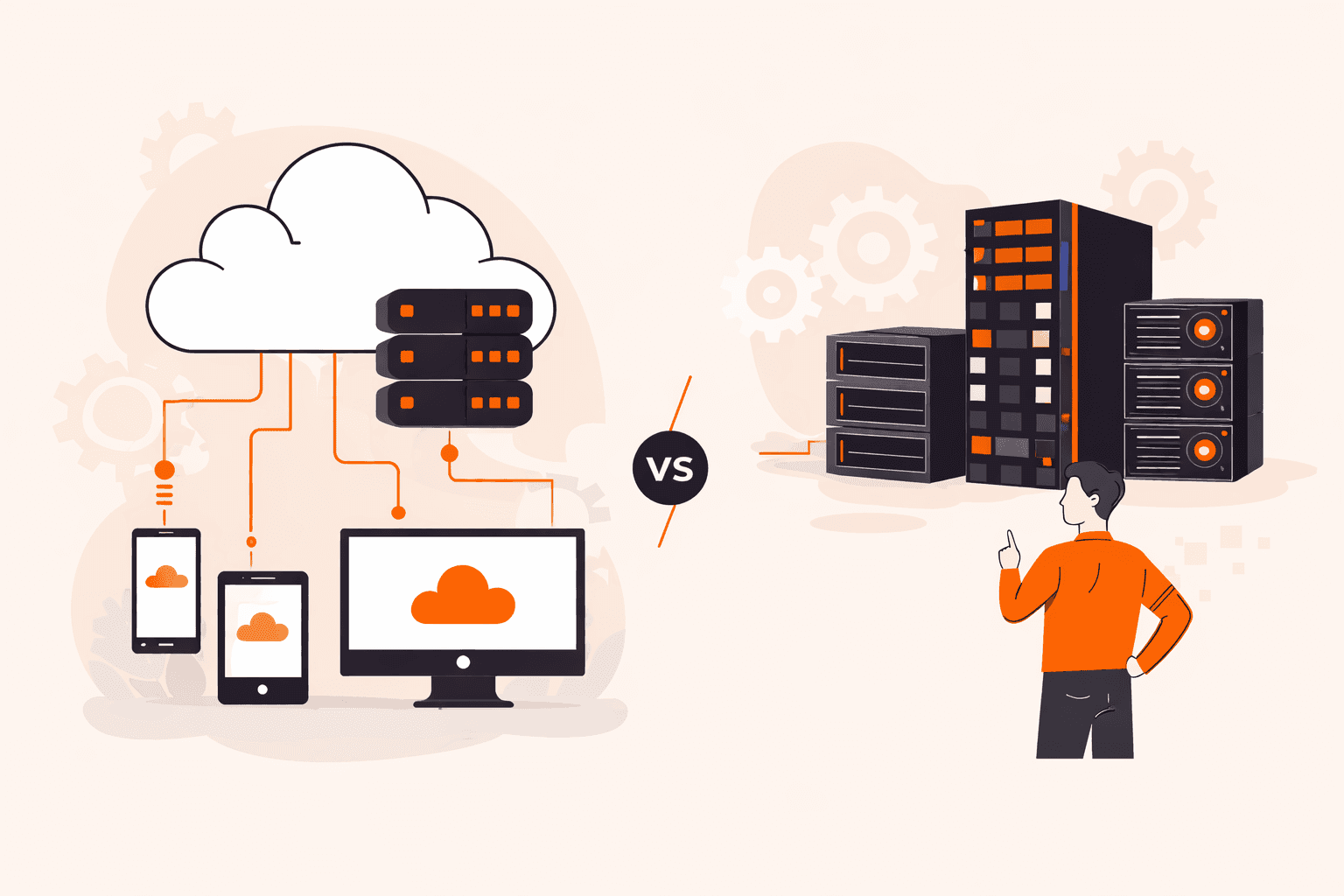
Your server choice could be quietly costing you, or quietly holding you back. Pick the wrong infrastructure for your workload and you're either overpaying for idle hardware every month or watching your site buckle under traffic spikes you could have absorbed instantly. The stakes are real: cloud servers can scale resources up or down during peak periods to cut wasted spend on idle infrastructure, while dedicated servers deliver exclusive CPU, RAM, and storage that eliminate the "noisy neighbor" performance drops that plague shared environments.
Neither option is universally better, and that's exactly the problem. A healthcare firm handling HIPAA-sensitive records has completely different needs than a startup scaling a donation portal through unpredictable traffic surges. Getting this decision wrong means either locking yourself into fixed monthly costs you can't justify, or exposing performance-critical workloads to resource competition you can't control.
You'll learn how cloud and dedicated servers actually compare on performance, cost structure, security, and compliance, plus the management tradeoffs each demands. You'll also find clear use-case breakdowns and a practical framework for choosing the right fit for your specific workload.
What is the difference between a cloud server and a dedicated server?
The core differences come down to resource ownership, scalability, and how you pay.
With a cloud server, your workload runs on virtualized resources spread across multiple physical machines. That shared infrastructure means you can scale up or down instantly. No hardware procurement, no waiting. The tradeoff? The "noisy neighbor" effect. Other tenants on the same hardware can occasionally affect your performance.
A dedicated server gives you an entire physical machine to yourself. Exclusive access to the CPU, RAM, and storage means consistent, predictable performance. That isolation also simplifies compliance documentation. Industries with strict requirements like HIPAA or GDPR sometimes prefer dedicated hosting because it simplifies audit trails, though cloud hosting with proper configuration and a Business Associate Agreement also meets these standards.
Think about use cases for a second. Cloud servers suit variable workloads well: startups, development environments, or a donation portal that spikes during campaigns. Dedicated servers are the better fit for high-traffic sites, data-intensive databases, and applications like case management software where performance needs to stay steady regardless of demand.
Cost works differently too. Cloud uses pay-as-you-go pricing, so your bill fluctuates with usage. That's great for unpredictable workloads, but harder to budget around. Dedicated servers carry fixed monthly fees, which makes financial planning straightforward if your resource needs are stable.
| Feature | Cloud server | Dedicated server |
|---|---|---|
| Resource ownership | Shared (virtualized) | Exclusive (physical) |
| Scalability | Instant, on-demand | Limited by hardware |
| Performance consistency | Variable (noisy neighbor risk) | High and predictable |
| Security model | Shared responsibility | Full physical isolation |
| Pricing | Pay-as-you-go (variable) | Fixed monthly fee |
| Best fit | Variable or unpredictable workloads | Stable, high-performance workloads |
How do cloud servers and dedicated servers compare on performance?
Performance comes down to your workload. Cloud and dedicated servers each have a clear edge, depending on what you're running.
Dedicated servers win on raw, sustained throughput. You're not sharing CPU cycles or memory with anyone else, so resource-intensive tasks like large database queries or video rendering run at full capacity without interruption. No I/O contention. Latency stays predictable.
Cloud servers can match that under normal conditions, but the noisy neighbor effect is a real risk. If another tenant on the same physical host spikes their resource usage, your workload feels it. Most of the time it's minor, but for latency-sensitive applications? It matters.
Here's where cloud pulls ahead: availability. If a host fails, cloud infrastructure can automatically restart your workload on healthy hardware, typically within a few minutes. For near-zero downtime, you'll need to architect your application across multiple instances and availability zones. During planned maintenance, live migration can move your workload with minimal disruption. Dedicated servers don't have that built-in failover. If the hardware fails, recovery depends entirely on your disaster plan.
Bursty workloads are another area where cloud shines. Dedicated hardware can't scale beyond its physical limits, so a traffic surge that exceeds capacity hurts performance fast. Cloud handles those spikes without breaking a sweat.
In simple terms: Dedicated servers win on consistent, predictable performance; cloud servers win on availability and handling sudden load spikes. Your workload type determines which trade-off matters more.
What are the cost differences between cloud and dedicated servers?
Cloud and dedicated servers don't just cost different amounts. They cost differently altogether, and that distinction matters more than most people realize.
Cloud servers run on pay-as-you-go pricing, billed by the hour or minute. That's genuinely useful when your workload fluctuates. At 3 AM when traffic drops, you're not paying for idle capacity sitting around doing nothing. The catch? Costs can creep up fast during sustained high usage, and without careful monitoring, your monthly bill can catch you off guard.
Dedicated servers flip that model entirely. Fixed monthly fee, regardless of how much you use the hardware. For stable, resource-heavy workloads, that predictability is valuable. Think of a law firm running case management software around the clock. They get more value from a flat, predictable cost than from metered usage that adds up the same way every month.
Where dedicated gets expensive is upfront. You're committing to a lease term, and if your needs shrink, you can't scale down. Cloud lets you right-size instantly. Spin down resources you don't need with autoscaling and stop paying for them.
In practice, stable high-utilization workloads often cost less on dedicated servers over time. For variable demand, startups, dev environments, seasonal traffic spikes, cloud's flexible pricing wins.
| Feature | Cloud servers | Dedicated servers |
|---|---|---|
| Pricing model | Pay-as-you-go (OpEx) | Fixed monthly fee (OpEx, or CapEx if owned) |
| Cost predictability | Variable, usage-dependent | Consistent and foreseeable |
| Idle resource cost | Minimal, scale down when unused | Full cost regardless of utilization |
| Scaling cost | Incremental, on demand | Requires new hardware commitment |
| Best value for | Variable or unpredictable workloads | Stable, high-utilization environments |
| Upfront commitment | Low | Higher, often contract-based |
How do cloud and dedicated servers handle security and compliance?
Cloud and dedicated servers take fundamentally different approaches to security, and which one fits depends heavily on your regulatory obligations.
With cloud servers, security is a shared responsibility. Your provider locks down the physical infrastructure, hypervisor, and network. Everything above that, including your OS, applications, access controls, and data, is on you. That split works fine for most workloads. The catch? You can't audit the hardware layer directly. If you're pursuing compliance certifications, you're partly relying on your provider's attestations to fill that gap.
Dedicated servers are a different story. Full physical isolation, no shared hardware, no noisy neighbors, no multi-tenant risk. That eliminates multi-tenant attack vectors and can simplify compliance audits. Healthcare organizations handling patient data under HIPAA, or firms managing financial records under PCI DSS or GDPR, may choose dedicated hosting to simplify their audit trail — though cloud providers also offer compliant shared infrastructure with the right agreements and configurations. You control the entire stack, from hardware configuration down to firewall rules.
If your industry requires demonstrable control over physical infrastructure, dedicated servers make that audit trail much easier to defend. Cloud can meet strict compliance requirements too, but it takes more deliberate configuration, thorough documentation, and real trust in your provider's compliance attestations since you can't directly audit the underlying hardware.
In simple terms: Cloud security is a shared job between you and your provider, while dedicated servers give you more control — and more responsibility. For compliance-sensitive workloads, dedicated hosting simplifies audit documentation, but cloud hosting with proper configuration meets the same regulatory standards.
What are the management and maintenance differences?
It really comes down to one question: how much of the operational burden do you want to own?
- Cloud automation: Cloud providers handle the underlying infrastructure for you. Hardware failures trigger live VM migration automatically, patches get applied at the hypervisor level, and you can schedule backups through a dashboard without touching a command line. It largely runs itself.
- Dedicated server ownership: With a dedicated server, you own the full maintenance stack. OS updates, firewall rules, security patches, hardware monitoring, all of it lands on you unless you pay for managed services on top.
- Provisioning speed: Spinning up a cloud server takes minutes through a web console or API call. Dedicated servers typically take hours to days, depending on hardware availability and data center configuration.
- Managed dedicated options: Most dedicated hosting providers offer managed tiers that handle patching, monitoring, and support. It's a solid middle ground, you keep the isolation benefits while offloading day-to-day operations.
- Scaling operations: Cloud scaling is largely automated. Set your thresholds, and the platform adds or removes resources without manual intervention. Scaling a dedicated environment means physically provisioning new hardware, which takes planning and lead time.
- Monitoring and observability: Cloud platforms ship with built-in monitoring dashboards, alerting, and logging integrations. Dedicated servers need third-party tools or custom setups to reach the same level of visibility.
- Disaster recovery and redundancy: Cloud environments handle failover automatically across multiple physical hosts. If continuous availability is critical and you don't want to architect your own standby systems, our disaster recovery service handles failover for you.
- Access and control: Dedicated servers give you root-level access to configure hardware settings, custom kernel parameters, and specialized software stacks that cloud environments can't always support.
| Term | What it does | Best for |
|---|---|---|
| Cloud automation | Handles patching, failover, backups automatically | Teams with limited ops resources |
| Dedicated server ownership | Full control over every maintenance task | Teams needing custom configurations |
| Provisioning speed | Cloud spins up in minutes; dedicated takes hours to days | Rapid deployment needs |
| Managed dedicated options | Offloads ops while keeping physical isolation | Regulated workloads, lean teams |
| Scaling operations | Cloud scales automatically; dedicated requires planning | Variable vs. stable workloads |
| Monitoring and observability | Cloud includes built-in tools; dedicated needs custom setup | Teams prioritizing visibility |
| Disaster recovery | Cloud automates failover; dedicated needs manual architecture | High-availability requirements |
| Access and control | Root-level hardware access on dedicated only | Custom software and hardware needs |
What are the best use cases for cloud vs. dedicated servers?
It really comes down to one question: how predictable is your workload?
- Variable traffic workloads: Traffic spikes you can't plan for, like seasonal sales, viral content, or donation drives, are exactly what cloud servers handle well. Scale capacity up during peaks, back down when demand drops. You only pay for what you use, so idle infrastructure doesn't burn budget.
- Startup and dev environments: Cloud is the natural fit for early-stage teams. You can spin up test environments in minutes, iterate fast, and avoid committing to hardware before you actually know your resource needs.
- High-traffic production sites: Running consistently heavy workloads? Large e-commerce platforms, high-volume databases. Dedicated servers eliminate the noisy neighbor effect that can degrade cloud performance under sustained load.
- Regulated industries: Healthcare, finance, and legal sectors sometimes prefer dedicated servers for compliance simplicity with standards like HIPAA or GDPR. Physical isolation can simplify audit documentation, though cloud infrastructure with proper configuration also meets these requirements.
- Resource-intensive applications: Workloads like video rendering, scientific computing, or large-scale data processing benefit from dedicated CPU and RAM that aren't shared with other tenants.
- Disaster recovery and redundancy: Cloud environments handle failover automatically across multiple physical hosts. If continuous availability is critical and you don't want to architect your own standby systems, cloud wins here.
- Custom software stacks: Some applications need specific kernel parameters, custom drivers, or hardware configurations that virtualized environments can't support. Dedicated servers give you that root-level flexibility.
- Predictable, stable workloads: If your traffic is steady and you can forecast resource needs accurately, dedicated servers offer fixed monthly costs that are easier to budget than fluctuating cloud bills.
| Use case | What it does | Best for |
|---|---|---|
| Variable traffic workloads | Scales resources up and down with demand | Seasonal or unpredictable traffic |
| Startup and dev environments | Fast provisioning with no hardware commitment | Early-stage teams, testing |
| High-traffic production sites | Eliminates resource competition for sustained loads | Large databases, e-commerce |
| Regulated industries | Physical isolation supports compliance audits | Healthcare, finance, legal |
| Resource-intensive applications | Exclusive CPU and RAM for heavy compute tasks | Rendering, data processing |
| Disaster recovery and redundancy | Automatic failover across multiple hosts | High-availability requirements |
| Custom software stacks | Root-level access for specialized configurations | Custom kernels, hardware setups |
| Predictable, stable workloads | Fixed costs for forecastable resource usage | Budget-sensitive stable workloads |
How do you choose between a cloud server and a dedicated server?
Match your workload profile to the strengths of each option. Don't chase the cheapest price or the most impressive specs.
Start with your traffic pattern. If demand fluctuates, cloud servers let you scale without committing to hardware you'll only need occasionally. Steady, predictable load? Dedicated servers give you fixed costs and consistent performance that cloud billing can't match.
Next, think about compliance. Regulated industries may prefer dedicated hosting for compliance simplicity, but physical isolation is not a regulatory mandate — HIPAA, GDPR, and PCI DSS can all be met on properly configured cloud infrastructure with appropriate agreements in place. Cloud's shared responsibility model works for many organizations, though it adds complexity to audit documentation that dedicated hosting simplifies.
Then consider your team's capacity. Cloud management is largely automated, patching, backups, and failover happen without manual intervention. Dedicated servers put that responsibility on you unless you opt for managed services.
Here's the honest answer: most organizations don't need to pick one forever. Hybrid cloud approaches work well when your core workload is stable but you need burst capacity for peaks.
In simple terms: Match cloud to variable, unpredictable workloads and dedicated to stable, high-performance, or compliance-sensitive ones, then decide who manages the infrastructure day to day.
How can Gcore help with cloud and dedicated server hosting?
Gcore supports both virtual machine hosting and dedicated server hosting, so you don't have to choose a provider when your needs span both models. The Gcore platform lets you deploy cloud instances for variable workloads and provision dedicated servers for performance-critical or compliance-sensitive environments, all from the same infrastructure.
Gcore's global network spans 210+ points of presence, giving your workloads low-latency connectivity regardless of which hosting model you choose. If you need to scale cloud resources during traffic peaks and keep dedicated hardware for your core database layer, that's a configuration Gcore supports without forcing you into a single-tier architecture.
Explore Gcore cloud and dedicated hosting options to find the right fit for your workload.
Frequently asked questions
Is a cloud server faster than a dedicated server?
Not exactly. Dedicated servers typically deliver more consistent raw performance because you're not sharing CPU and RAM with other tenants. Cloud servers can match or exceed that speed under normal loads, but the "noisy neighbor" effect can cause unpredictable slowdowns that dedicated hardware simply doesn't have.
Can I switch from a dedicated server to a cloud server later?
Yes, you can migrate from a dedicated server to a cloud server. It takes planning, though. You'll need to transfer your data, reconfigure networking, and test your applications before cutting over fully.
Which is more secure: a cloud server or a dedicated server?
Neither is inherently more secure. Dedicated servers offer more control over security configuration and eliminate multi-tenant risks, which can simplify compliance audits. Cloud providers invest heavily in infrastructure security, automated patching, and managed security tools. The right choice depends on your team's expertise and your specific compliance requirements.
How much does a dedicated server cost compared to a cloud server?
Dedicated servers typically run on fixed monthly fees. Predictable, yes, but you pay whether you're using the resources or not. Cloud servers charge based on actual usage, which costs less for variable workloads but can spike unexpectedly under heavy load.
What is a hybrid cloud and dedicated server setup?
A hybrid setup combines both: you run steady, predictable workloads on dedicated servers while using cloud resources to handle traffic spikes or development environments. You get the performance isolation of dedicated hardware alongside the flexibility of on-demand scaling.
Which option is better for high-traffic applications?
Dedicated servers handle high-traffic applications better when your loads are consistent and predictable. You get exclusive CPU and RAM with no noisy neighbor interference. If your traffic spikes unpredictably, cloud servers win. Automatic failover and instant scaling keep your app available without over-provisioning hardware you'll only need occasionally.
Do I need technical expertise to manage a dedicated server?
Yes, managing a dedicated server requires solid sysadmin skills. You'll handle OS updates, firewall configuration, and hardware troubleshooting yourself. If that's not your team's strength, most providers offer managed dedicated hosting where they take care of day-to-day maintenance for you.

Related articles
Imagine discovering that migrating your company's data to a new cloud provider will cost hundreds of thousands of dollars in egress fees alone, before you've even touched the re-engineering work. Or worse, picture being in Synapse Financial
Subscribe to our newsletter
Get the latest industry trends, exclusive insights, and Gcore updates delivered straight to your inbox.