



Vendor Lock-In in Cloud Computing: What It Is and How to Avoid It
- March 9, 2026
- 7 min read
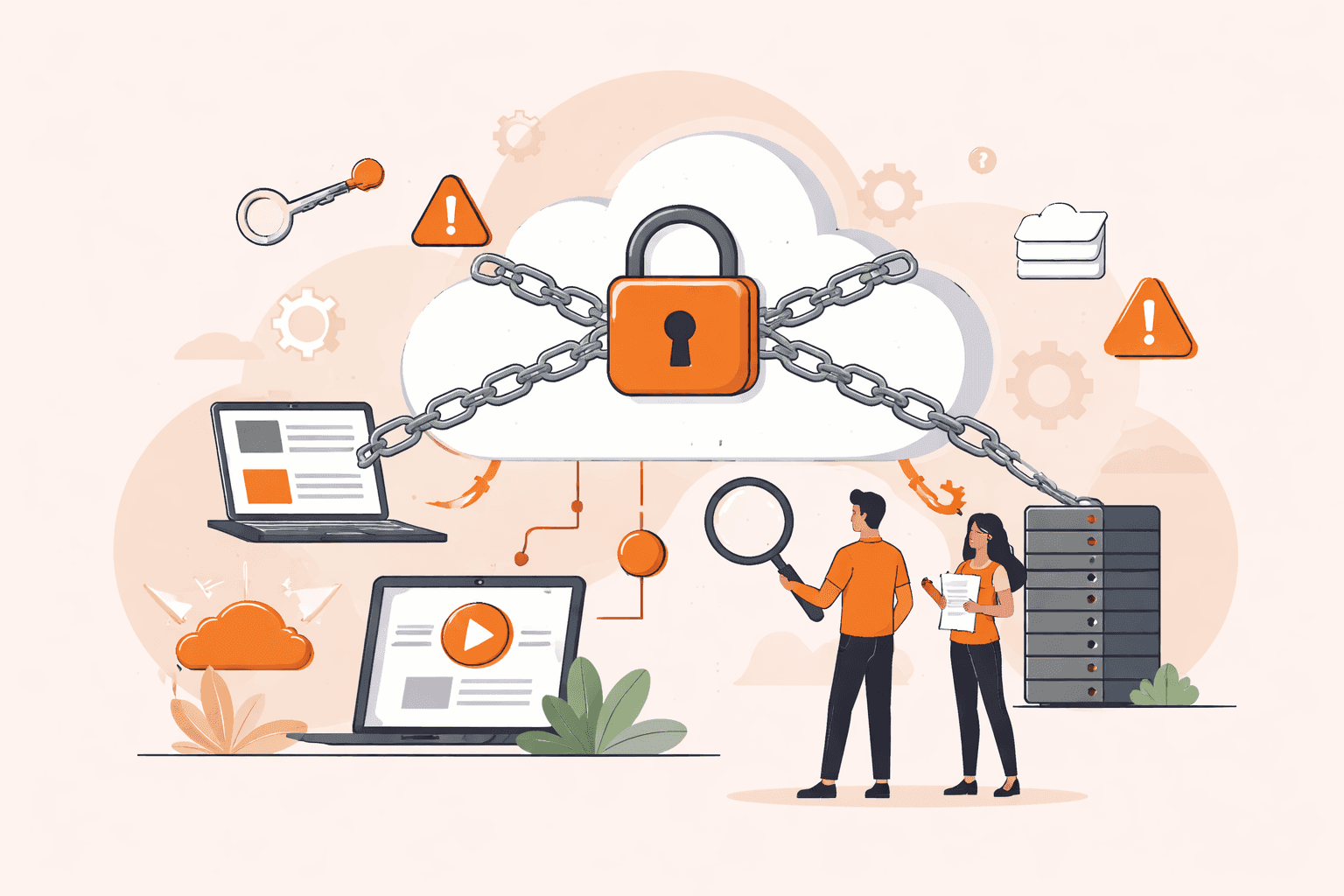
Imagine discovering that migrating your company's data to a new cloud provider will cost hundreds of thousands of dollars in egress fees alone, before you've even touched the re-engineering work. Or worse, picture being in Synapse Financial Technologies' position, where vendor lock-in became so severe that a database provider threatened to delete a critical data cache needed to distribute $100 million to customers, ultimately contributing to a Chapter 11 bankruptcy filing. These aren't edge cases. They're the real consequences waiting at the end of a road most organizations don't realize they're already on.
The three major cloud providers, have each built advanced ecosystems of proprietary APIs, long-term contracts, and deeply integrated services designed to make leaving painful. Commitments ranging from one to three years come with financial penalties for early termination, while specialized services create technical dependencies that require substantial re-engineering to replicate elsewhere. The cloud industry doesn't treat this as a flaw. It treats it as a feature.
In this article, you'll learn exactly how vendor lock-in traps organizations, which mechanisms each provider uses, and the proven strategies you can use right now to protect your business before switching becomes unthinkable.
What is vendor lock-in in cloud computing?
Cloud vendor lock-in happens when your organization becomes so dependent on a single provider's proprietary technologies, contracts, or data formats that switching becomes prohibitively expensive, time-consuming, or technically complex. It's not just about preferring one platform. It's about the technical and contractual barriers that make leaving extremely difficult. Proprietary APIs, high data egress fees, long-term contracts with exit penalties, and deeply integrated service bundles all work together to make migration feel impossible. The result? Your provider gains serious negotiating power over pricing and service terms, while you lose the freedom to shop around.
How does cloud vendor lock-in happen?
Cloud vendor lock-in happens gradually, often before you realize it's a problem. You start with a simple service, object storage, a managed database, a serverless function, and it works well. So you add more services. Each one integrates cleanly with the last, and before long, your architecture depends on a dozen proprietary tools that don't exist anywhere else.
The mechanism is straightforward. Proprietary APIs, custom data formats, and tightly bundled services create technical dependencies that are expensive to untangle. A data lake built on one provider's storage, query engine, and pipeline tools can't simply be lifted and moved. It typically requires significant redevelopment and testing to rebuild on another platform.
Financial incentives deepen the trap. Reserved instance discounts and enterprise agreements offer real savings, but they require one- to three-year commitments with penalties for early exit. Data egress fees add another barrier: moving large datasets out costs money, which makes migration increasingly unattractive as your data grows.
What are the main risks of cloud vendor lock-in?
Cloud vendor lock-in risks are the business vulnerabilities that emerge when your core infrastructure becomes too dependent on a single provider's ecosystem. Here are the main ones to watch for.
- Pricing vulnerability: When you're deeply integrated with one provider, they control your costs. If they raise prices, you have little choice but to pay. Switching is too expensive and disruptive to be a realistic alternative.
- Data egress fees: Moving data out of a cloud environment isn't free. Major providers charge egress fees that create a direct financial barrier to migration, making the cost of leaving higher than the cost of staying.
- Proprietary service dependencies: Specialized services like serverless compute, managed databases, and analytics platforms are built to work within a specific provider's ecosystem. Replicating that functionality elsewhere requires significant re-engineering effort.
- Contract penalties: Reserved instance discounts and enterprise agreements often lock you in for one to three years. Early termination triggers financial penalties that can make switching economically unviable.
- Reduced negotiating power: Once your core infrastructure is deeply integrated, you lose bargaining power. The provider knows migration costs are high, which weakens your position during contract renewals or pricing disputes.
- Cascading service dependencies: Bundled services, storage, compute, analytics, visualization, are optimized to work together within one ecosystem. The more services you adopt from a single provider, the harder it becomes to untangle them later.
- Business continuity risk: If your provider experiences outages, changes its service terms, or discontinues a product, your options are limited. The Synapse Financial Technologies case illustrates this well: vendor lock-in with a database provider threatened the deletion of data needed to distribute $100 million to customers.
- Migration complexity: Migrating isn't just a technical challenge. It's a project that can span months or years. Munich's LiMux project attempted to move its entire IT infrastructure away from a major proprietary platform, only to revert back after finding the migration too complex to complete successfully.
- Compliance and regulatory exposure: If your provider doesn't meet evolving regulatory requirements in your region, you may need to migrate quickly. Lock-in makes that kind of rapid response extremely difficult.
What are real-world examples of cloud vendor lock-in?
Real-world examples of cloud vendor lock-in show how quickly deep dependence on a single provider can box your organization into a corner.
- Munich's LiMux project: The city of Munich spent years migrating its IT infrastructure from Microsoft to open-source software, only to reverse course entirely. Documents and applications were so deeply tied to proprietary formats that the migration became unworkable.
- Synapse Financial Technologies: This fintech company filed for Chapter 11 bankruptcy partly because its database provider threatened to delete a critical data cache. That cache held the records needed to distribute $100 million to customers, a stark reminder of how lock-in can become an existential risk.
- Proprietary data lake dependencies: When you build a data lake using a single provider's storage, processing, and visualization tools, each service compounds the dependency. Migrating that data lake later means rebuilding and retesting nearly everything from scratch.
- Serverless function sprawl: Building applications around a provider's proprietary serverless platform means your code, event triggers, and integrations are written specifically for that environment. Porting to another platform requires substantial redevelopment, not just a simple lift-and-shift.
- Reserved instance commitments: Major cloud providers offer significant discounts in exchange for one- to three-year commitments. Breaking those agreements early triggers financial penalties, which effectively traps you even if a better option appears.
- Proprietary database dependencies: Specialized managed databases, particularly NoSQL and analytics-optimized offerings, use custom APIs that don't map cleanly to alternatives. Switching means re-engineering your data access layer, not just pointing to a new endpoint.
- Deep enterprise software dependencies: Organizations running workloads tightly coupled to a provider's enterprise software ecosystem face compounding dependencies. Hybrid benefit programs encourage even deeper integration, making the cost of leaving higher with every service you add.
How do you assess your current level of vendor lock-in?
You assess your lock-in level by auditing which provider-specific services your workloads depend on. Start by cataloging every service in your stack, databases, serverless functions, storage buckets, analytics tools, and flag anything that uses a proprietary API or has no open-source equivalent.
Next, calculate your data egress costs. If moving your data elsewhere would cost thousands of dollars in transfer fees, that's a concrete lock-in signal. Check your contracts too. Reserved instance commitments ranging from one to three years with early termination penalties are a hard dependency, not just a technical one.
Then assess replaceability. For each proprietary service, ask: could you swap this for an open standard or containerized alternative without rewriting significant portions of your application? If the answer is no for most of your stack, you're deeply locked in.
The key thing here is to think in layers. IaaS, PaaS, and SaaS each carry different lock-in risks. A managed database service is far harder to migrate than a virtual machine.
How to avoid cloud vendor lock-in?
You avoid cloud vendor lock-in by building portability into your architecture from the start, rather than trying to escape a provider's ecosystem after you're already deep inside it.
Adopt open standards and portable technologies. Build on open-source tools, container formats, and standard APIs wherever possible. When your workloads run in containers orchestrated by Kubernetes, moving them between providers becomes a configuration change, not a redevelopment project. A managed Kubernetes service simplifies that further by handling the orchestration layer for you.
Design for multi-cloud from day one. Spread workloads across two or more providers based on capability and cost. This isn't just a backup plan. It gives you real negotiating power when contract renewal comes around.
Avoid proprietary managed services for critical workloads. Proprietary databases, serverless platforms, and analytics tools are convenient, but they're also the stickiest parts of any cloud ecosystem. If you can't run an equivalent service elsewhere, you're locked in.
- Monitor and control data egress costs. Egress fees are one of the biggest financial barriers to migration. Know exactly how much data leaves your environment each month, and architect your systems to reduce unnecessary cross-provider data transfers.
Use provider-agnostic infrastructure as code tools. Tools like Terraform let you define your core infrastructure in a portable way. If you've written everything in a provider's proprietary deployment format, you've added another layer of migration complexity.
- Negotiate exit terms into your contracts. Before signing any enterprise agreement, ensure your contract includes clear data portability guarantees, reasonable egress fee caps, and exit clauses without punishing financial penalties.
- Test your portability regularly. Don't assume you can migrate until you've actually tried. Run periodic drills where you deploy a workload to an alternative provider. You'll discover hidden dependencies before they become emergencies.
The Synapse Financial Technologies case is a useful reminder here. The company's inability to access its own data during a crisis contributed to a bankruptcy filing. Portability isn't just a technical preference. It's a business continuity requirement.
How can Gcore help you avoid vendor lock-in?
Gcore reduces vendor lock-in risk by building its infrastructure around open standards, portable workloads, and transparent pricing, so you're less likely to be trapped by proprietary dependencies. Gcore bare metal hosting and cloud instances run on open-source-friendly environments, and there are no punishing egress fees that make leaving expensive.
There's no pressure to commit to multi-year contracts just to get reasonable pricing. You get competitive rates without the lock-in mechanics that major cloud providers use to keep customers from exploring alternatives.
Explore Gcore Edge Cloud to see how it fits into a portable architecture.
Frequently asked questions
What is the difference between vendor lock-in and vendor dependency?
Vendor dependency is manageable. You rely on a provider's tools but can still switch if needed. Vendor lock-in is when that dependency becomes a trap, where proprietary APIs, egress fees, or deep integrations make leaving so costly and complex that you effectively can't.
Is cloud vendor lock-in always a bad thing?
Not always. Staying with one provider can make sense if the deep integration genuinely improves performance and reduces operational complexity for your use case. The real problem starts when that dependency gives the provider unchecked power over your pricing and service terms.
How much does it cost to migrate away from a locked-in cloud provider?
Migration costs vary widely depending on how deeply you're embedded in a provider's proprietary services, but expect to budget for data egress fees, re-engineering work, and potential early-termination penalties from long-term contracts. The Synapse Financial Technologies case shows the stakes can go beyond money. Vendor lock-in can threaten business survival itself.
What cloud providers are most associated with vendor lock-in issues?
The three major cloud providers, the big hyperscalers, are most associated with vendor lock-in, each using different tactics: proprietary databases and serverless functions, deep enterprise software integration, and specialized analytics services with custom APIs that don't port cleanly elsewhere. Data egress fees and one- to three-year reserved instance commitments make the problem worse once you're deep in their ecosystems.
How does a multi-cloud plan reduce vendor lock-in risk?
Spreading your workload across multiple cloud providers means no single vendor controls your core infrastructure, so you're never fully at their mercy when prices rise or terms change. Open standards and portable architectures keep your options open, making migration a business decision rather than a technical crisis.
What role do open-source tools play in preventing cloud lock-in?
Open-source tools like Kubernetes, Terraform, and PostgreSQL let you build on portable, standards-based foundations that any provider can run, reducing the amount of redevelopment required when switching. Provider-specific integrations may still require migration work, but these tools shift the power balance back in your favor.
How does vendor lock-in affect data sovereignty and compliance?
Vendor lock-in can force your data to stay within a specific provider's infrastructure, making it hard to meet local data residency laws or switch to a compliant region. If your provider's terms don't align with regulations like GDPR, you're stuck negotiating from a weak position.

Related articles

Subscribe to our newsletter
Get the latest industry trends, exclusive insights, and Gcore updates delivered straight to your inbox.