


What Is Sovereign Cloud and Why Does It Matter?
- March 9, 2026
- 8 min read
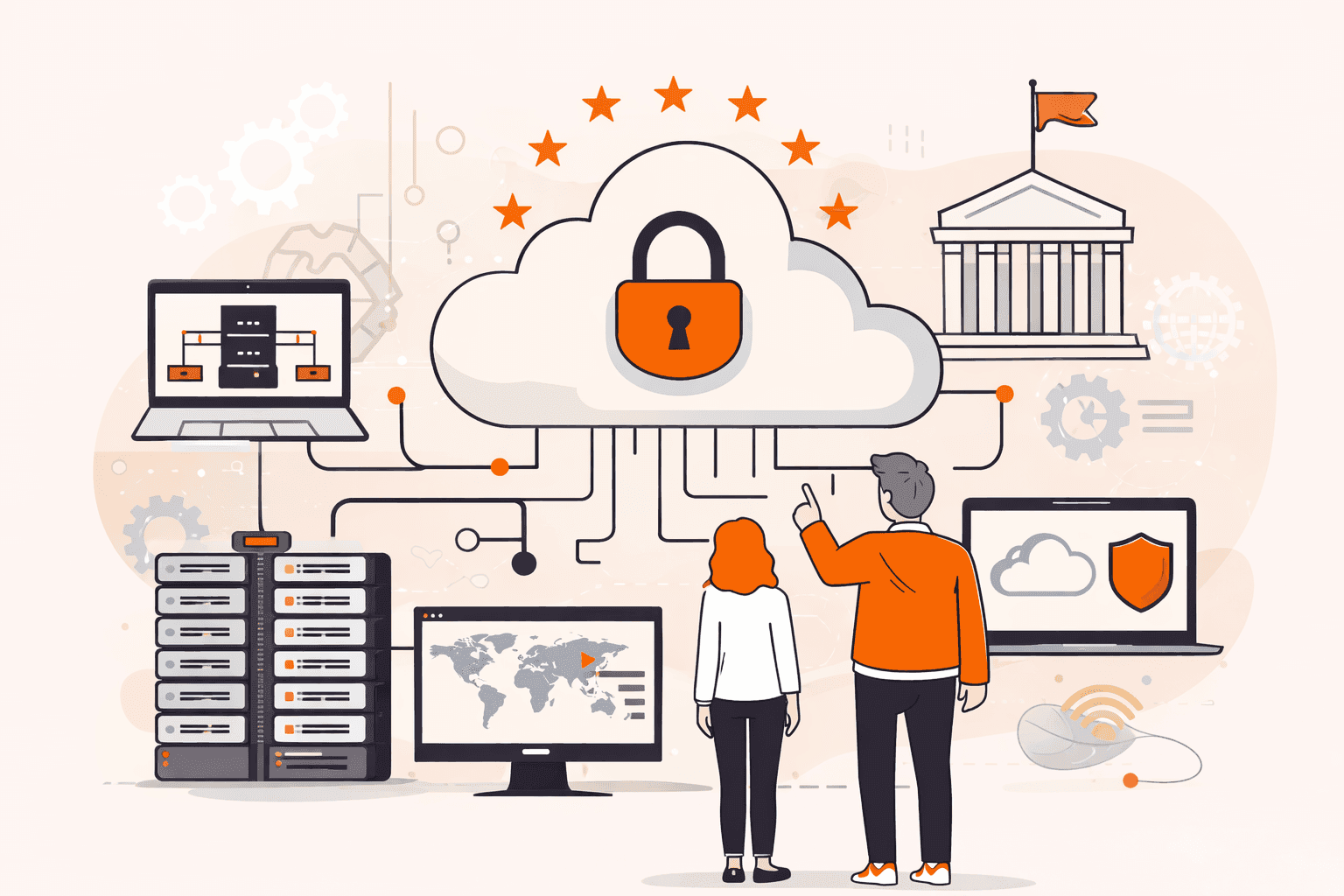
Picture this: a foreign government issues a legal order forcing your cloud provider to hand over sensitive patient records, classified research data, or critical national infrastructure details. You can't stop it. This isn't hypothetical. Geopolitical tensions are rising, regulations like GDPR are mandatory across Europe and beyond, and the consequences of storing sensitive data under foreign legal jurisdiction have never been more serious.
For organizations in government, healthcare, finance, and advanced research, the stakes are real. Your proprietary algorithms, your citizens' private data, your classified operations, all potentially exposed to foreign legal requests the moment you rely on a hyperscaler operating outside your country's legal boundaries. Regulators aren't waiting, and demand for a better solution is growing fast.
This guide explains exactly how sovereign cloud works, what makes it different from traditional public cloud, and how to evaluate whether your organization needs it, including the key features, real-world use cases, and best practices for choosing the right approach.
What is sovereign cloud?
Sovereign cloud is a cloud computing environment where your data, applications, and infrastructure stay within a specific country's legal jurisdiction, fully protected from foreign access, legal requests, and geopolitical interference. Unlike standard public cloud deployments, it ensures data stays within defined borders at rest, in transit, and during processing. That distinction matters enormously for organizations handling sensitive information. When a foreign government can legally compel a cloud provider to hand over your data, "secure" stops meaning what you think it means.
The real value goes beyond simple data residency. Sovereign cloud gives you operational control through local governance, organization-managed encryption keys, dedicated networking, and full auditability of both hardware and software stacks. Sectors like government, healthcare, finance, and advanced research rely on it to meet strict compliance requirements, GDPR being the most prominent example, while protecting intellectual property from exploitation. It's not just a compliance checkbox. It's technological independence.
Why is sovereign cloud important?
Data doesn't stay private by default. Foreign governments can legally compel major cloud providers to hand over data stored on their infrastructure, even if that data belongs to your organization.
For regulated industries like healthcare, finance, and government, that's an unacceptable risk. Strict frameworks like GDPR require data to stay within defined borders, and violating those rules carries serious legal consequences.
There's also the geopolitical angle. If your critical operations depend on infrastructure controlled by a foreign entity, you're exposed to disruptions you can't predict or control. Sovereign cloud keeps your data, processing, and governance within your own jurisdiction, so your business continuity isn't hostage to someone else's political climate.
The result is real operational independence: full auditability, locally managed encryption keys, and compliance you can actually demonstrate to regulators.
How does sovereign cloud work?
Sovereign cloud keeps all your data, workloads, and infrastructure within a defined legal and geographic boundary, and enforces that boundary at every layer of the stack.
Here's what that means in practice. Data residency controls ensure your data stays within a specific country, whether it's at rest, in transit, or being processed. Dedicated networking (sometimes air-gapped, sometimes private VPN) prevents unauthorized external access. You manage your own encryption keys, so no third party can decrypt your data without your explicit authorization.
Jurisdictional control is the other critical piece. Because the infrastructure runs under local law, foreign governments can't compel access through legal mechanisms that apply to multinational providers. Local personnel handle operations, and full audit trails give regulators and your own compliance teams verifiable proof of control.
The result is a cloud environment where you're not just trusting a provider's policies. You're backed by legal frameworks, technical architecture, and operational governance that all point to the same jurisdiction.
What are the key features of sovereign cloud?
Sovereign cloud features center on one goal: keeping your data, operations, and legal obligations inside a defined jurisdiction. Here's what that looks like in practice.
- Data residency: Your data stays within specific geographic borders at rest, in transit, and during processing. No foreign-jurisdiction server processes or stores it.
- Jurisdictional control: Local legal frameworks govern all operations, so foreign courts and governments can't compel access to your data. This is the core protection that public clouds can't reliably offer.
- Regulatory alignment: Built-in compliance with regional frameworks like GDPR means your core infrastructure meets mandatory requirements by design, not as an afterthought.
- Organization-managed encryption keys: You hold the keys, not the provider. Dedicated key management prevents third-party access, even at the infrastructure level.
- Dedicated networking: Air-gapped environments or private VPN connections isolate your workloads from shared public infrastructure, reducing exposure to external threats. Many sovereign clouds use secure networking rather than full air-gapping, and complete isolation isn't a universal requirement.
- Full auditability: Complete visibility into hardware and software stacks lets you verify compliance and demonstrate it to regulators. Audit trails support trust with both customers and governing bodies.
- Personnel vetting: Staff with access to sovereign environments undergo rigorous background checks. This closes the human vector that technical controls alone can't address.
- Vendor portability: Open standards let you migrate workloads without being locked into a single provider's proprietary stack, which is critical for long-term operational independence.
- Planned autonomy: Because sovereign clouds prioritize compliance over raw scalability, you're insulated from geopolitical disruptions that could affect hyperscaler availability or data access in your region.
What are the benefits of sovereign cloud?
Sovereign cloud benefits go beyond simple data storage. They give your organization genuine control over where data lives, who can access it, and how it's governed.
- Data residency: Your data stays within defined geographic and legal boundaries at rest, in transit, and during processing. This matters most when regulations like GDPR require you to prove exactly where data is stored and handled.
- Jurisdictional immunity: Because data stays within defined borders and under local legal frameworks, foreign governments have significantly less ability to compel access through subpoenas or national security orders. You're protected by domestic law rather than foreign jurisdiction.
- Regulatory compliance: Sovereign cloud infrastructure is built around local legal requirements from the start, not retrofitted to meet them. For regulated industries like healthcare and finance, that's a meaningful difference.
- Encryption key control: You manage your own encryption keys rather than sharing that responsibility with a provider. If you control the keys, you control who can read your data.
- Auditability: Full visibility into hardware and software stacks means you can verify compliance claims rather than trust them. Regulators and customers get transparency backed by evidence.
- Reduced geopolitical risk: When infrastructure is locally owned and operated, your operations don't depend on the political relationship between two countries. Business continuity stays insulated from tensions outside your control.
- IP protection: Research institutions and technology companies can run AI workloads and proprietary algorithms without risk of foreign exploitation. Your intellectual property stays yours.
- Vendor portability: Open standards mean you're not locked into a single provider's ecosystem. You can migrate workloads if priorities change, which keeps your long-term options open.
What are the main challenges of sovereign cloud adoption?
Sovereign cloud comes with real trade-offs. These are worth understanding before you commit.
- Higher infrastructure costs: Building or contracting dedicated, in-country infrastructure is expensive. You don't get the economies of scale that shared public cloud environments offer, so per-unit costs are often higher.
- Limited geographic scalability: Sovereign clouds are bounded by jurisdiction, by design. If your workloads need to span multiple regions quickly, that constraint becomes a genuine bottleneck.
- Talent and operational complexity: Running a sovereign environment requires specialized expertise in compliance, security, and local regulatory frameworks. Finding and retaining that talent in-country isn't always straightforward.
- Vendor lock-in risk: Not all sovereign cloud providers support open standards or interoperable technologies. If portability wasn't built in from the start, migrating workloads later gets painful.
- Compliance overhead: Regulatory alignment isn't a one-time checkbox. Requirements like GDPR evolve, and keeping your environment continuously compliant demands dedicated governance processes and audit trails.
- Slower feature velocity: Sovereign environments prioritize control over agility. New capabilities typically arrive later than on hyperscaler platforms, because every update must pass stricter vetting.
- Integration challenges: Connecting sovereign infrastructure to existing systems, especially legacy on-premises environments, often requires custom networking solutions like private VPNs or air-gapped configurations, which add complexity.
- Supply chain transparency: Full auditability of hardware and software stacks is a core sovereign requirement, but verifying every component in the supply chain is time-consuming and technically demanding.
How does sovereign cloud compare to other cloud models?
Sovereign cloud sits in a different category from standard public, private, and hybrid cloud models. The core difference isn't about performance or price. It's about control and legal jurisdiction.
Public cloud gives you scalable, shared infrastructure, but your data can physically reside anywhere the provider chooses. If that provider runs under foreign law, your data is potentially subject to foreign legal requests. You don't control where it lives or who can access it.
Private cloud brings more control, but it doesn't automatically mean your data stays within a specific legal boundary or that operations align with national sovereignty requirements. You can run a private cloud in a data center that's still subject to another country's laws. Private clouds may also lack the regulatory alignment and auditability that sovereign clouds specifically provide.
Sovereign cloud changes the equation entirely. Data residency is guaranteed within defined borders at rest, in transit, and during processing. Operations run under local jurisdiction, with local staff and domestic legal frameworks. That's what separates it from the others: it's not just where the servers are, it's who legally controls them.
How to choose the right sovereign cloud provider?
Not every provider calling itself "sovereign" actually delivers full sovereignty. Here's what to look for when evaluating your options.
- Data residency guarantees: Confirm that your data stays within your required jurisdiction at rest, in transit, and during processing. Vague commitments aren't enough. You need contractual guarantees backed by auditable infrastructure.
- Local legal ownership and operations: The provider should be incorporated, staffed, and operated under your country's legal framework. Foreign parent companies can undermine sovereignty even when the servers are local.
- Encryption key control: You should manage your own encryption keys, not the provider. If they hold the keys, they hold access, and so does anyone who can compel them legally.
- Compliance certifications: Look for verifiable alignment with relevant regulations, whether that's GDPR or sector-specific standards in healthcare, finance, or defense. Certifications should be current and independently audited.
- Open standards and portability: Proprietary lock-in defeats the purpose of sovereignty. Choose providers built on interoperable technologies so you can migrate workloads without starting from scratch.
- Full auditability: You need visibility into the entire hardware and software stack, not just the application layer. Audit trails and transparent governance matter to regulators and your own security teams.
- Incident response under local jurisdiction: When something goes wrong, who responds and under which legal authority? Ensure breach notification, access controls, and personnel vetting all fall within your domestic legal framework.
How can Gcore help with sovereign cloud?
Gcore helps organizations meet sovereign cloud requirements through secure cloud computing that keeps data, workloads, and infrastructure within specific legal jurisdictions, fully insulated from foreign access or cross-border legal exposure. Gcore's cloud infrastructure deploys across dedicated regional environments where you control the keys, the access policies, and the audit trail.
If you're in a regulated sector such as government, healthcare, or finance, that level of control isn't optional. It's the baseline. Gcore's bare metal hosting and cloud infrastructure support strict data residency requirements, organization-managed encryption, and verifiable compliance so your sensitive workloads stay where they're supposed to.
Explore Gcore Edge Cloud to see how it supports your sovereign cloud requirements.
Frequently asked questions
What is the difference between sovereign cloud and private cloud?
A private cloud gives you dedicated infrastructure, but it doesn't automatically protect you from foreign legal jurisdiction. Sovereign cloud adds that layer, ensuring your data stays within specific national borders and under local law. The distinction matters most for regulated industries where a government subpoena to an overseas parent company could expose your data regardless of where the servers sit.
What regulations require sovereign cloud compliance?
GDPR in Europe is the most prominent driver, but sector-specific mandates such as NIS2, HIPAA, ITAR, and national data localization laws are also pushing organizations toward sovereign cloud. If you handle government, healthcare, or financial data, there's almost certainly a regulation in your jurisdiction requiring strict data residency and jurisdictional control.
Is sovereign cloud more expensive than standard cloud?
Yes, sovereign cloud typically costs more than standard cloud because you're paying for dedicated infrastructure, local compliance overhead, and specialized operational controls. The trade-off is reduced legal risk and regulatory penalties, which often outweigh the higher base cost for regulated industries.
How does sovereign cloud support AI and data processing workloads?
Sovereign cloud keeps AI workloads (training data, model weights, and inference pipelines) inside defined legal boundaries, so your intellectual property stays protected from foreign access or legal compulsion. That's especially critical for research institutions and government agencies processing sensitive datasets where jurisdictional control isn't optional.
What certifications should a sovereign cloud provider hold?
Look for ISO 27001 (information security), ISO 27017 (cloud security), and regional compliance certifications, such as SOC 2 Type II. These confirm that a provider meets rigorous data protection and operational standards. If you're in Europe, GDPR alignment and national-level certifications such as France's SecNumCloud or Germany's C5 are non-negotiable.
Can small and mid-sized businesses benefit from sovereign cloud?
Yes, small and mid-sized businesses in regulated industries (healthcare, finance, legal) can benefit if they handle sensitive data subject to strict compliance requirements. It's less about company size and more about your data's regulatory exposure and the legal risks of storing it outside your jurisdiction.
How does sovereign cloud handle cross-border data transfers?
Sovereign cloud keeps data within defined borders by blocking cross-border transfers at the infrastructure level. Your data stays in-country at rest, in transit, and during processing. If a foreign legal request demands access, the local jurisdictional framework and in-country operational control significantly strengthen your legal position and provide grounds to contest or refuse it under domestic law.

Related articles
Imagine discovering that migrating your company's data to a new cloud provider will cost hundreds of thousands of dollars in egress fees alone, before you've even touched the re-engineering work. Or worse, picture being in Synapse Financial
Subscribe to our newsletter
Get the latest industry trends, exclusive insights, and Gcore updates delivered straight to your inbox.